- Focus: mercy, humility in du‘a, Allah’s creative power, and the rejection of attributing a “son” to Allah.
- Method: highlight themes, logic, and moral implications directly grounded in the verses.
1. Kaf. Ha. Ya. ‘Ain. Sad.
2. (This is) a mention of the mercy of your Lord to His slave Zachariah.
3. When he called to his Lord, a call (supplication) in secret.
4. He said: “My Lord, indeed my bones have grown feeble and grey hair has spread on my head, and I have never been unblest in my supplication to You, my Lord.”
5. “And indeed, I fear my relatives after me. And my wife is barren. So give me from Yourself an heir.”
6. “Who shall inherit me and inherit from the family of Jacob. And make him, my Lord, pleasing (to You).”
7. “O Zachariah, indeed We give you the good tidings of a son whose name will be John. We have not given to any (this) name before.”
8. He said: “My Lord, how will I have a son, and my wife has been barren, and I have reached extreme old age.”
9. He said: “So shall it be.” Your Lord says: “That is easy for Me, and indeed I did create you before, and you were not anything.”
10. He said: “My Lord, appoint for me a sign.” He said: “Your sign is that you shall not speak to people for three nights, (having) no bodily defect.”
11. So he came out to his people from the sanctuary and by gestures directed them to glorify (Allah's) praises (in) the morning and the evening.
12. “O John, take the Book with might.” And We gave him wisdom (while yet) a child.
13. And compassion from Us, and purity. And he was righteous.
14. And dutiful to his parents. And he was not arrogant, disobedient.
15. And peace be upon him the day he was born, and the day he dies, and the day he shall be raised up to life (again).
Surah Maryam (19:1–15) — The Mercy to Zachariah and the Gift of John (Yaḥyā) (Child-Friendly)
- 19:1 — “Kaf. Ha. Ya. ‘Ain. Sad.”
Some surahs begin with special Arabic letters.
- These are special opening letters in the Qur’an.
- Allah knows their full meaning completely.
- They remind us: the Qur’an is from Allah, and some things are beyond humans.
“It’s like a special opening that only Allah fully understands.”
- 19:2 — Allah’s mercy to His servant Zachariah
Allah says this story is about His mercy (kindness) to Zachariah.
- Allah is showing how He helps a sincere servant.
- This story teaches: when you ask Allah sincerely, Allah is kind and merciful.
“This story shows how Allah helps people who truly ask Him.”
- 19:3 — He made a secret du‘ā (quiet prayer)
Zachariah called on Allah quietly, in private.
- You do not have to shout for Allah to hear you.
- Even a soft whisper is heard by Allah perfectly.
- Private du‘ā shows sincerity and closeness to Allah.
“You can speak to Allah softly. Allah still hears you.”
- 19:4 — He is old, but Allah always helped him
Zachariah explains his weakness and remembers Allah’s past kindness.
What he says
- “My bones are weak.”
- “My hair is white.”
- “But You never left me disappointed when I prayed.”
- He is saying: “Allah, I am very old now.”
- But he also says: “Whenever I asked You, You were good to me.”
- So he prays with hope, not hopelessness.
“Allah, I’m old… but You’ve always been good to me when I ask.”

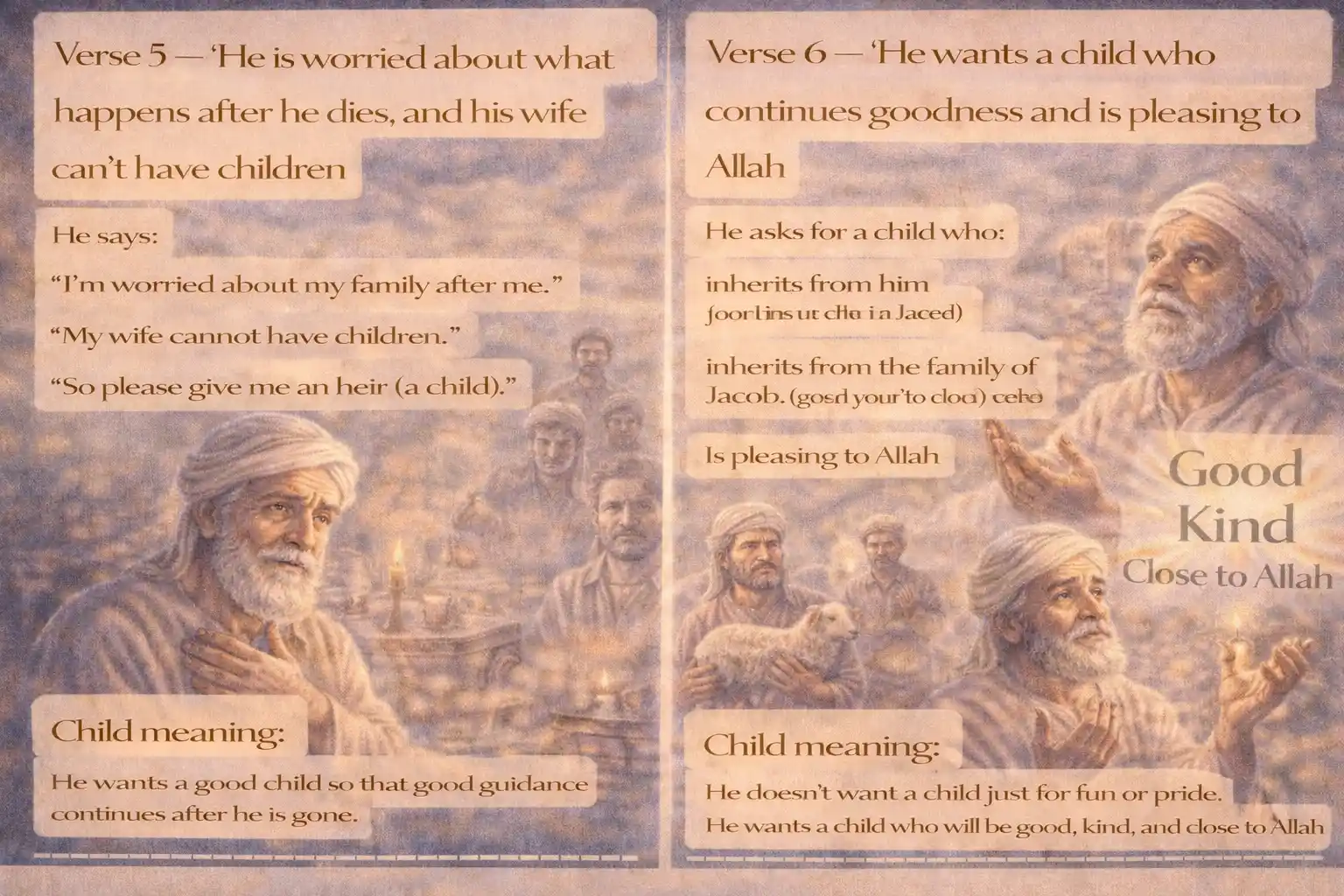
- 19:5 — He worries about after he dies; his wife can’t have children
Zachariah explains what he fears and what he hopes for.
What he says
- “I’m worried about my relatives after me.”
- “My wife cannot have children.”
- “So please give me an heir (a child).”
- He wants goodness to continue after he is gone.
- He wants someone to protect the religion and guide people properly.
- He is not asking for pride—he is asking for a good future.
“He wanted a good child so good guidance continues after him.”
- 19:6 — He wants a child who continues goodness and is pleasing to Allah
He asks for a child who carries on good work and stays close to Allah.
What he asks for
- A child who inherits from him (continues his mission).
- A child who inherits from the family of Jacob (righteous people before him).
- A child who is pleasing to Allah.
- He does not want a child just for fun or pride.
- He wants a child who is good, kind, and obedient to Allah.
“He wanted a child who would be good and close to Allah.”
- 19:7 — Allah gives amazing good news: “You will have a son named John (Yaḥyā)”
Allah answers Zachariah with happy news.
What Allah says
- “We give you good news of a son.”
- “His name will be John (Yaḥyā).”
- “No one had that name before.”
- Allah accepted the du‘ā.
- Allah promises a son who will be special.
- The unique name shows this is a special gift and plan from Allah.
“Allah said: ‘Yes. You will have a son, and he will be special.’”
- 19:8 — Zachariah is shocked: “How can I have a son?”
Zachariah is surprised because of old age and his wife’s condition.
What he says
- “My wife cannot have children.”
- “I’m extremely old.”
- He is not saying Allah cannot do it.
- He is amazed and asking: “How will Allah make it happen?”
- It is the surprise of a miracle, not rejection.
“He wasn’t doubting Allah—he was amazed: ‘How will this happen?’”

- 19:9 — Allah answers: “That is easy for Me”
Allah reminds Zachariah of Allah’s power to create.
What Allah says
- “It will happen.”
- “That is easy for Me.”
- “I created you before when you were nothing.”
- Allah created Zachariah from nothing.
- So giving him a child is not difficult for Allah.
- Allah can create in any way He wants.
“You exist because Allah created you. So Allah can give you a child too.”
- 19:10 — Zachariah asks for a sign (a clue)
He asks for a sign to know the miracle has started.
What happens
- Zachariah asks: “Give me a sign.”
- Allah answers: “You will not speak to people for three nights, while you are not sick.”
- Allah gives him a clear clue that the promise is beginning.
- He will be healthy, but his speech will be stopped for a short time.
- This sign helps him feel calm and certain.
“You will be healthy, but you won’t be able to talk for a few nights.”

- 19:11 — He tells people to worship Allah (without speaking)
Even without speech, Zachariah still guides his people.
What happens
- He comes out from the place of worship.
- He uses gestures (hand signs) to guide them.
- He tells them to praise Allah in the morning and evening.
- Even when he cannot speak, he still calls people to remember Allah.
- This shows strong faith and strong leadership.
“Even without words, he still encouraged people to worship Allah.”

- 19:12 — Allah tells John: “Hold the Book strongly”
Allah teaches John (Yaḥyā) to take guidance seriously.
What “with strength” means
- Take it seriously.
- Learn it carefully.
- Obey it properly.
- Allah’s guidance is precious.
- John must treat it with respect and commitment.
“Be serious about Allah’s guidance. Don’t treat it like a toy.”

- 19:12 (end) — Allah gave John wisdom while he was still a child
Allah gave John a mature and wise heart early in life.
- John had wisdom even when he was young.
- Allah can give special understanding to whom He wills.
“Even as a child, John had a wise heart.”
- 19:13 — Allah gave him compassion and purity
Allah describes John’s beautiful character.
What Allah gave him
- Compassion (a soft, caring heart).
- Purity (clean character, staying away from evil).
- Righteousness (he obeyed Allah).
- He was kind, gentle, and careful about right and wrong.
- He stayed away from bad behavior and loved goodness.
“He had a soft heart and a clean character.”
- 19:14 — He was good to his parents and not arrogant
Allah highlights how John treated his parents and how humble he was.
What John was like
- He respected and served his parents.
- He was not proud or rude.
- He was not rebellious or disobedient.
- He had good manners at home.
- He obeyed Allah and treated people gently, especially his parents.
“He was humble and respectful, especially to his parents.”

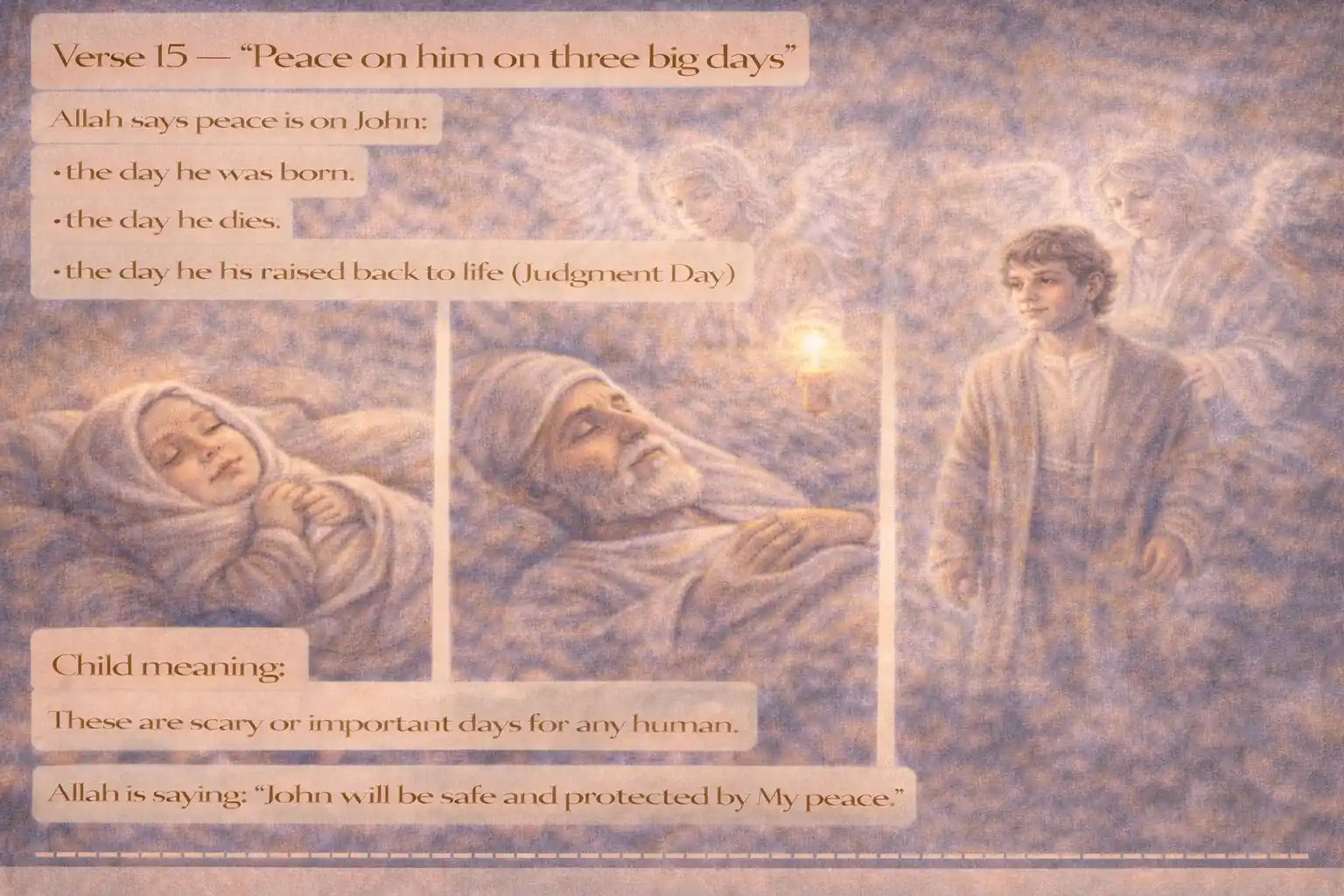
- 19:15 — Peace on him on three big days
Allah gives John safety and peace on the most serious days of life.
The three big days
- The day he was born.
- The day he dies.
- The day he is raised back to life (Judgment Day).
- These are very important and serious days for any human.
- Allah promises John peace and protection on those days.
“Allah says: ‘John will be safe and protected by My peace.’”
Zachariah was very old and wanted a good child to continue doing good. He prayed quietly to Allah, and Allah gave him amazing news: “You will have a son named John (Yaḥyā).” Zachariah was surprised because he and his wife were very old, but Allah said, “That is easy for Me.” Allah gave Zachariah a sign: he would not speak for three nights even though he was healthy. Later, John grew up to be very wise, kind, pure, and respectful to his parents. Allah promised him peace in this life and the next.
16. And mention in the Book, Mary. When she had withdrawn from her family to a place toward east.
17. So she had chosen seclusion from them. Then We sent to her Our Spirit. So he appeared before her as a perfect man.
18. She said: “Indeed, I seek refuge in the Beneficent from you, if you should be fearing (Allah).”
19. He said: “I am only a messenger from your Lord that I may bestow on you a pure son.”
20. She said: “How can I have a son, and no man has touched me, and I have not been unchaste.”
21. He said: “Thus shall it be.” Your Lord says: “It is easy for Me. And that We may make of him a sign for mankind and a mercy from Us. And it is a matter decreed.”
22. So she conceived him, then she withdrew with him to a far place.
23. Then the pains of childbirth drove her to the trunk of the palm tree. She said: “Oh, would that I had died before this and had become (a thing) forgotten, out of sight.”
24. Then he (baby or angel) called her from below her: “Grieve not, your Lord has placed a brook beneath you.”
25. “And shake toward you the trunk of the palm tree, it will drop fresh dates on you.”
26. So eat and drink and keep cool (your) eyes. Then if you see of any person, say: “Indeed, I have vowed a fast to the Beneficent, so I shall not speak today to (any) man.”
27. Then she brought him to her people, carrying him. They said: “O Mary, indeed you have brought something hard to believe.”
28. “O sister of Aaron, your father was not a man of evil, nor was your mother unchaste.”
29. So she pointed to him. They said: “How can we talk to one who is in the cradle, a child.”
30. He (the child) said: “Indeed, I am a slave of Allah. He has given me the Book and has made me a prophet.”
31. “And He has made me blessed wherever I may be, and He has enjoined upon me prayers and charity as long as I live.”
32. “And dutiful to my mother, and He has not made me arrogant, unblest.”
33. “And peace be upon me the day I was born, and the day I die, and the day I shall be raised alive.”
34. Such is Jesus, son of Mary. (This is) a statement of truth about which they are in doubt.
35. It befits not for Allah that He should take anyone as a son. Glory be to Him. When He decrees a matter, He only says to it, “Be” and it is.
36. “And indeed, Allah is my Lord and your Lord, so worship Him. That is the straight path.”
37. Then the factions have differed among themselves. So a dreadful woe for those who disbelieved, from the meeting of a tremendous Day.
38. (How well) they will hear and see on the Day they come to Us. But today the wrong doers are in error manifest.
39. And (O Muhammad) warn them of the Day of anguish when the matter will be decided. And (now) they are in heedlessness, and they believe not.
40. Indeed, it is We who will inherit the earth and whatever is upon it. And to Us they shall be returned.
Surah Maryam (19:16–40) — Mary, Jesus, and the Clear Truth (Child-Friendly)
- 19:16 — Mary goes away to a quiet place
Mary (Maryam) steps away from people for quiet worship.
What happens
- Mary left her family for a while.
- She went to a place in the east.
Sometimes a good person wants quiet time to worship Allah and be alone.

- 19:17 — She chooses privacy, and Allah sends “Our Spirit”
Mary makes a private space, and Allah sends Angel Jibril with a message.
What happens
- Mary made a private space so nobody would disturb her.
- Allah sent “Our Spirit” (Angel Jibril/Gabriel).
- He appeared as a perfect-looking man.
Allah sent an angel with an important message, and the angel looked like a human so Mary could understand and speak.

- 19:18 — Mary protects herself with Allah
Mary feels fear and immediately turns to Allah for protection.
What happens
- Mary got scared and said:
- “I seek refuge in the Most Merciful from you—if you fear Allah.”
When Mary felt unsafe, she did the best thing: she turned to Allah for protection.

- 19:19 — The angel explains: “I’m a messenger”
The angel calms her and explains his mission from Allah.
What happens
- The angel said:
- “I am only a messenger from your Lord, to give you a pure son.”
He says: “Don’t worry. I’m not here to harm you. I’m here with Allah’s message.”

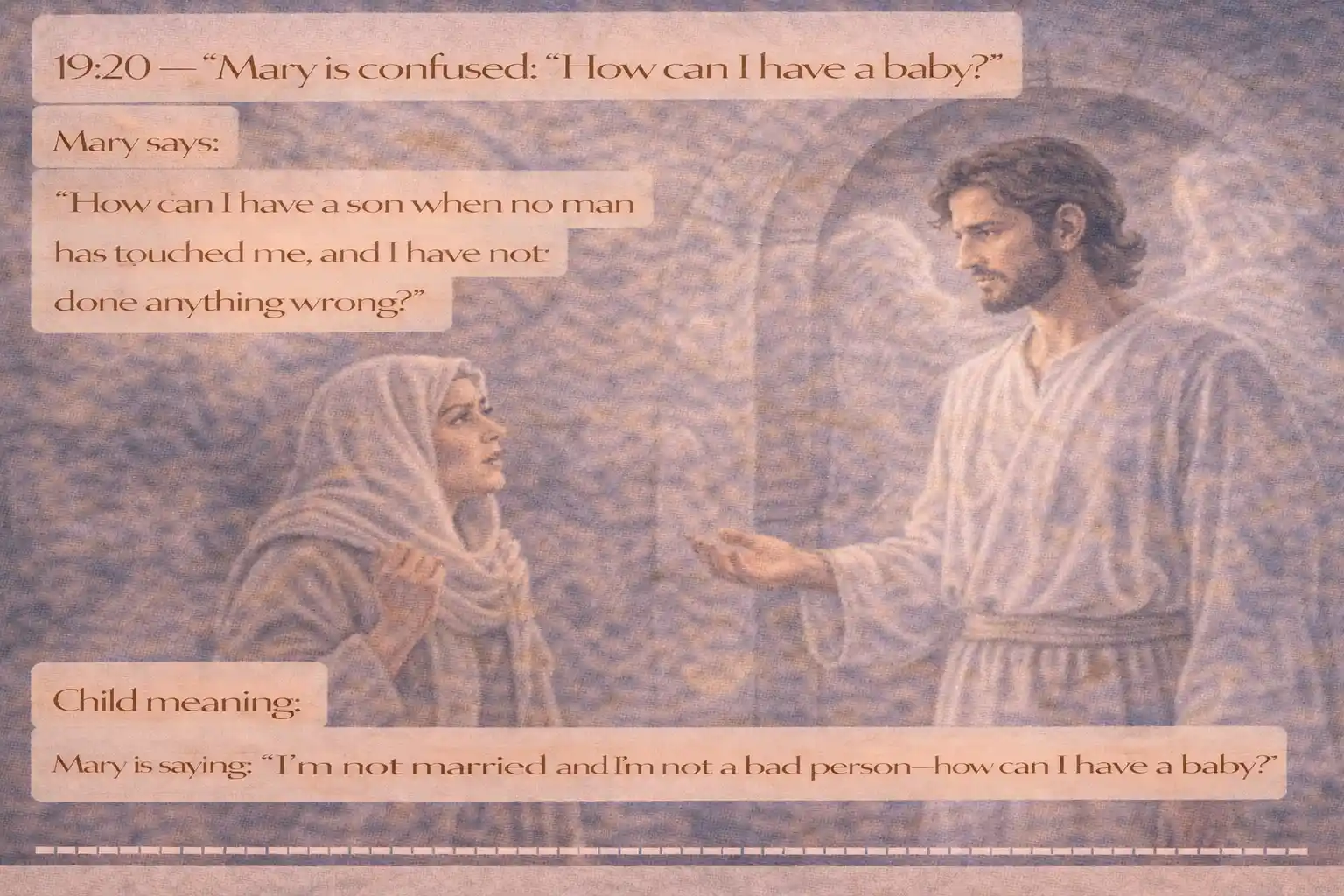
- 19:20 — Mary is confused: “How can I have a baby?”
Mary asks how this can happen, because she is innocent.
What happens
- Mary said:
- “How can I have a son when no man has touched me, and I have not done anything wrong?”
Mary is saying: “I’m not married and I’m not a bad person—how can I have a baby?”
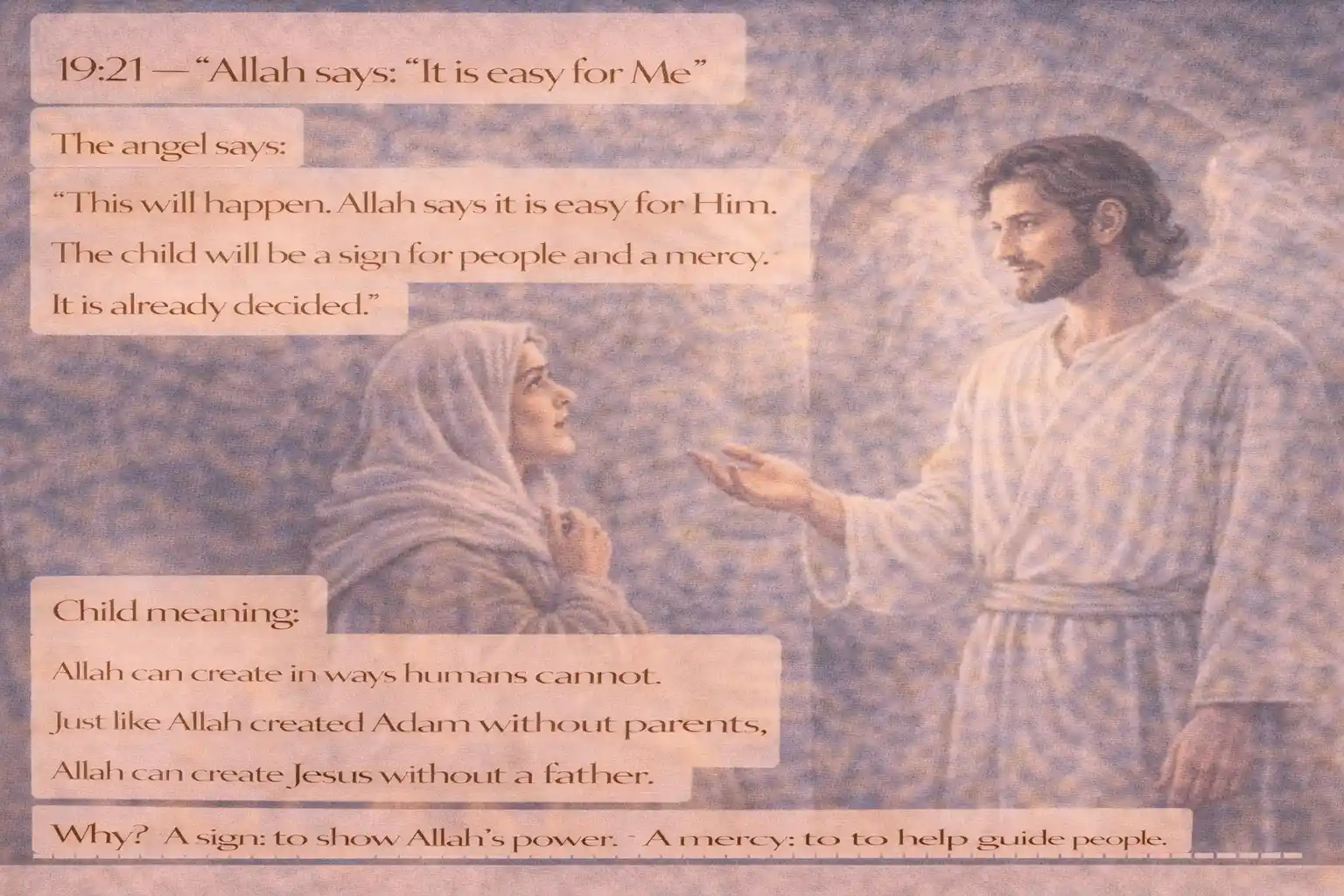
- 19:21 — Allah says: “It is easy for Me”
Allah can create in ways humans cannot. This will be a sign and a mercy.
What happens
- The angel said this will happen.
- Allah says it is easy for Him.
- The child will be a sign for people and a mercy.
- This matter is already decided.
- Allah can create in ways humans cannot.
- Just like Allah created Adam without parents, Allah can create Jesus without a father.
- A sign: to show Allah’s power.
- A mercy: to help guide people.
- 19:22 — Mary becomes pregnant and goes far away
Mary withdraws to a distant place for privacy.
What happens
- Mary became pregnant.
- She went to a far place, away from people.
She wanted privacy because she knew people might talk badly or misunderstand.

- 19:23 — Childbirth pain and sadness
Mary experiences intense pain and fear of people’s accusations.
What happens
- The pain of childbirth drove her to a palm tree.
- She felt extremely sad and said she wished she could be forgotten.
Mary was not wishing death because she hated Allah—she was overwhelmed and scared of people accusing her.

- 19:24 — Allah comforts her: “Don’t be sad”
Allah comforts Mary and provides water.
What happens
- A voice called her:
- “Don’t be sad. Your Lord has placed a small stream beneath you.”
Allah did not abandon her. Allah comforted her and gave her water.
- 19:25 — “Shake the palm tree; fresh dates will fall”
Allah provides food, but Mary is told to take action too.
What happens
- She is told to shake the palm tree.
- Fresh dates will fall for her.
Even when Allah is helping, Mary still has to do her part. Allah gives the result, but we still try.

- 19:26 — Eat, drink, and don’t argue
Allah tells Mary to regain strength and avoid arguments.
What happens
- She is told to eat and drink and calm down.
- If people question her, she should say:
- “I promised a fast to Allah, so I will not speak today.”
Allah is protecting her from arguments. Sometimes the best answer is silence, and letting Allah show the truth.

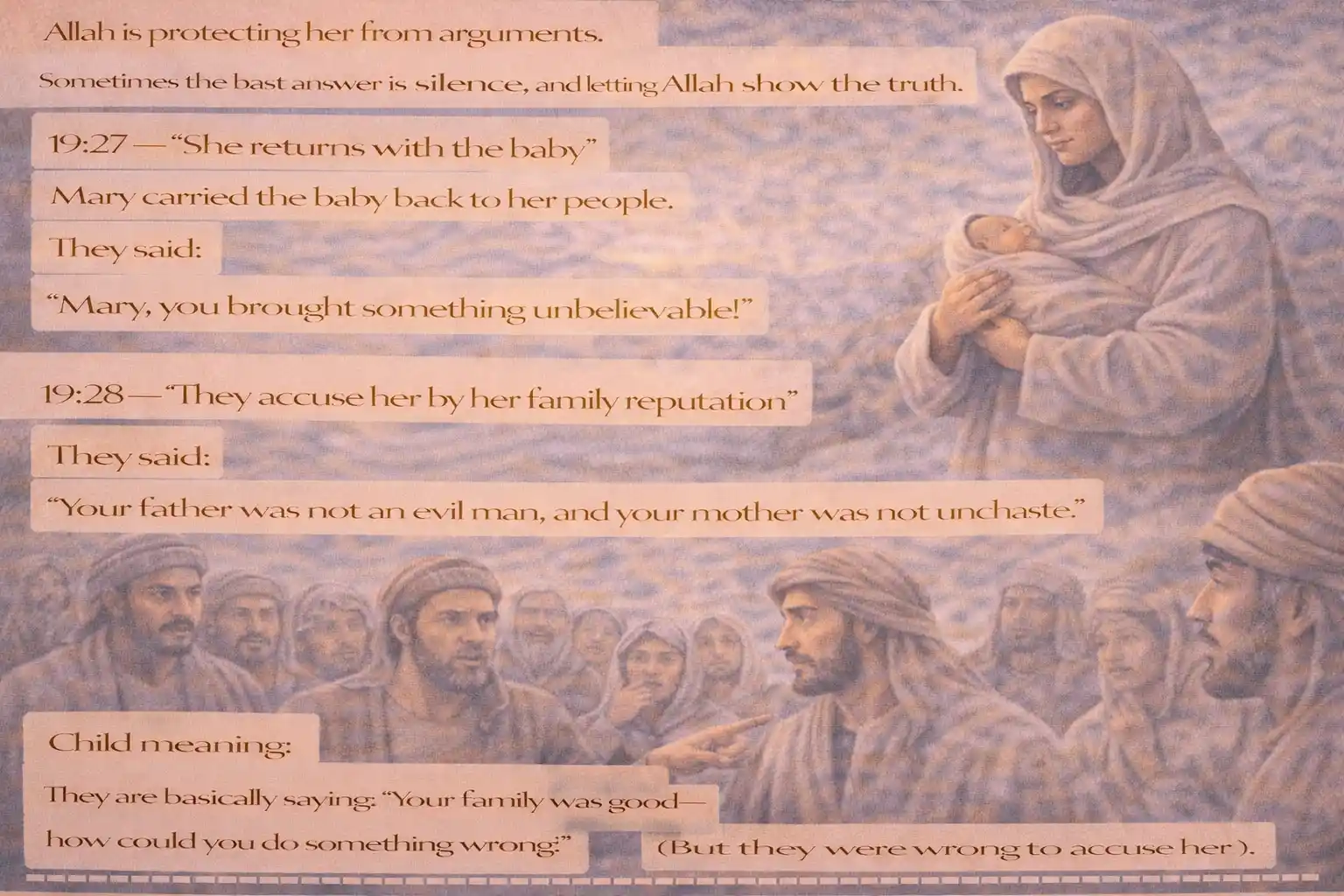
- 19:27 — She returns with the baby
Mary returns to her people carrying the baby, and they react with shock.
What happens
- Mary carried the baby back to her people.
- They said she brought something unbelievable.
They were shocked because they didn’t understand the miracle.

- 19:28 — They accuse her by her family reputation
They compare Mary’s situation to her family’s good reputation.
What happens
- They said her father was not evil and her mother was not unchaste.
They are basically saying: “Your family was good—how could you do something wrong?”
(But they were wrong to accuse her.)
- 19:29 — Mary points to the baby
Mary stays silent and points to the baby, letting Allah show the truth.
What happens
- Mary did not speak; she pointed to the baby.
- They said: “How can we talk to a baby in a cradle?”
Mary obeyed Allah’s instruction: don’t argue—let Allah show the truth.

- 19:30 — The baby speaks: “I am a servant of Allah”
This is the miracle: the baby speaks to defend the truth.
What happens
- The baby (Jesus/‘Isa) spoke and said:
- “I am a servant of Allah. He gave me the Book and made me a prophet.”
This is the miracle: a baby speaking. And the first thing he says is NOT “I am God.”
He says: “I am Allah’s servant.”

- 19:31 — He talks about prayer and charity
He describes what Allah commanded him to do throughout his life.
What happens
- He says Allah made him blessed.
- Allah commanded him to:
- pray
- give charity
- as long as he lives.
A prophet teaches people to worship Allah and do good.

- 19:32 — He is kind to his mother
He highlights respect for parents and warns against arrogance.
What happens
- He says:
- “Allah made me dutiful to my mother and not arrogant.”
A good person respects parents. Arrogance is a big danger.

- 19:33 — Peace on him in life, death, and resurrection
Allah grants peace to him at the biggest moments of existence.
What happens
- He says:
- “Peace on me the day I was born, the day I die, and the day I am raised.”
These are scary big moments, and Allah gives him peace through them.
- 19:34 — This is the truth about Jesus
Allah states the truth clearly, even if people doubt.
What happens
- Allah says this is Jesus, son of Mary—the true statement people doubt about.
Allah is telling the real story clearly.

- 19:35 — Allah does not have a son
Allah is perfect and unlike humans; He creates by command.
What happens
- Allah says it is not fitting for Him to take a son.
- When Allah decides something, He says: “Be” — and it is.
Allah is not like humans. He doesn’t need children. Allah creates by command: “Be.”
- 19:36 — Jesus calls to worship Allah alone
Jesus teaches the same core message: worship Allah alone.
What happens
- Jesus says:
- “Allah is my Lord and your Lord, so worship Him. That is the straight path.”
Jesus himself teaches: Allah is his Lord and our Lord—so worship Allah alone.

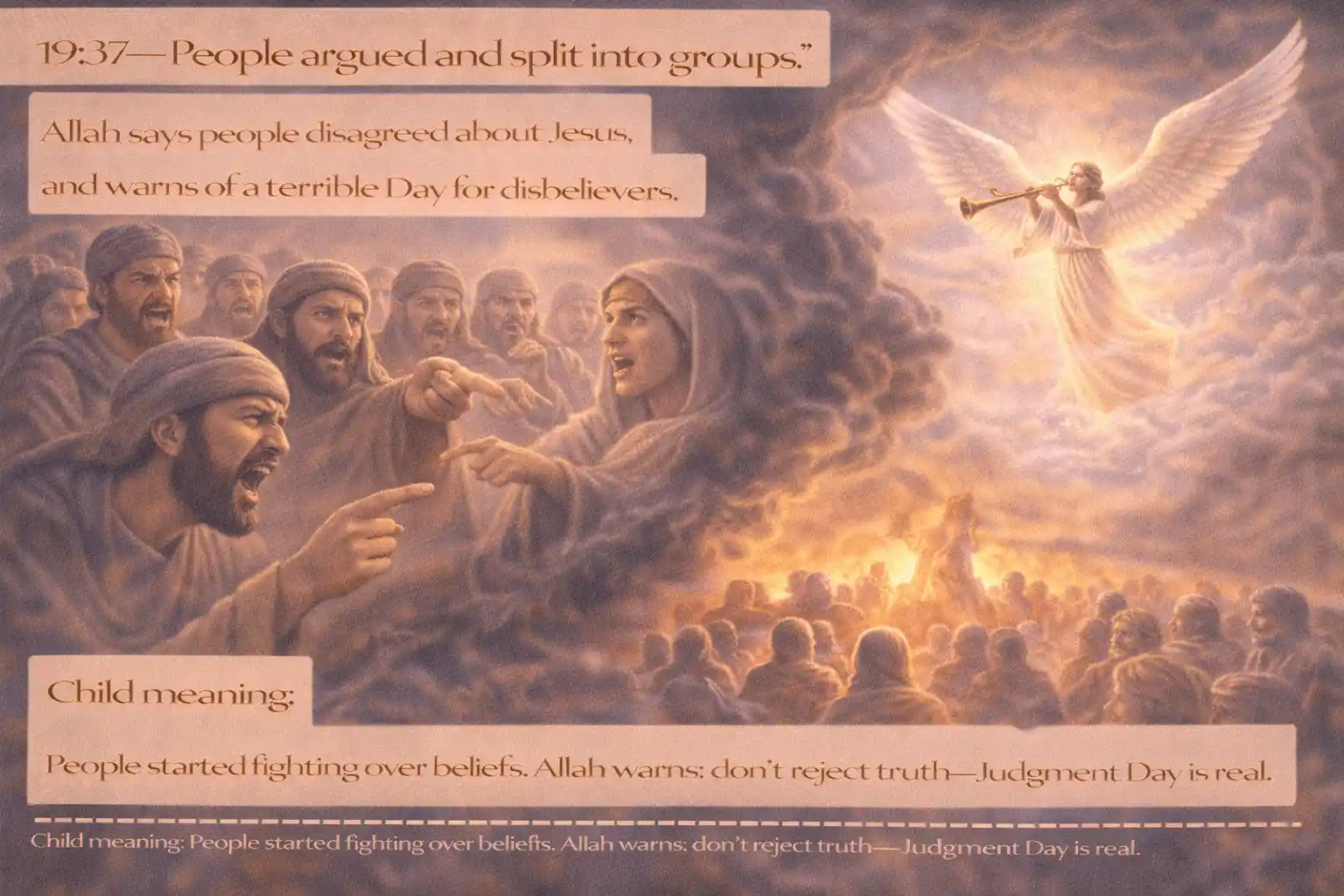
- 19:37 — People argued and split into groups
Allah warns that arguing and rejecting truth leads to a terrible Day.
What happens
- People disagreed about Jesus and split into factions.
- Allah warns of a dreadful Day for those who disbelieve.
People started fighting over beliefs. Allah warns: don’t reject truth—Judgment Day is real.
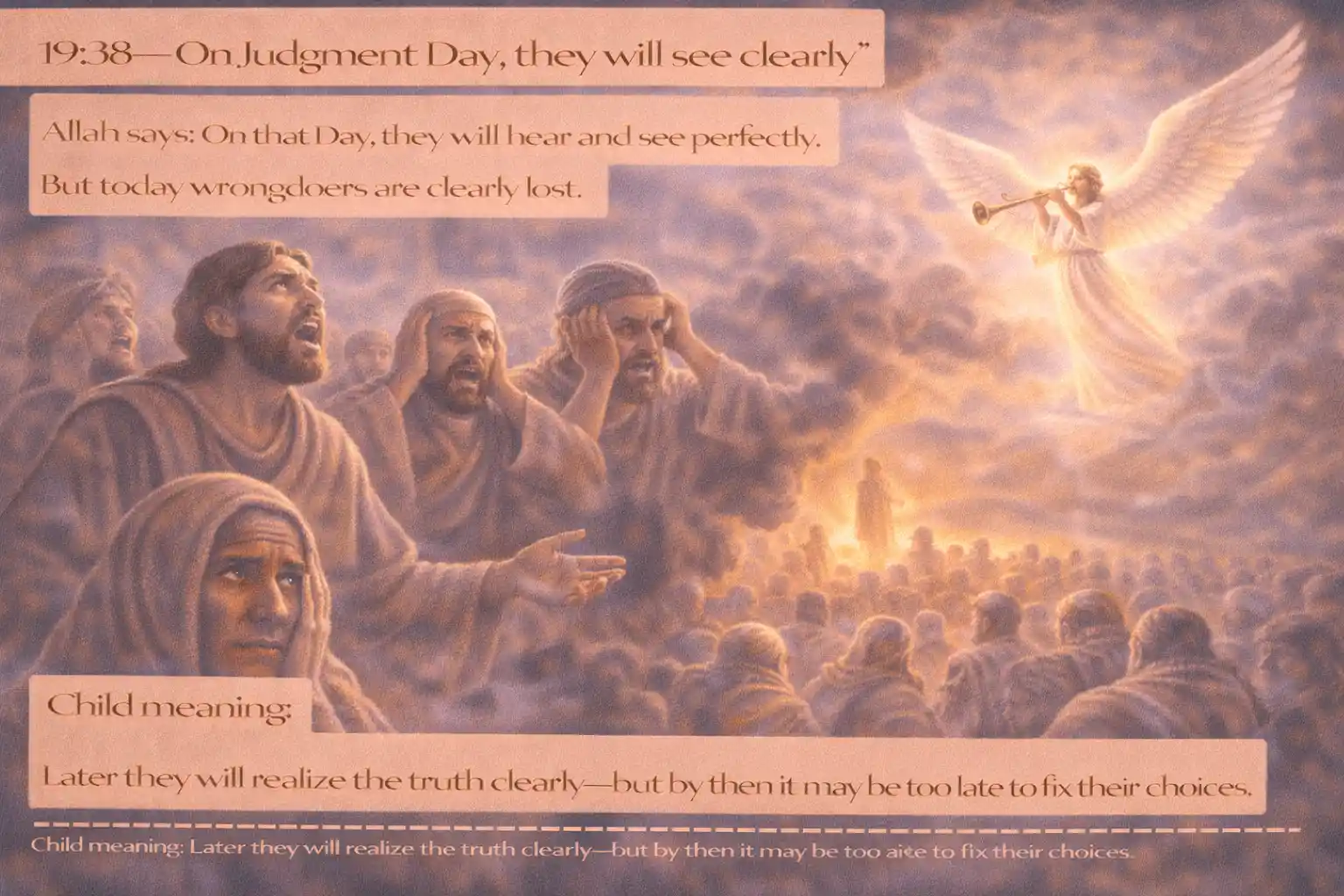
- 19:38 — On Judgment Day, they will see clearly
On that Day, the truth will be obvious, but today some people ignore it.
What happens
- On the Day they come to Allah, they will hear and see perfectly.
- But today, wrongdoers are clearly lost.
Later they will realize the truth clearly—but by then it may be too late to fix their choices.
- 19:39 — Warn them about the Day of regret
Allah tells the Prophet to warn people before the final decision day comes.
What happens
- Allah tells the Prophet to warn people of the Day when everything is decided.
- Many people are careless and do not believe.
Allah is saying: “Wake up before it’s too late.”

- 19:40 — Allah owns everything and everyone returns to Him
Everything ends, and everyone returns to Allah.
What happens
- Allah says He will inherit the earth and everything on it.
- And to Allah everyone will return.
People think they “own” things, but one day all people die, everything ends, and everyone returns to Allah.

Mary was a pure, good woman. Allah helped her through a big test and gave her a miracle baby, Jesus. Jesus spoke as a baby to defend his mother and to tell everyone clearly: “I am Allah’s servant—worship Allah alone.” And Allah reminds us: this world is temporary, and everyone will return to Allah.
41. And mention in the Book, Abraham. Indeed, he was a man of truth, a prophet.
42. When he said to his father: “O my father, why do you worship that which hears not and sees not, and cannot avail you in anything.”
43. “O my father, indeed there has come to me of the knowledge that which has not come to you. So follow me, I will guide you to a straight path.”
44. “O my father, do not worship Satan. Indeed, Satan is disobedient to the Beneficent.”
45. “O my father, indeed I fear that there would touch you a punishment from the Beneficent, so that you would become a companion of Satan.”
46. He (father) said: “Have you turned away from my gods, O Abraham. If you do not desist, I will surely stone you. And depart from me a long while.”
47. He (Abraham) said: “Peace be upon you. I shall ask forgiveness of my Lord for you. Indeed, He is gracious to me.”
48. “And I shall withdraw from you and what you call upon other than Allah. And I shall call upon my Lord. It may be that I shall not be unblest, in calling unto my Lord.”
49. So when he had withdrawn from them and that which they worshipped other than Allah, We gave him Isaac and Jacob. And each We made a prophet.
50. And We bestowed on them of Our mercy, and We made for them a sublime tongue (for telling) truth.
51. And mention in the Book, Moses. Indeed, he was chosen, and he was a messenger, a prophet.
52. And We called him from the right side of the mount, and We brought him near to confide in.
53. And We bestowed on him out of Our mercy his brother Aaron, a prophet.
54. And mention in the Book, Ishmael. Indeed, he was true to his promise, and he was a messenger, a prophet.
55. And he used to enjoin on his family prayers and charity, and he was pleasing to his Lord.
56. And mention in the Book, Idris. Indeed, he was a man of truth, a prophet.
57. And We raised him to high station.
58. Those were they upon whom Allah bestowed favor from among the prophets, of the offspring of Adam, and of those whom We carried (on the ship) with Noah, and of the offspring of Abraham and Israel, and from among those whom We guided and chose. When the revelations of the Beneficent were recited unto them, they fell down prostrating and weeping.
Surah Maryam (19:41–58) — Prophets, Truth, Respect, and Humility (Child-Friendly)
- 19:41 — Abraham is a truthful prophet
Allah tells us to remember Prophet Ibrahim (Abraham), a man who always spoke truthfully.
What Allah is teaching (simple)
- Ibrahim was a man of truth (he didn’t lie or twist things).
- He was a prophet (Allah chose him to deliver guidance).
“Ibrahim was one of Allah’s best people. He always told the truth.”

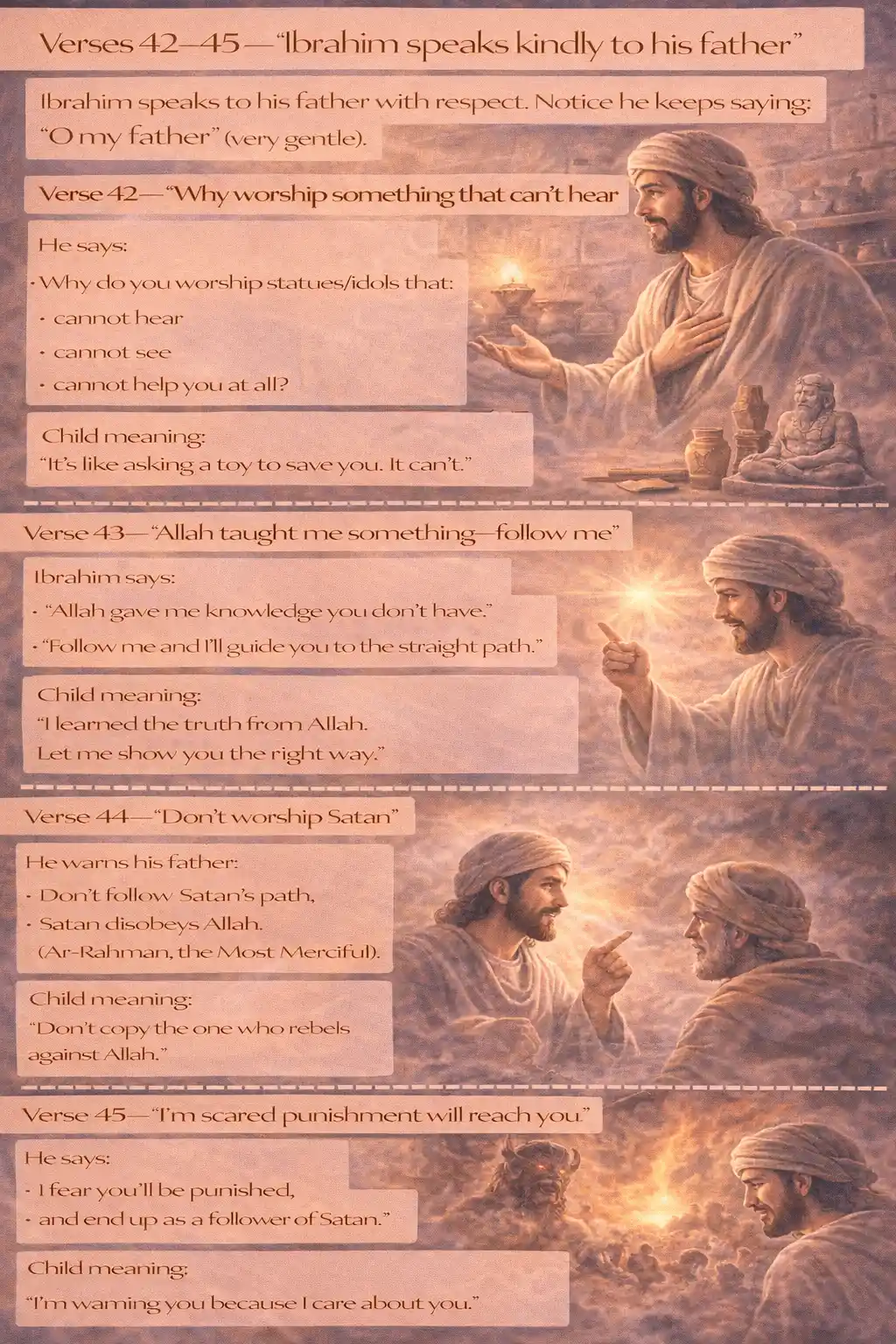
- 19:42–45 — Ibrahim speaks kindly to his father
Ibrahim talks to his father gently and respectfully. He keeps saying: “O my father” (very polite).
19:42 — “Why worship something that can’t hear or see?”
- Ibrahim asks: why worship idols/statues that:
- cannot hear, cannot see, and cannot help at all?
“It’s like asking a toy to save you. It can’t.”
19:43 — “Allah taught me something—follow me”
- Ibrahim says Allah gave him knowledge his father doesn’t have.
- He says: “Follow me and I’ll guide you to the straight path.”
“I learned the truth from Allah. Let me show you the right way.”
19:44 — “Don’t worship Satan”
- Ibrahim warns: don’t follow Satan’s path.
- Satan disobeys Allah (Ar-Rahman, the Most Merciful).
“Don’t copy the one who rebels against Allah.”
19:45 — “I’m scared punishment will reach you”
- Ibrahim says he fears his father may be punished if he continues in wrong worship.
- He warns because he cares, not because he wants to insult.
“I’m warning you because I care about you.”
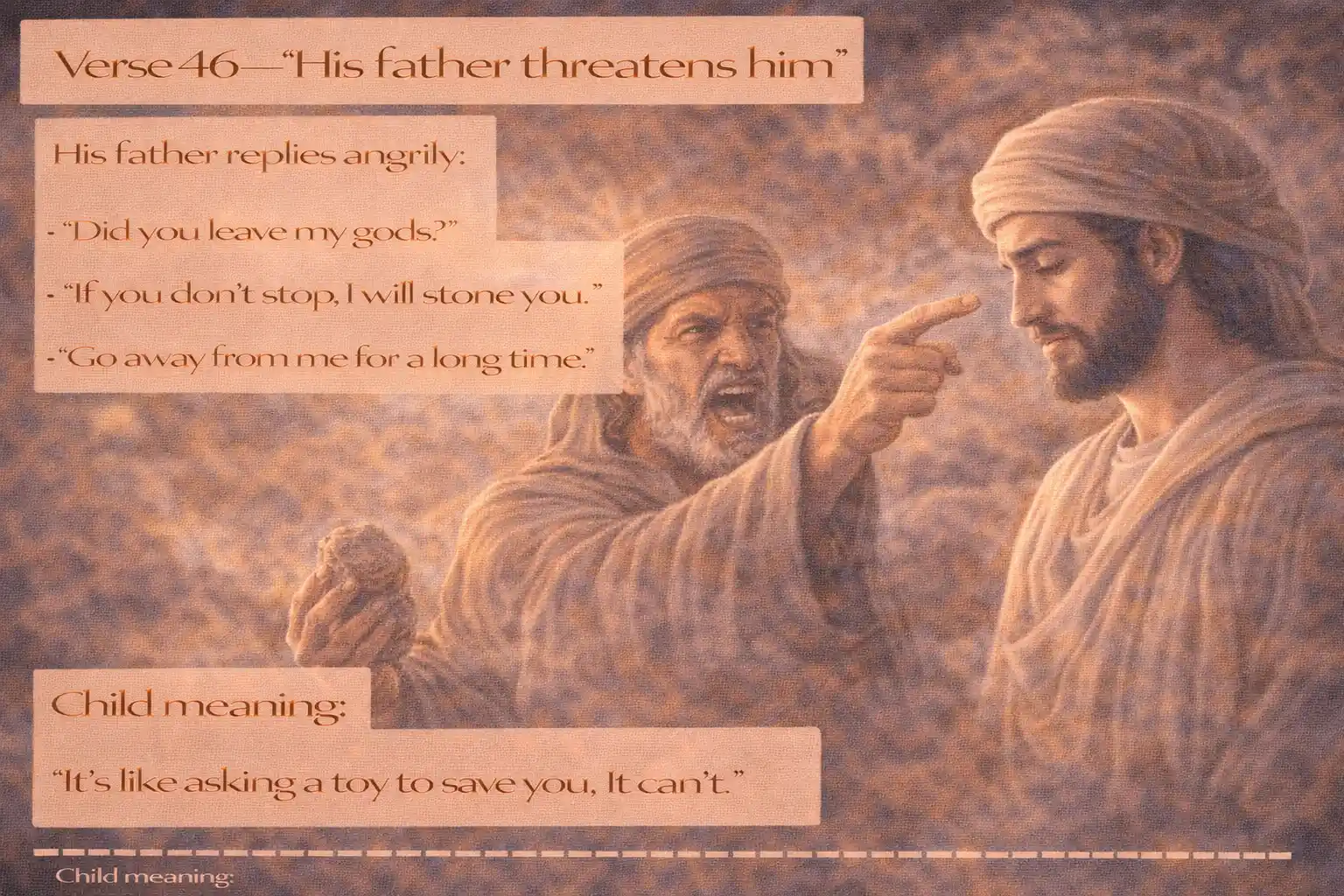
- 19:46 — His father threatens him
Instead of listening calmly, his father becomes angry and threatens Ibrahim.
What happens
- His father says: “Did you leave my gods?”
- He threatens: “If you don’t stop, I will stone you.”
- He says: “Go away from me for a long time.”
“His father got mad and threatened him instead of thinking calmly.”
- 19:47–48 — Ibrahim stays polite and chooses to leave
Ibrahim does not fight back with rude words. He stays calm, then chooses to step away from idol worship.
19:47 — Ibrahim says “Peace”
- Ibrahim replies: “Peace be upon you.”
- He says he will ask Allah to forgive his father.
- He says Allah has been kind to him.
“Even when someone is harsh, Ibrahim stays calm and respectful.”
19:48 — “I will leave your idol worship”
- Ibrahim says he will separate himself from them and what they worship besides Allah.
- He says he will call only on his Lord.
- He hopes Allah will not disappoint him.
“I won’t join you in wrong worship. I will stick to Allah.”

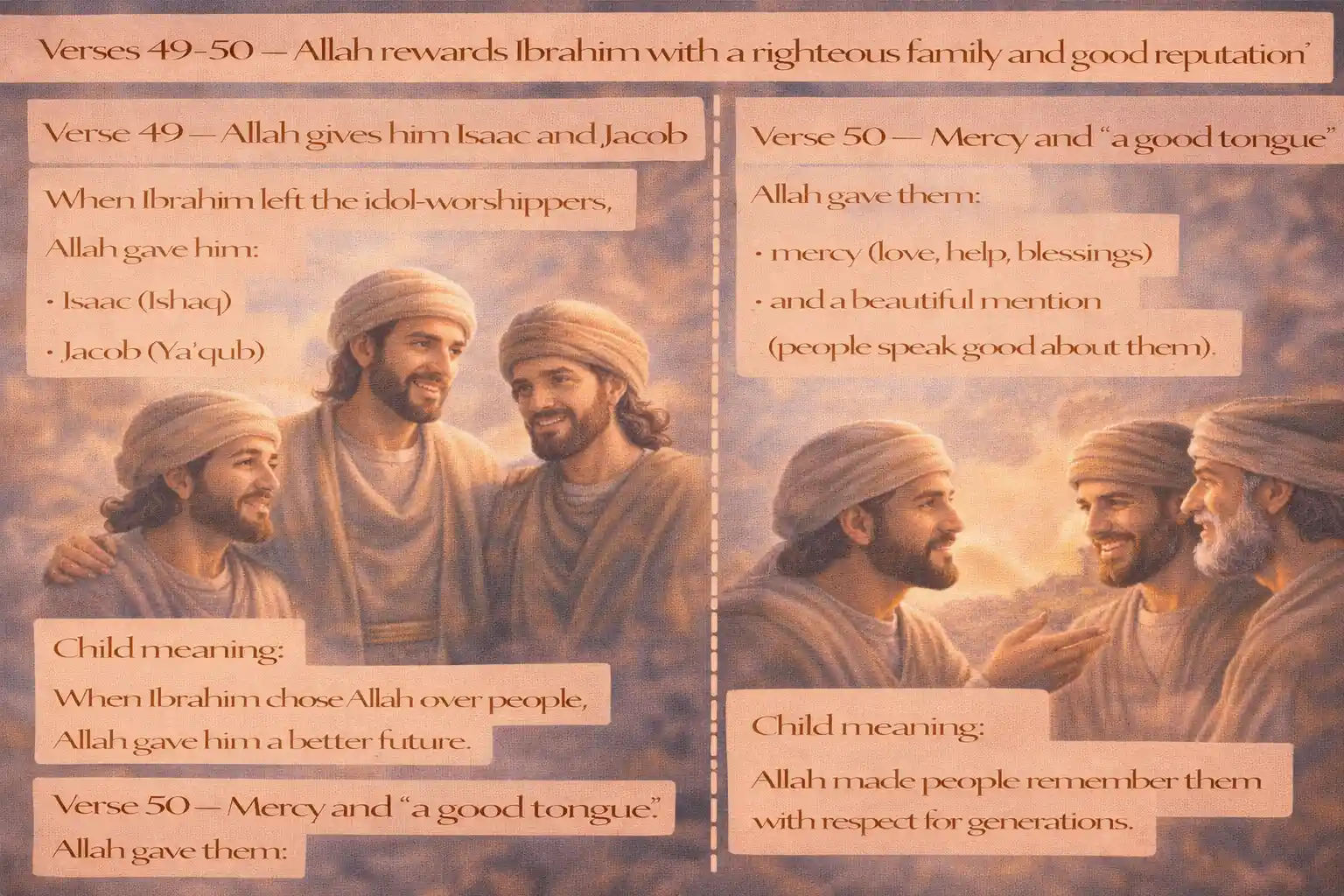
- 19:49–50 — Allah rewards Ibrahim with a righteous family and good reputation
When Ibrahim chose Allah over people, Allah gave him blessings and a good future.
19:49 — Allah gives him Isaac and Jacob
- After Ibrahim withdrew from idol worship, Allah gave him:
- Isaac (Ishaq) and Jacob (Ya‘qub).
- Allah made them prophets too.
“When Ibrahim chose Allah over people, Allah gave him a better future.”
19:50 — Mercy and “a good tongue”
- Allah gave them mercy (love, help, blessings).
- Allah gave them a beautiful mention (people speak well of them).
“Allah made people remember them with respect for generations.”
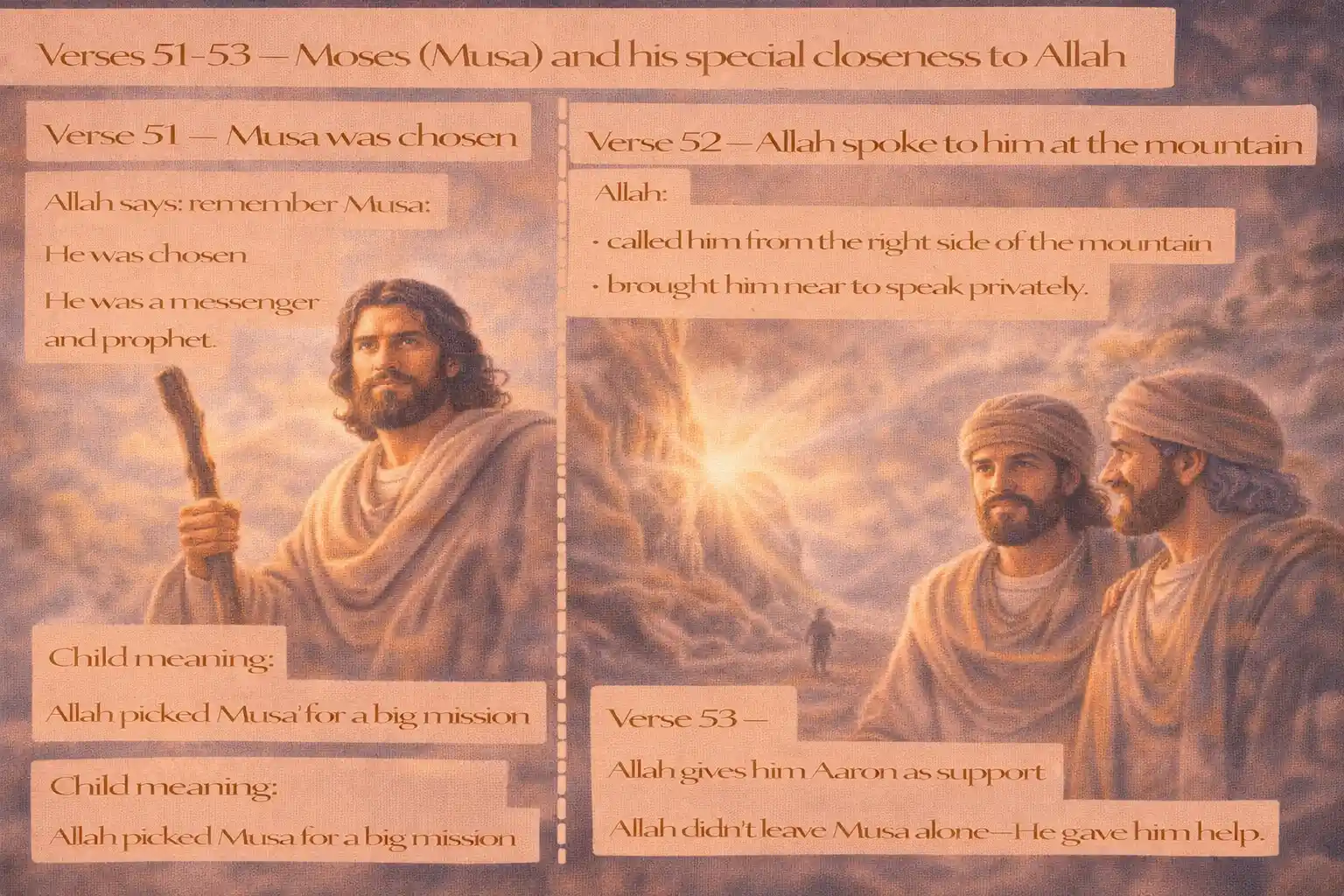
- 19:51–53 — Moses (Musa) and his special closeness to Allah
Allah reminds us about Prophet Musa and how Allah honored him and supported him.
19:51 — Musa was chosen
- Musa was chosen.
- He was a messenger and a prophet.
“Allah picked Musa for a big mission.”
19:52 — Allah spoke to him at the mountain
- Allah called him from the right side of the mountain.
- Allah brought him near to speak privately.
“Allah honored Musa by speaking to him directly in a special way.”
19:53 — Allah gives him Aaron as support
- Allah gave Musa his brother Aaron (Harun) as support.
- Aaron was a prophet too.
“Allah didn’t leave Musa alone—He gave him help.”
- 19:54–55 — Ishmael (Isma‘il): keeps promises and teaches his family
Allah mentions Prophet Isma‘il and highlights his honesty and good leadership at home.
19:54 — True to his promise
- Isma‘il always kept his promises.
- He was a messenger and a prophet.
“He was reliable. If he said he would do something, he did it.”
19:55 — He taught prayer and charity at home
- He told his family to pray and give charity.
- Allah was pleased with him.
“A good leader starts by teaching their own family good habits.”

- 19:56–57 — Idris: truthful prophet raised high
Allah mentions Prophet Idris and shows how Allah honored him.
19:56 — Idris was truthful
- Idris was a man of truth.
- He was a prophet.
19:57 — Raised to a high station
- Allah raised Idris to a high rank and honor.
“Allah honored Idris greatly.”

- 19:58 — How these prophets reacted to Allah’s words
Allah describes the humble hearts of the prophets when they heard His verses.
What Allah says (simple)
- These prophets came from blessed family lines (Adam, those with Noah, Abraham, Israel).
- Allah guided them and chose them.
- When Allah’s verses were recited, they:
- fell in prostration and wept.
“When they heard Allah’s words, they didn’t act proud. They felt the truth deeply and worshipped Allah with humble hearts.”

- Be respectful even when others are rude (like Ibrahim).
- Use your brain: don’t worship what can’t help you.
- Choose Allah even if people get angry.
- Allah rewards sacrifice with something better.
- Keep promises (like Isma‘il).
- Teach good in your home first.
- When you hear Allah’s words, be humble—not arrogant.
59. Then after them there followed a posterity, who have ruined the prayers and have followed lusts. So they shall meet with the doom.
60. Except those who repent and believe and do righteousness. So such shall enter Paradise, and they shall not be wronged in the least.
61. Gardens of Eden, which the Beneficent has promised to His slaves in the unseen. Indeed, His promise must come to pass.
62. They shall not hear therein idle talk, except (greeting of) peace. And they will have therein their sustenance, morning and evening.
63. That is the Paradise which We give as an inheritance to those of Our slaves who are fearing (Allah).
64. And We (angels) descend not except by the command of your Lord. To Him belongs what is before us and what is behind us and what is between those two, and your Lord is never forgetful.
65. Lord of the heavens and the earth and whatever is between them. So worship Him, and be steadfast in His worship. Do you know (any of) same name as He.
66. And man says: “When I am dead, shall I be brought forth alive.”
67. Does not man remember that We created him before, and he was not a thing.
68. So by your Lord, surely We shall gather them and the devils, then We shall bring them around Hell upon their knees.
69. Then indeed, We shall drag out from every sect all those who were worst in rebellion against the Beneficent.
70. Then certainly We know best of those who are most worthy of being burned therein.
71. And there is not one of you but will pass over it (Hell). That is upon your Lord, a decree which must be accomplished.
72. Then We shall save those who used to fear (Allah). And We shall leave the wrongdoers therein on their knees.
73. And when Our clear revelations are recited to them, those who disbelieve say to those who believe: “Which of the two groups has a better status and grander in assemblies.”
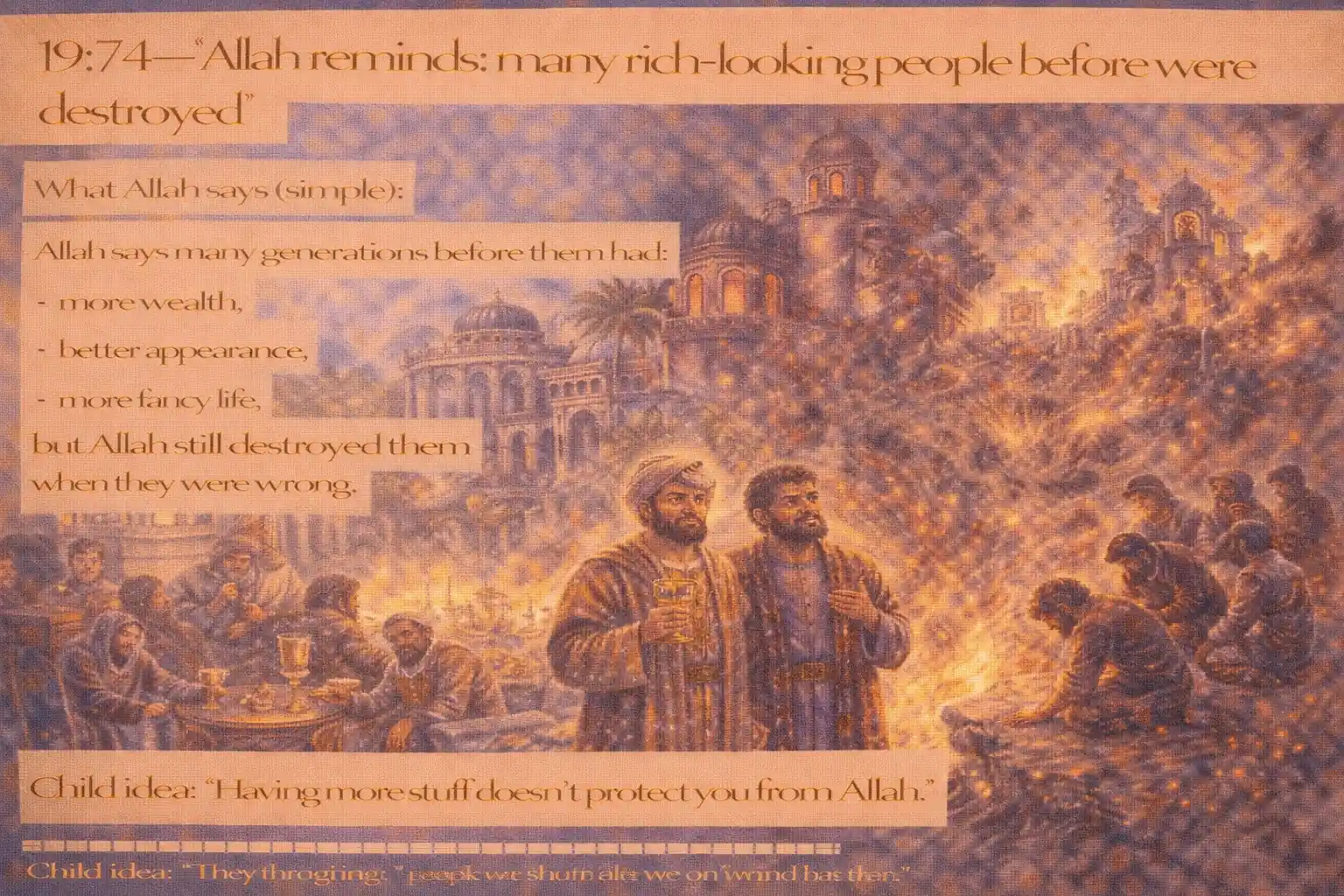
74. And how many a generation have We destroyed before them, who were better in wealth and (outward) appearance.
75. Say: “Whoever is in error, the Beneficent will surely prolong span (of his life) for him, until when they behold that which they were promised, either a punishment (in this world), or the Hour (of Resurrection). Then they will know who it is, worst in position and weaker in forces.”
76. And Allah increases those who were guided, in guidance. And the enduring righteous deeds are better with your Lord for reward, and better for resort.
What Allah says (simple):
After the good prophets, some later people became worse:
- They stopped caring about prayer (they delayed it, ignored it, or treated it as unimportant).
- They followed lusts (they chased whatever they wanted—fun, desire, ego—without thinking about Allah).
Result: They will meet doom (serious punishment).

What Allah says (simple):
Not everyone is doomed. Allah makes an exception:
If they:
- repent (say sorry to Allah and truly stop),
- believe,
- do good deeds,
then they will enter Paradise, and Allah will not treat them unfairly at all.

What Allah says (simple):
Paradise is like Gardens of Eden, and Allah promised it to His servants.
Even though we can’t see it right now, Allah’s promise is real and will happen.

What Allah says (simple):
In Paradise:
- You won’t hear bad talk, rude talk, or pointless arguments.
- You will hear peace (greetings and kindness).
- You will have food and comfort all the time (morning and evening).

What Allah says (simple):
Paradise is given to Allah’s servants who fear Allah.
Fear Allah here means:
- you respect Allah,
- you don’t want to disobey Him,
- you try to do what is right.

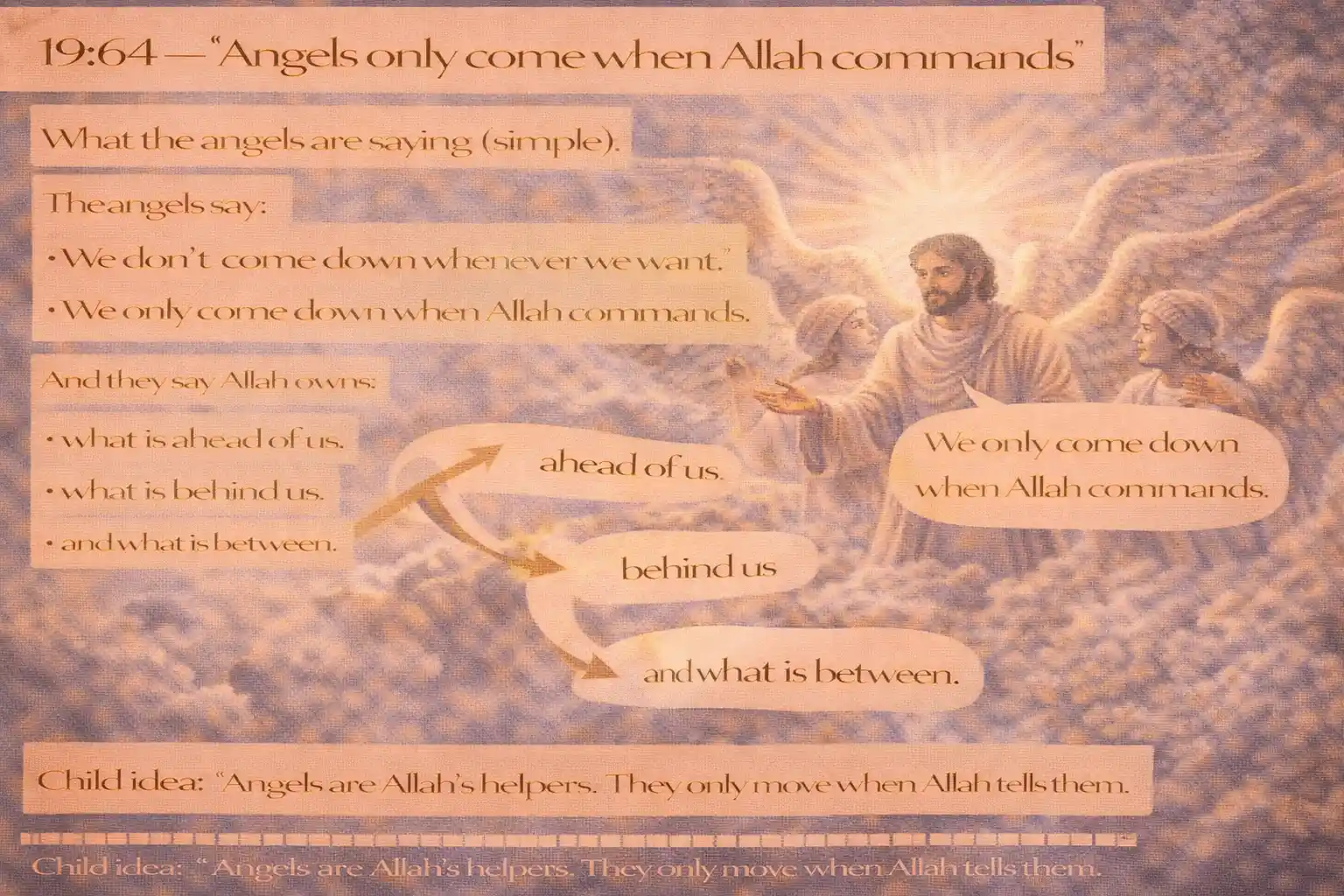
What the angels are saying (simple):
The angels say:
- “We don’t come down whenever we want.”
- “We only come down when Allah commands.”
And they say Allah owns:
- what is ahead of us,
- what is behind us,
- and what is between.
And Allah is never forgetful.
What Allah says (simple):
Allah is the Lord of:
- the heavens,
- the earth,
- everything between.
So:
- worship Him,
- and be steadfast (keep doing it, don’t quit).
Then Allah asks: “Do you know anyone like Him?”
Meaning: No one is like Allah.

19:66 (simple):
Some people say: “When I’m dead, will I really be brought back alive?”
19:67 (simple answer):
Allah says: Don’t they remember? Allah created them before when they were nothing.

What Allah says (simple):
Allah swears that He will gather:
- people,
- and devils (shayateen),
and bring them around Hell.

What Allah says (simple):
- Allah will pull out the ones who were the most rebellious against Him.
- Allah knows exactly who deserves what.
What Allah says (simple):
Every person will pass over it (Hell). This is a decision Allah has decreed.
Note: This is a moment of truth that everyone will face—no one can avoid that Day.

What Allah says (simple):
- Allah will save those who feared Him.
- Wrongdoers will be left there, humbled, on their knees.

What Allah says (simple):
When Allah’s clear verses are read, disbelievers say to believers:
“Which group has better status? Better meetings? Better lifestyle?”
Meaning:
They judge truth by money, popularity, and fancy places.

What Allah says (simple):
Allah says many generations before them had:
- more wealth,
- better appearance,
- more fancy life,
but Allah still destroyed them when they were wrong.
What Allah says (simple):
If someone is in error, Allah may let them live longer and continue—until:
- they see a punishment in this world, or
- the Hour (Judgment Day) comes.
Then they will finally know who is truly weak and in the worst position.

What Allah says (simple):
- Allah increases the guided people in guidance (they grow better).
- The “lasting good deeds” are better with Allah for reward and final home.
Lasting good deeds means deeds Allah loves and that keep helping, like:
- prayer, faith, honesty,
- charity,
- kindness,
- truthfulness,
- helping people,
- worship done sincerely.
This life is a test. Some people ignore prayer and chase desires, and that leads to trouble. But if you repent and do good, Allah forgives and gives Paradise. Don’t be fooled by people bragging about money—truth is not measured by wealth. Keep doing good deeds, because they last forever with Allah.

77. Then, have you seen him who disbelieved in Our verses and he said: “Assuredly I shall be given wealth and children.”
78. Has he obtained knowledge of the unseen, or has he taken a covenant with the Beneficent.
79. Nay, We shall record what he says and We shall increase for him a span of punishment.
80. And We shall inherit from him what he talks, and he shall come to Us alone.
81. And they have taken besides Allah (false) gods that they may be a strength for them.
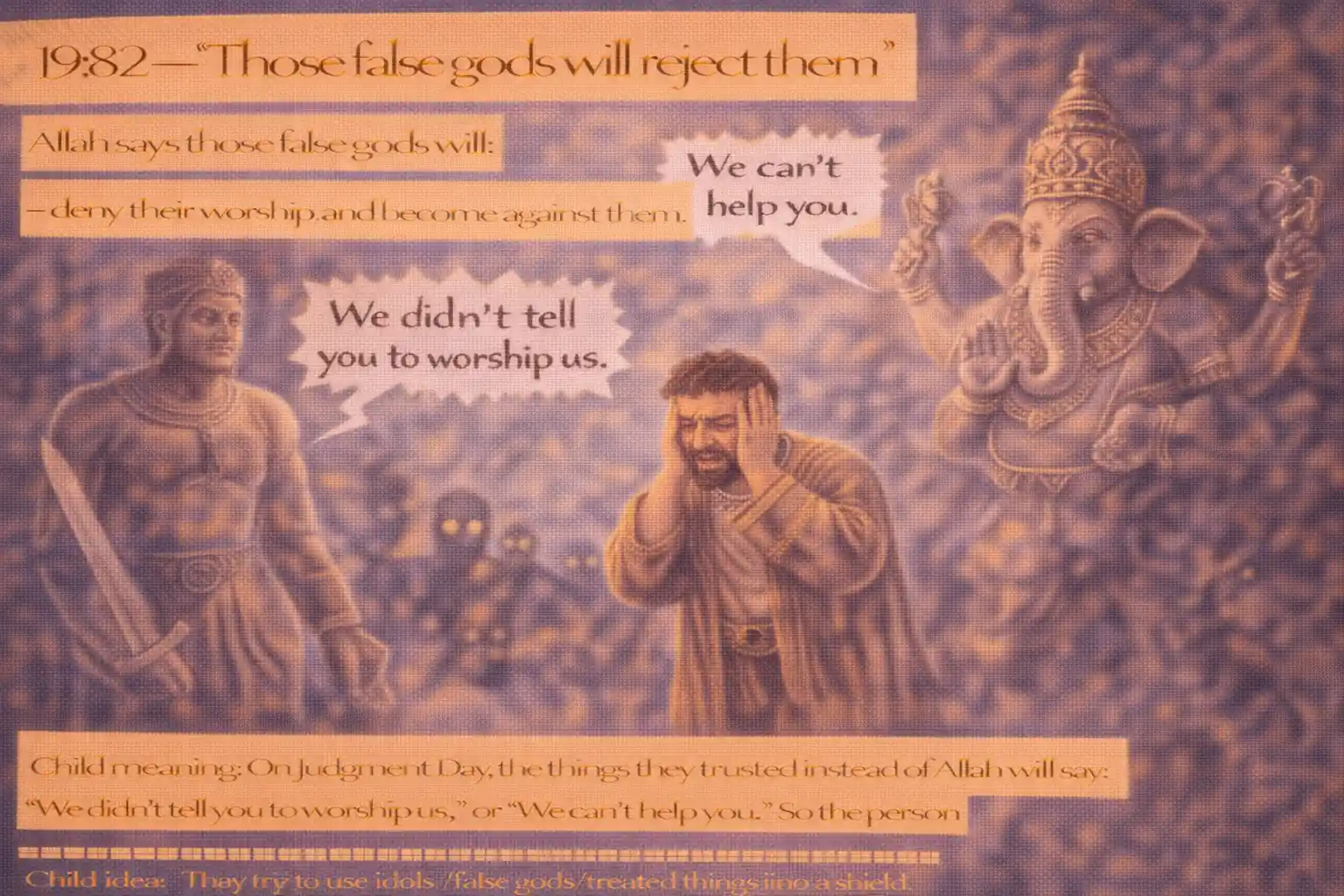
82. Nay, they will deny their worship of them and will become opponents against them.
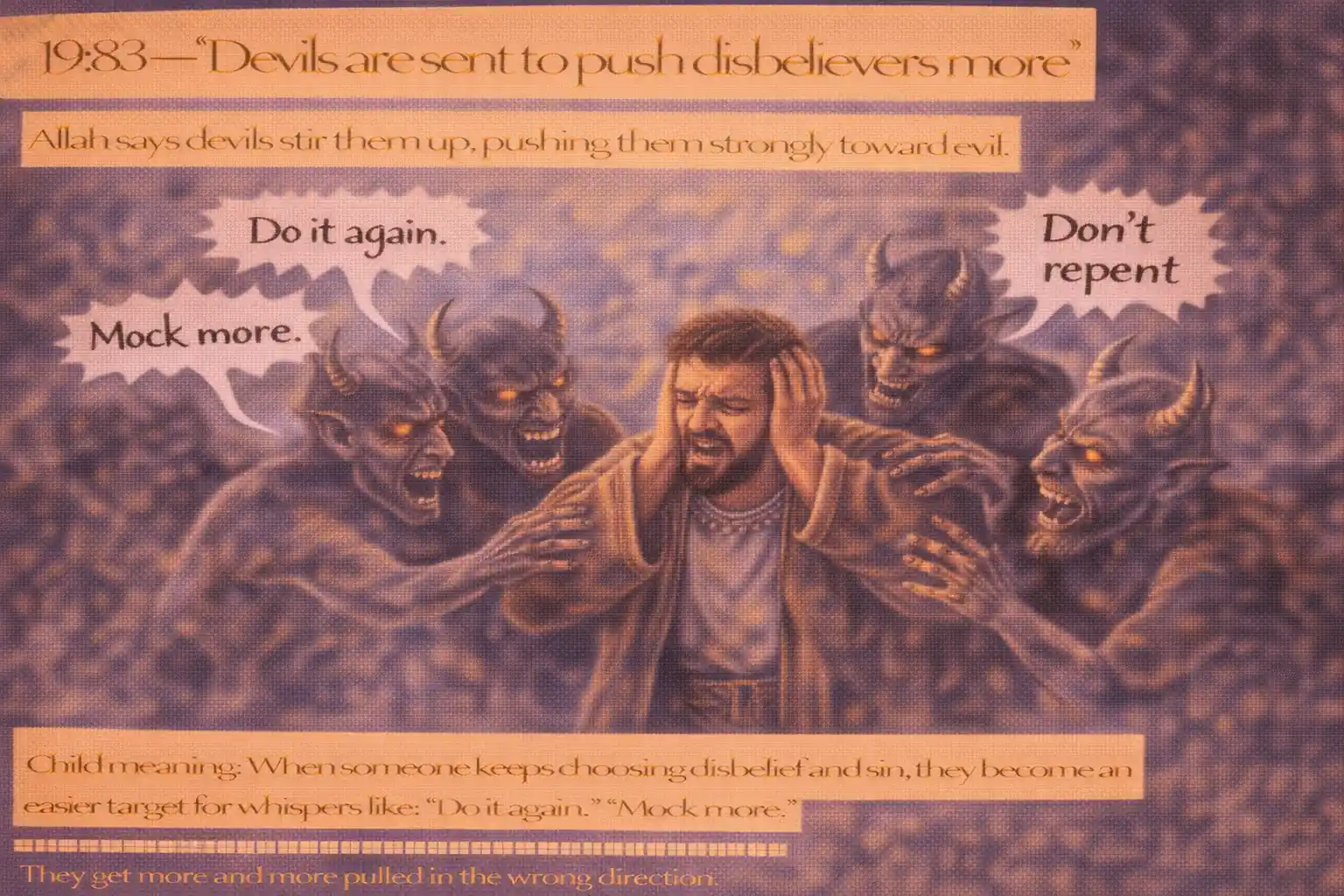
83. Do you not see that We have sent the devils upon the disbelievers who incite them (with great) incitement.
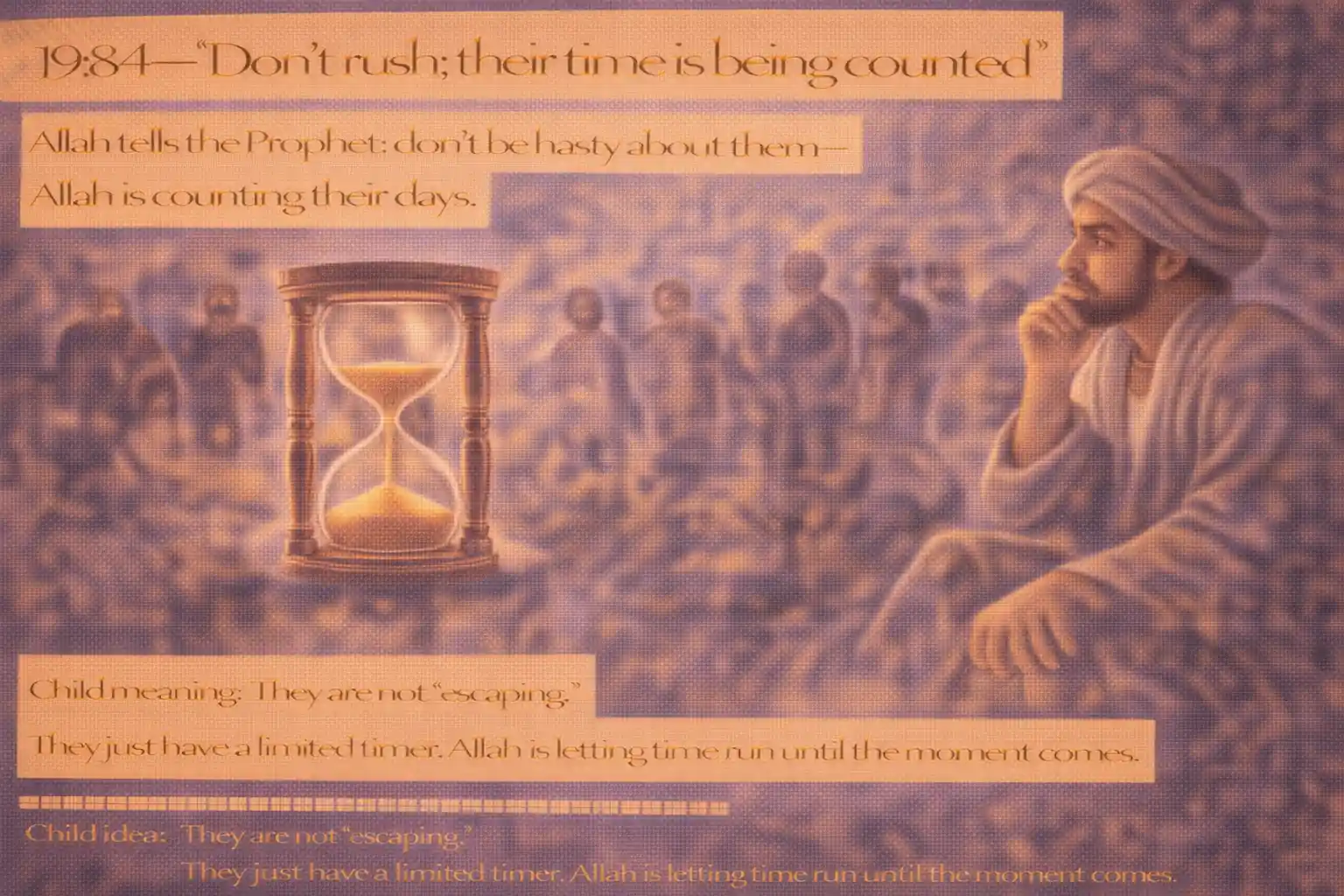
84. So make no haste over them. We only count out to them a (limited) number (of days).
85. The Day We shall gather the righteous to the Beneficent, like a delegate.
86. And We shall drive the criminals to Hell, like thirsty cattle.
87. They will have no power of intercession, except him who has made a covenant with the Beneficent.
88. And they say: “The Beneficent has taken a son.”
89. Indeed, you have brought forth an atrocious thing.
90. The heavens are almost torn therefrom, and the earth is split asunder, and the mountains fall in ruins.
91. That they ascribe to the Beneficent a son.
92. And it is not appropriate for (the Majesty of) the Beneficent that He should take a son.
93. There is no one in the heavens and the earth but he shall come to the Beneficent as a slave.
94. Certainly, He encompasses them and has counted them a (full) counting.
95. And each one of them will come to Him on the Day of Resurrection, alone.
96. Indeed, those who believe and do righteous deeds, the Beneficent will bestow love for them.
97. So, We have only made this (Qur'an) easy in your tongue that you may give good tidings therewith to those who are righteous, and warn with it a contentious people.
98. And how many of generations before them have We destroyed. Do you perceive any one of them, or you hear a whisper of them.
Qur’an-Only Explanation (19:77–98)
- 19:77 — A person boasts: “I will definitely get wealth and children”
Someone rejects Allah’s verses, then brags: “I will surely be given money and children.”
- This person is not just disbelieving—he is speaking with arrogant certainty about his future.
- He acts like blessings are guaranteed, even while rejecting Allah’s guidance.
- Child idea: “Even if I ignore Allah, I’ll still have a great life and a great future.”

- 19:78 — Allah asks: “How does he know that?”
Does he know the unseen, or did he take a promise from Allah?
- Allah exposes the claim: where is his evidence?
- Either he would need access to the unseen (future, next life) or a contract/promise from Allah—he has neither.
- Child idea: “Did he peek into the future? Who told him that?”

- 19:79 — Allah says: “No. We record his words, and punishment increases”
Allah rejects his claim, records his words, and increases the punishment.
- Allah makes clear: this is not knowledge; it is arrogant talk.
- Allah records statements like this—meaning words matter, especially when they contain denial and pride.
- Child idea: Like a teacher writing down serious misconduct—because it is not “small talk.”

- 19:80 — Allah says: “All that he talks about will be taken, and he comes alone”
That wealth and children he brags about will not remain with him, and he will come alone.
- Even if a person gains wealth and children in this life, none of it stays in his hands forever.
- Death strips away possessions and status; the return to Allah is individual.
- Child idea: “You can’t carry money or family into the next life—only deeds.”

- 19:81 — People take false gods for “strength”
They take things besides Allah as gods so those things can be their support and protection.
- People cling to created things as ultimate protectors: idols, people, power, status, money—anything treated like “a god.”
- They do this seeking honor, backup, and security from other than Allah.
- Child idea: Like using a weak stick as a shield, thinking it will protect you.

- 19:82 — Those false gods will reject them and fight against them
Those worshipped “supports” will deny them and become enemies against them.
- On the Day of Judgment, the false “helpers” will not confirm the worship—rather they will disown it.
- Instead of protection, there will be opposition and rejection.
- Child idea: “I did not tell you to worship me. I have nothing to do with you.”
- 19:83 — Devils push disbelievers strongly into evil
Devils are sent against disbelievers to drive them deeper into wrongdoing.
- Persistent rejection makes a person easier to influence: whispers become stronger, temptations feel “normal,” wrong looks “fun.”
- This is a spiritual consequence: when truth is refused repeatedly, the pull toward falsehood intensifies.
- Child idea: Like a bad influence saying: “Do it… it’s fine… nothing will happen…”
- 19:84 — Don’t rush; their time is being counted
Allah tells the Prophet: don’t be hasty; their days are numbered.
- Allah’s justice is not absent—there is a timeline and a count.
- Delay is not approval; it is part of the test and the accounting.
- Child idea: Like a timer running down: “They think it’s forever, but it’s being measured.”
- 19:85 — Righteous people gathered to Allah like honored guests
Allah gathers the righteous to Ar-Rahman like an honored delegation.
- The righteous are not dragged—they are received with dignity.
- “Delegation” implies respect, acceptance, and honor.
- Child idea: Like VIP guests welcomed to a palace.

- 19:86 — Criminals are driven to Hell like thirsty cattle
The criminals are driven to Hell, forced onward like thirsty animals.
- This image shows humiliation and lack of control: not proud, not calm—pushed forward.
- Thirst signals desperation and distress.
- Child idea: Being herded with no choice, ashamed and terrified.

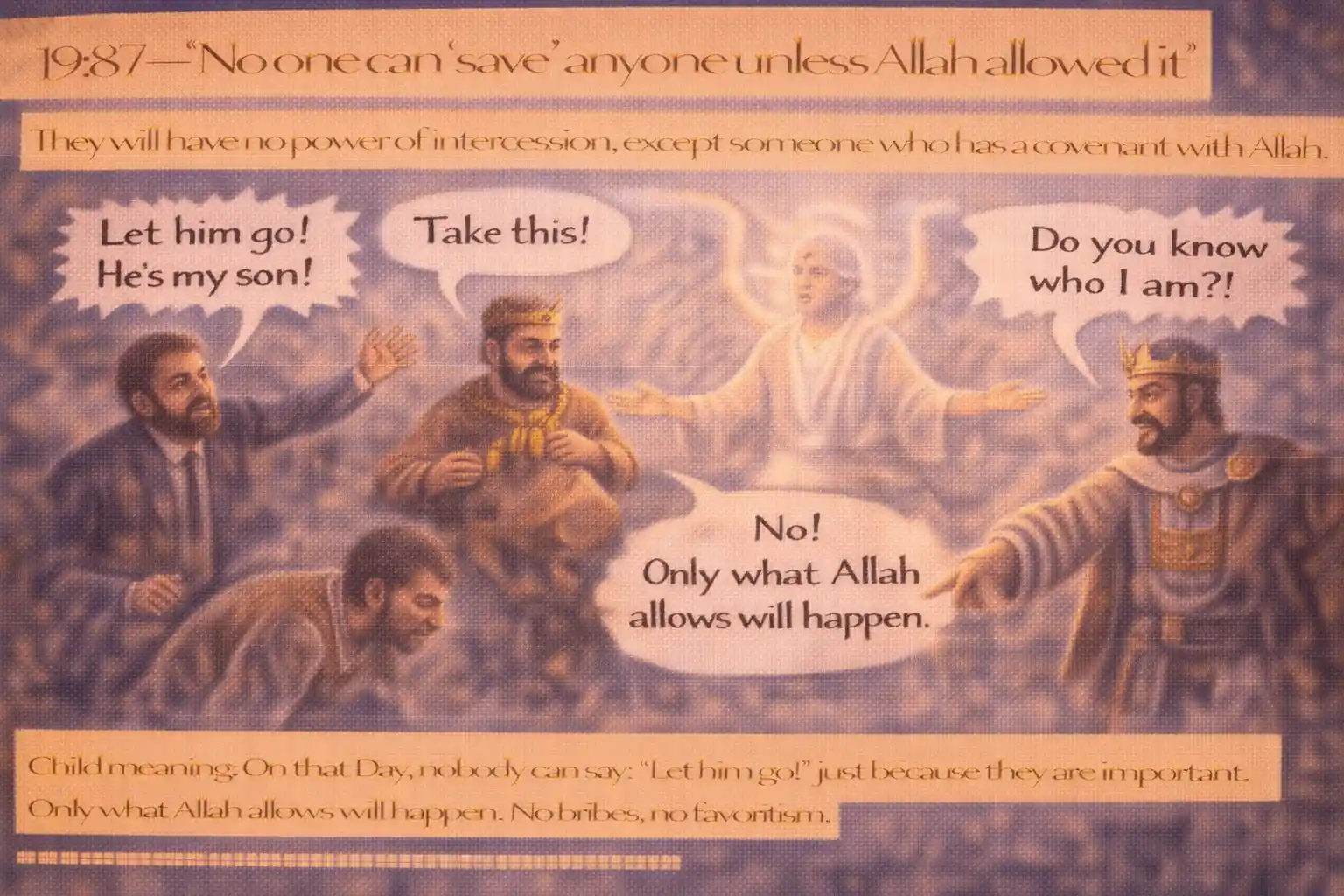
- 19:87 — No one can help them—except someone with a covenant
No intercession/aid works—except for one who has a covenant with Allah.
- No one can override Allah’s judgment by personal power or friendship.
- Any allowed help is only by Allah’s permission—described here as a covenant.
- Child idea: Nobody can just say “Let him go!” unless Allah allows it.
- 19:88 — They say: “The Most Merciful has taken a son”
They claim that Ar-Rahman has taken a son.
- This is a claim that assigns human-like family concepts to Allah.
- Child idea: Speaking about Allah like He is a human.

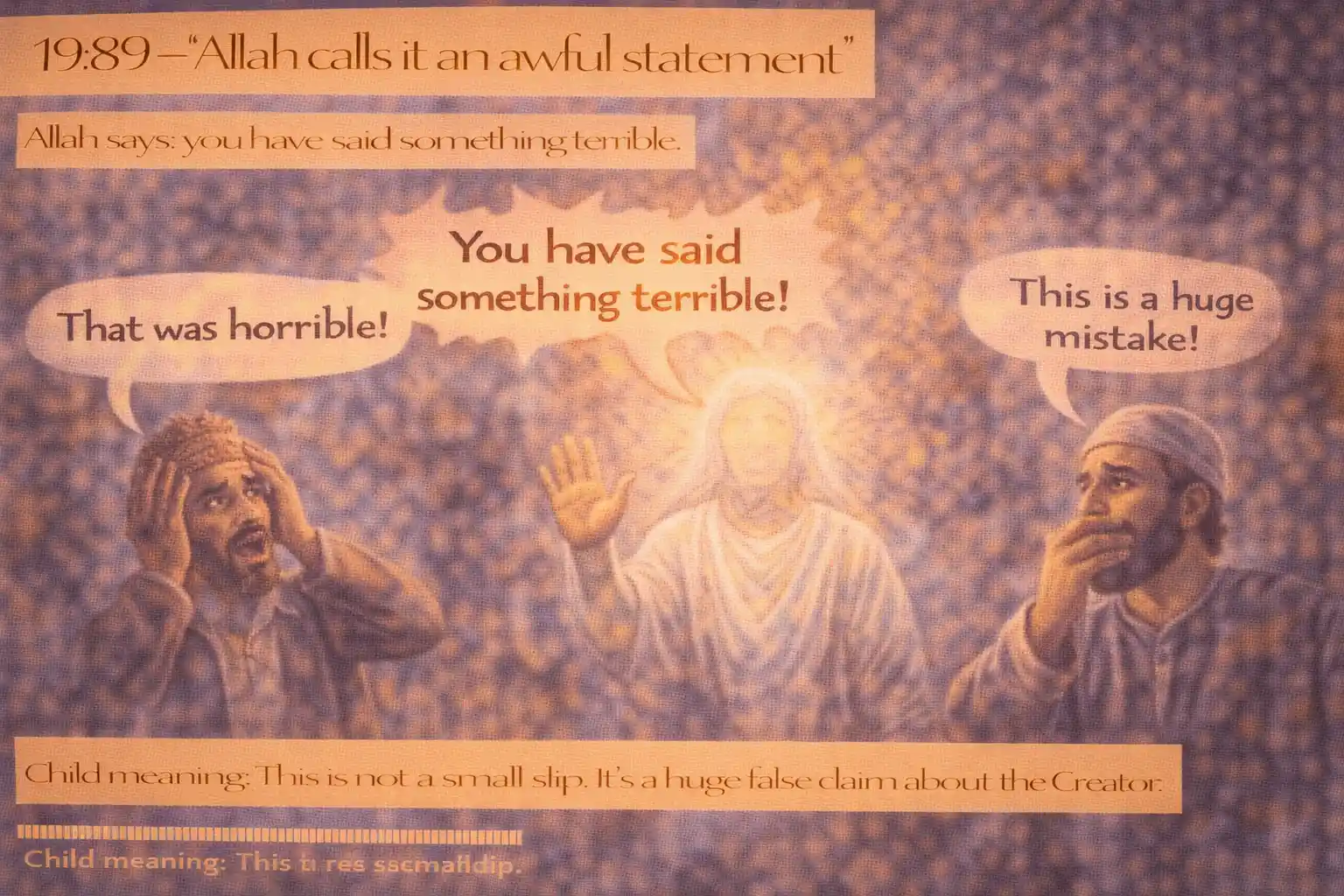
- 19:89 — Allah says: “That is a horrible statement”
Allah describes this claim as an atrocious, terrible statement.
- Allah frames it as not a “small mistake” but a severe falsehood about Him.
- Child idea: A very serious lie about Allah.
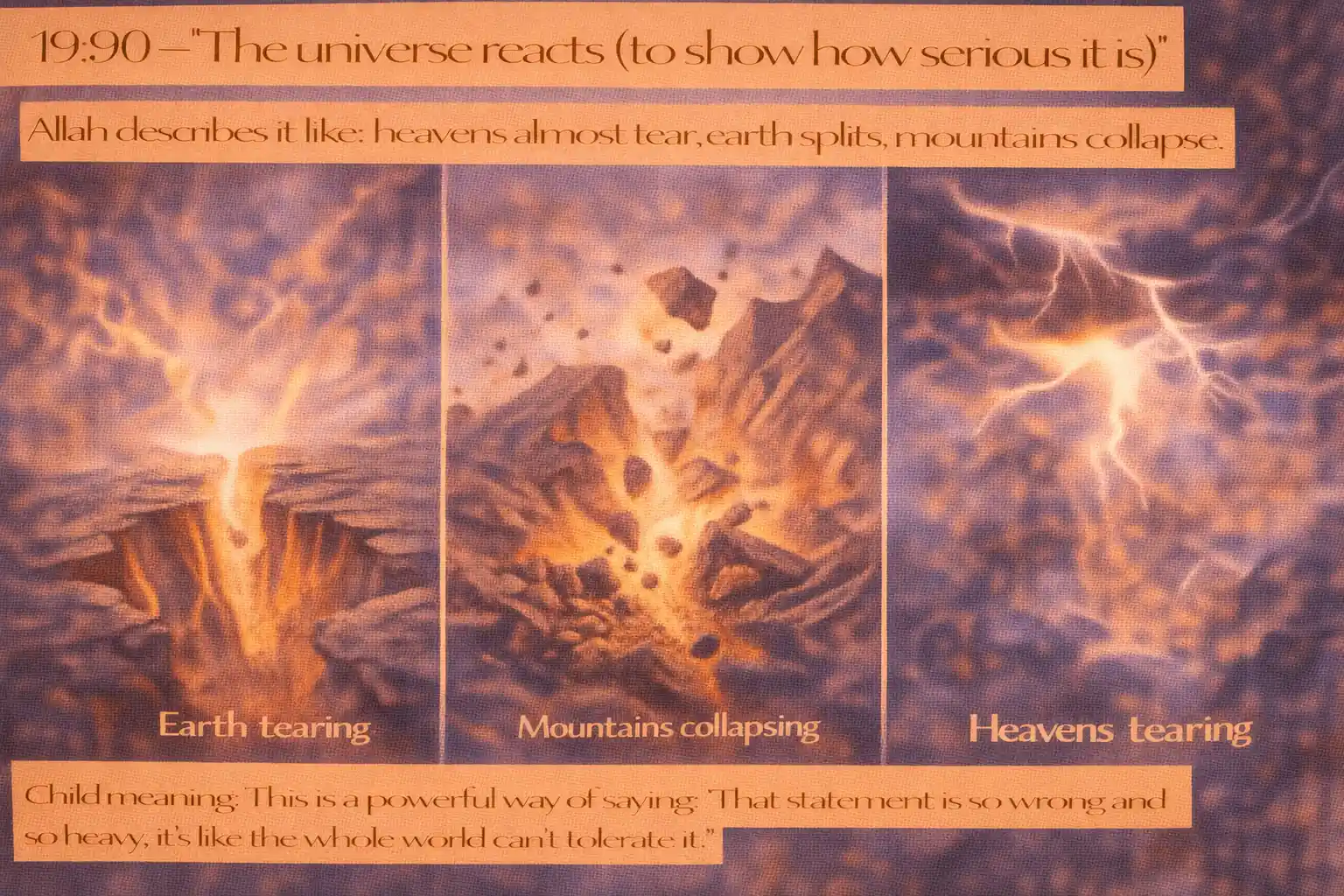
- 19:90 — The universe almost breaks from this claim
The skies almost tear, the earth almost splits, and the mountains almost collapse.
- Allah uses cosmic imagery to show how heavy and corrupt the statement is.
- It portrays the claim as something creation itself cannot “tolerate.”
- Child idea: “So wrong and insulting, it’s like the world can’t bear it.”
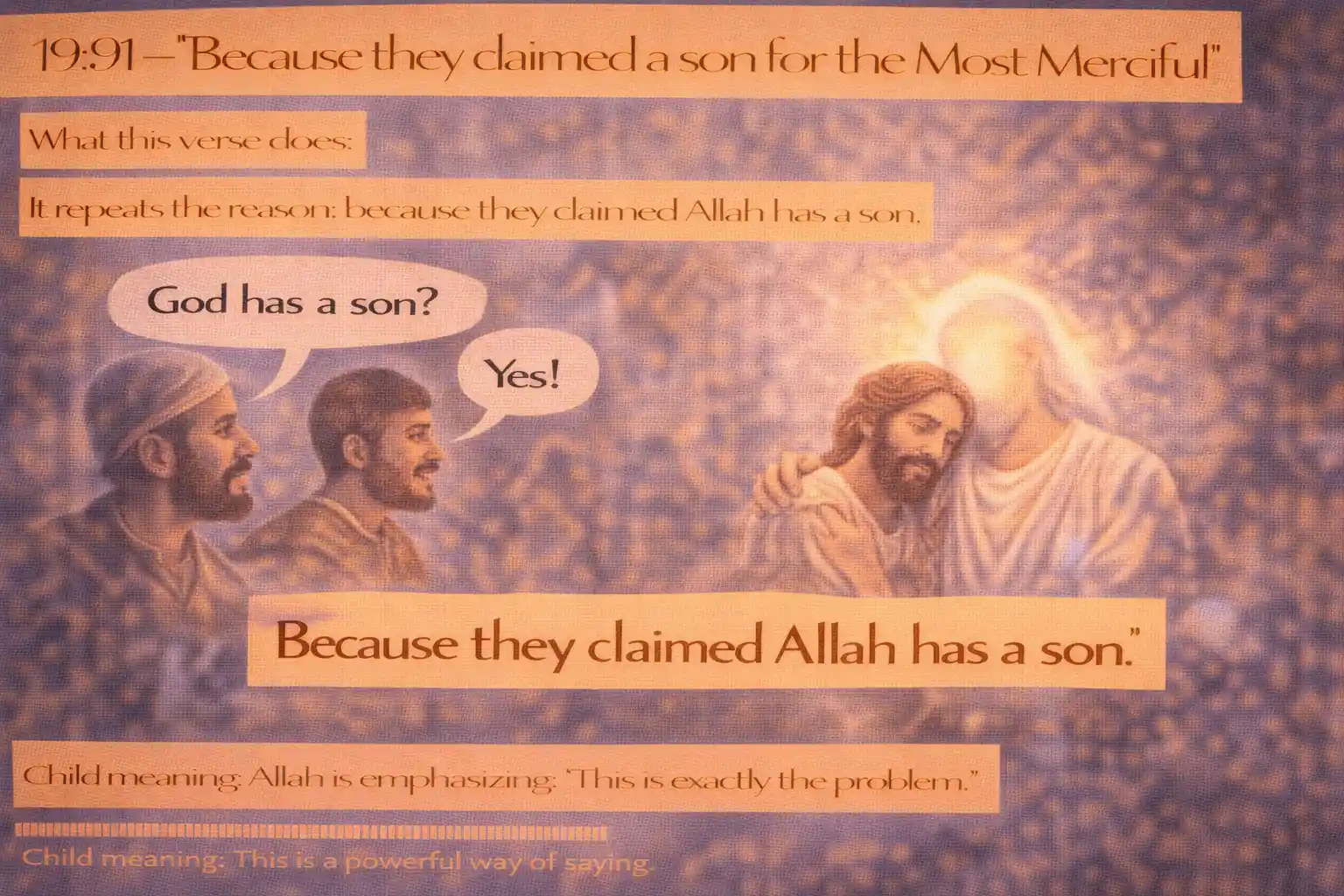
- 19:91 — Because they claimed a son for the Most Merciful
Allah repeats the reason: they ascribed a son to Ar-Rahman.
- The repetition highlights the core issue: the offense is the attribution itself.
- Child idea: “This is exactly the problem.”
- 19:92 — It does not fit Allah to have a son
It is not appropriate for Allah to have a son.
- “Son” implies creaturely needs: being born, inheriting, continuing a bloodline, needing family.
- Allah is above all of that—He is not a creature and has no needs.
- Child idea: Sons are for creatures; Allah needs none of that.

- 19:93 — Everyone comes to Allah as a servant
Every being in the heavens and earth comes to Ar-Rahman as a servant.
- All creation stands in the same fundamental position: created, owned, accountable.
- No one comes as “family” or “equal.”
- Child idea: Everyone comes saying: “I am Your creation.”
- 19:94 — Allah has counted everyone perfectly
Allah knows them all and has counted them precisely.
- Allah’s knowledge includes every person and every detail—nothing is lost.
- This includes public deeds and hidden intentions.
- Child idea: Nobody is missing from Allah’s knowledge.

- 19:95 — Each person comes alone on Judgment Day
Each one comes to Allah individually, alone.
- All worldly shields disappear: friends, crowds, status, family reputation.
- The meeting is personal: you and your record.
- Child idea: No hiding behind anyone—just you and what you did.

- 19:96 — Allah will place love for believers
Those who believe and do righteous deeds will be granted love.
- Allah places acceptance and love for them—true honor, not forced popularity.
- This includes: hearts being drawn to them because of their goodness and sincerity.
- Child idea: Allah makes good people beloved, and Allah loves them.

- 19:97 — Qur’an made easy in your language: good news + warning
Allah made the Qur’an easy in the Prophet’s language to give good news and to warn.
- The message is made understandable so guidance is not “hidden.”
- It carries two functions: glad tidings for the righteous and warnings for stubborn opponents of truth.
- Child idea: “Good people: be happy.” “Stubborn fighters: be careful.”

- 19:98 — Many past nations were destroyed; they vanished completely
Many generations before were destroyed—do you see any of them now, or hear even a whisper?
- Power, buildings, pride—none of it can resist Allah’s judgment when a people persist in corruption and denial.
- The verse forces reflection: entire civilizations can disappear until not even an “echo” remains.
- Child idea: They were strong once; now they are gone like they never existed.
Some people brag, “I’ll get everything I want,” while rejecting Allah—but they don’t control the future. False gods won’t help; they will turn against the worshipper. Everyone returns to Allah alone. The righteous are honored, and criminals are driven to consequences. And Allah is One—He does not need a son.
