- Allah’s signs, His absolute authority, and the Qur’an as the most just guidance.
- Personal accountability: each soul is responsible for what it earns.
- Core moral commands: worship Allah alone, kindness to parents, justice, and avoiding major sins.
- Warnings against arrogance, blind following, and rejecting revelation.
1. Glorified be He who took His servant (Muhammad) for a journey by night from the Sacred Mosque to the Farthest Mosque, the surroundings whereof We have blessed, that We might show him of Our signs. Indeed, He (Allah) is the All Hearer, the All Seer.
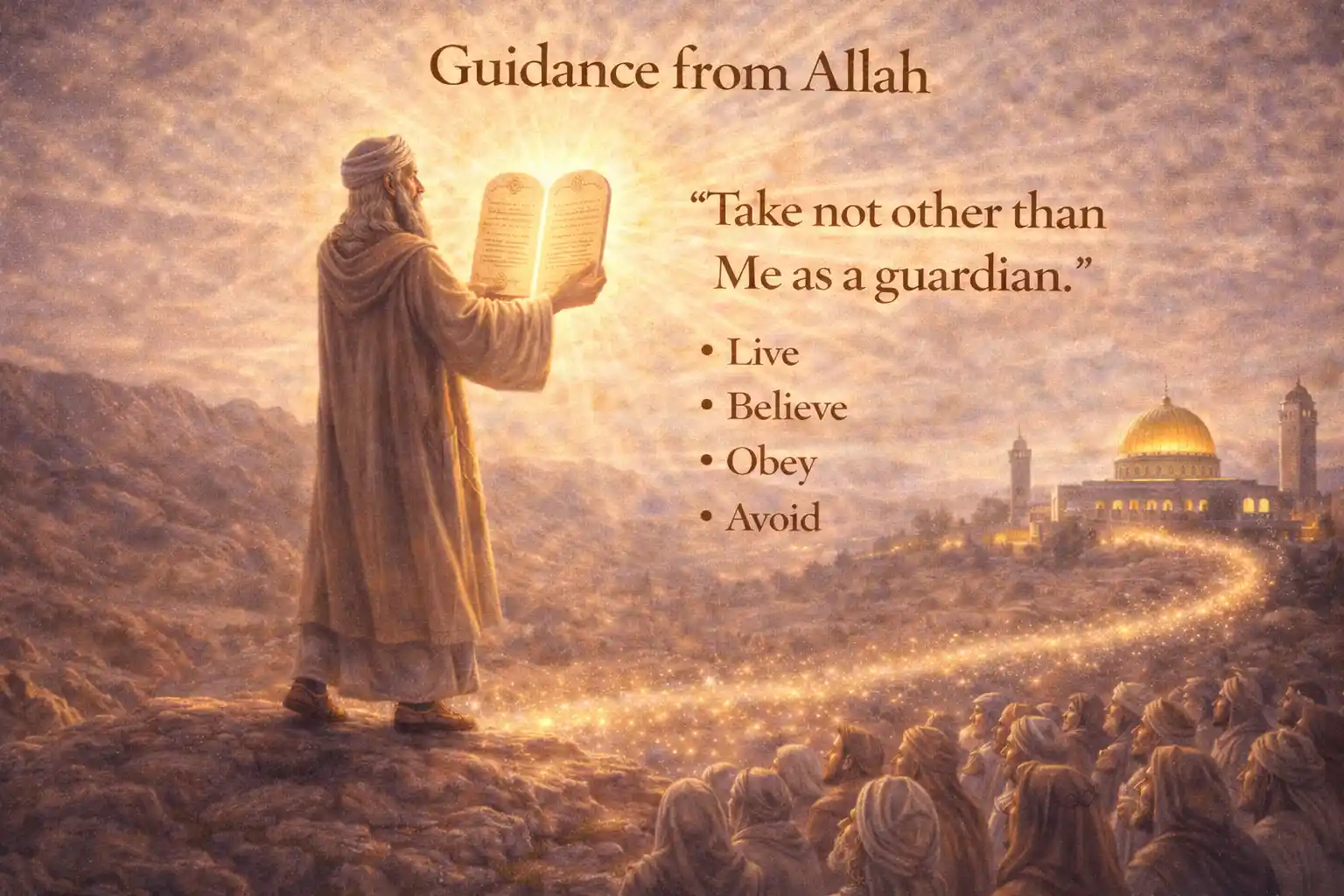
2. And We gave Moses the Scripture, and We made it a guidance for the Children of Israel, (saying): “Take not other than Me as a guardian.”
3. (They were) the descendants of those whom We carried (in the ship) with Noah. Indeed, he was a grateful servant.
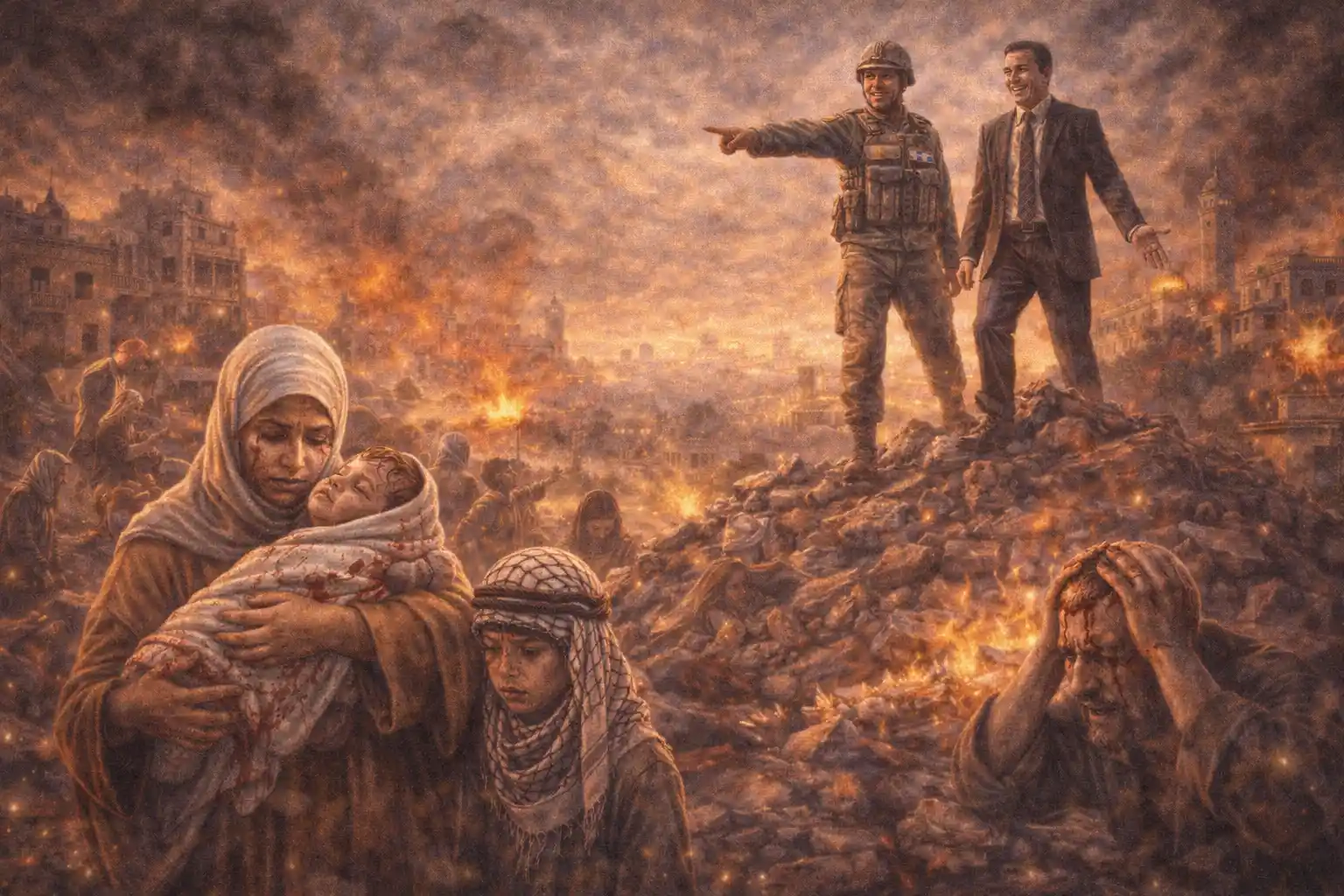
4. And We decreed for the Children of Israel in the Scripture that indeed you would cause corruption on the earth twice, and you would surely be elated with mighty arrogance.
5. Then when the (time of) promise came for the first of the two, We sent against you servants of Ours, of great might. So they entered the very innermost parts of your homes. And it was a promise fulfilled.
6. Then we gave back to you a return (victory) over them, and We helped you with wealth and sons and We made you more numerous in manpower.
7. (Saying): “If you do good, you do good for yourselves, and if you do evil, so it is for them (who do it).” Then, when the final (second) promise came, (We raised against you other enemies) to disfigure your faces, and to enter the temple as they entered it the first time, and to destroy what they took over, with (utter) destruction.
8. It may be that your Lord will have mercy upon you. And if you revert (to sin), We shall revert (to punishment). And We have made Hell a prison for the disbelievers.
9. Indeed, this Quran guides to that which is most just and gives good tidings to the believers who do righteous deeds that theirs will be a great reward.
10. And that those who do not believe in the Hereafter, We have prepared for them a painful punishment.
11. And man supplicates for evil as he supplicates for good. And man is ever hasty.
Qur’an-Only Explanation (17:1–11)
- 17:1 — The Night Journey
Who?
- Allah took His servant: Prophet Muhammad.
What happened?
- Allah took him on a journey at night:
- from the Sacred Mosque (in Makkah),
- to the Farthest Mosque (a blessed place).
Why did Allah do it?
- Allah says: “to show him of Our signs.”
- That means: Allah showed him powerful proofs that Allah is real, in control, and capable of anything.
When?
- It happened at night. The verse does not give a date.
Why does the verse end with “All-Hearer, All-Seer”?
- Allah hears everything and sees everything.
- So nobody can say: “Allah didn’t know” or “Allah didn’t see.”
Allah can do miracles. He showed His servant signs, and Allah knows everything that happens.

- 17:2 — Moses got the Scripture as Guidance
Who?
- Prophet Moses and the Children of Israel.
What did Allah give?
- Allah gave Moses the Scripture (a book) and made it guidance.
What is “guidance” (child simple)?
- Guidance is like a map so you don’t get lost.
- It tells you: what is right, what is wrong, what to do, what to avoid.
What is the main instruction?
- Allah says: “Do not take anyone besides Me as a guardian.”
What does “guardian” mean (child simple)?
- The one you trust the most.
- The one you obey the most.
- The one you think will protect you.
- The “main boss” you follow in life.
Why is Allah saying this?
- Because when people stop listening to Allah and follow other “bosses,” life gets corrupted.
Allah alone should be the One you rely on and obey as the highest authority.
- 17:3 — You come from people saved with Noah
Who is being talked to?
- The Children of Israel.
What is Allah reminding them?
- You are descendants of people Allah carried with Noah in the ship (the Ark).
Why mention Noah?
- It is like saying: “Your family history includes a huge rescue from Allah—so don’t forget Him.”
What does Allah say about Noah?
- Allah says Noah was a grateful servant.
What does “grateful” mean (child simple)?
- He noticed Allah’s blessings, thanked Allah, and obeyed Allah.
- He didn’t act like he saved himself.
Remember Allah’s past help. Be thankful like Noah, not proud.
- 17:4 — Two big times of corruption and arrogance
Who?
- The Children of Israel.
What did Allah warn?
- You will cause corruption on earth twice.
- You will become extremely arrogant.
What is “corruption” (child simple)?
- Spreading bad things in society: ظلم (oppression), injustice, cheating, harming people, ignoring Allah’s rules.
- It’s like making the world more broken and unfair.
Why “twice”?
- It means it happens in two major cycles:
- wrong grows big, then consequences come; then it happens again later.
What is “mighty arrogance” (child simple)?
- Not normal pride—aggressive pride:
- “We are above everyone,” “Nobody can correct us,” “We can do what we want.”
When people keep doing wrong and become arrogant, serious consequences come.
- 17:5 — The first punishment comes
When did it happen?
- When the time of the first promise came (the first consequence).
What happened?
- Allah sent against them servants of His who were very strong (a powerful force/army).
Why call them “servants of Ours”?
- Because even enemies are still under Allah’s control—Allah allows events to happen as consequences.
What does “entered the innermost parts of your homes” mean?
- It means: complete defeat—no safety, no protection, nowhere to hide.
What does “promise fulfilled” mean?
- Allah warned them, and it happened exactly as Allah said.
Allah’s warning is real. When wrongdoing reaches a peak, consequences arrive.
- 17:6 — Allah gives them strength again
What happened after the punishment?
- Allah gave them another chance:
- victory returned,
- more wealth,
- more children,
- more people and strength.
Why would Allah give strength again?
- Because Allah tests people:
- punishment can wake them up, then Allah gives a new chance to do better.
What is the danger?
- People might think: “We got power, so we must be right.”
- But power can be a test, not approval.
After hardship, Allah can give a second chance—but that second chance is also a test.
- 17:7 — The rule of life + the second punishment
First part: What is the rule?
- If you do good, you help yourself.
- If you do evil, you hurt yourself.
Why?
- Because your actions come back to you in life, and also on Judgment Day.
Second part: What happens when the final promise comes?
- Enemies come again:
- to disgrace them (“disfigure your faces” = humiliation),
- to enter the temple like the first time,
- to destroy what they controlled.
Why say “like the first time”?
- It shows: the lesson was not learned, so the consequence returned.
Good returns to you. Evil returns to you. If the same wrongdoing returns, the same consequence can return.
- 17:8 — Mercy is possible, but punishment returns if sin returns
What is Allah saying?
- Allah may have mercy on you.
- But if you return to sin, Allah returns to punishment.
Why does it say “maybe”?
- Because mercy is not something you demand while refusing to change.
- Mercy comes with humility, repentance, and correction.
What does “if you return, We return” mean (child simple)?
- If you repeat the wrong path → consequences repeat.
- If you truly change → mercy can come.
What does “Hell is a prison” mean?
- Prison means: locked in, no escape, serious punishment for rejecting truth.
Change brings mercy. Repeating sin brings repeating punishment.
- 17:9 — The Qur’an guides to the best path
What is being said?
- The Qur’an guides to what is most correct and most fair.
- It gives good news to believers who do righteous deeds.
What is the good news?
- A great reward (success with Allah).
Why mention “most just”?
- Because the Qur’an teaches truth, fairness, and the right way to live.
The Qur’an shows the straight, fair path—and promises reward for those who follow it.
- 17:10 — Painful punishment for rejecting the Hereafter
Who is this about?
- People who do not believe in the Hereafter.
What will happen?
- Allah prepared painful punishment for them.
Why mention the Hereafter?
- If someone thinks there is no afterlife, they may act like “I can do anything.”
- Allah says: No—there will be accountability.
Denying the afterlife does not remove accountability. Allah’s judgment still comes.
- 17:11 — People sometimes ask for bad things; humans are hasty
What is being said?
- Humans sometimes make dua for evil the same way they make dua for good.
- Humans are very hasty.
What does “dua for evil” look like (child simple)?
- When angry, someone says quickly:
- “Ya Allah destroy him!” “Ya Allah ruin my life!” “I wish I was dead!”
Why do people do that?
- Because humans react fast, speak fast, and want things immediately.
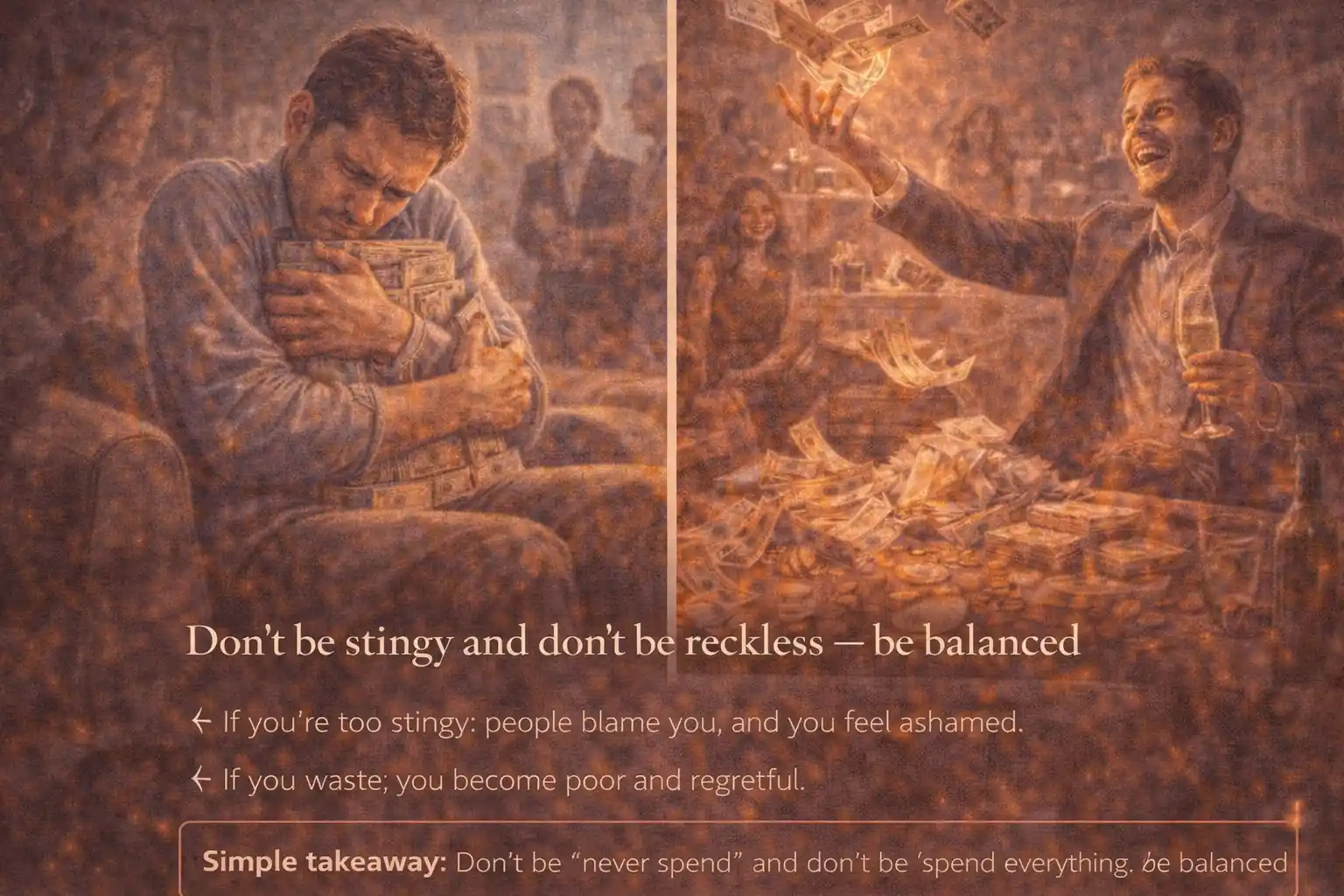
12. And We have made the night and the day as two signs. Then We have obscured the sign of the night, and made the sign of the day radiant that you may seek the bounty of your Lord, and that you may know the numbers of the years, and the account (of time). And every thing We explained in details. 13. And to every man, We have fastened his fate to his neck. And We shall bring forth for him on the Day of Resurrection a book which he will find spread open. 14. (It will be said): “Read your book. Sufficient is your self this Day against you as a reckoner.” 15. Whoever is guided, so he is guided only for his own self. And whoever goes astray, so he goes astray only against his (self). And no bearer of burdens will bear another's burden. And We would never punish until We have sent a messenger. 16. And when We intend to destroy a town, We command its affluent, so they commit abomination therein, then the word (decree) is justified against it, then We destroy it with (complete) destruction. 17. And how many have We destroyed from the generations after Noah. And Sufficient is your Lord of the sins of His servants as Knower, All Seer. 18. Whoever should desire what hastens away (worldly life), We hasten for him therein what We will, for whom We intend. Then We have appointed for him Hell. He will (enter to) burn therein, condemned, rejected. 19. And whoever desires the Hereafter and strives for it with the effort due to it, while he is a believer, then it is those whose effort shall be appreciated. 20. To each We bestow, these and (as well as) those, from the bounty of your Lord. And the bounty of your Lord can not be restricted. “We have made the night and the day as two signs…” What is Allah saying? What did Allah do with the night? What did Allah do with the day? Why did Allah do this? (Two reasons in the verse) “To every person We have fastened his record to his neck…” What is Allah saying? What does that mean (child simple)? What happens on Judgment Day? What is in the book? “Read your book. You are enough today to judge yourself.” What will be said? Why is this powerful? What does “you are enough as a reckoner” mean? “Whoever is guided is guided for himself… and no bearer of burdens bears another… and We do not punish until We send a messenger.” This verse gives 4 big rules: Rule 1: If you follow guidance, you benefit yourself Rule 2: If you go astray, you harm yourself Rule 3: No one carries someone else’s burden Rule 4: Allah does not punish until He sends a messenger “When We intend to destroy a town, We command its affluent… then We destroy it completely.” What is Allah saying? What does this mean (child simple)? Important clarity (very simple): Then what happens? “How many generations after Noah We destroyed… and your Lord is Knower, All-Seer.” What is Allah saying? What does “Knower, All-Seer” mean here? “Whoever desires the quick life… then We appoint for him Hell…” What is “what hastens away”? What is Allah saying? Then what happens? “Whoever desires the Hereafter and strives for it… while being a believer… their effort is appreciated.” Who is this about? What does “strives” mean (child simple)? What happens to them? “To each We bestow… from the bounty of your Lord… and the bounty of your Lord cannot be restricted.” What is Allah saying? Why mention this? What does “cannot be restricted” mean? 21. Look how We have exalted some of them above others, and the Hereafter will be greater in degrees and greater in preference. 22. Do not make with Allah any other god, (O man) lest you will sit in humiliated, forsaken. 23. And your Lord has decreed that you worship none except Him, and (show) kindness to parents. If they attain old age (while) with you, one of them or both of them, say not to them a word of disrespect, nor shout at them, and speak to them a gracious word. 24. And lower unto them the wing of submission through mercy, and say: “My Lord, have mercy on them both as they did care for me (when I was) little.” 25. Your Lord is best aware of what is within yourselves. If you should be righteous, then indeed He is ever Forgiving to those who turn (to Him). 26. And give to the near of kin his right, and the needy, and the wayfarer, and squander not (your wealth) extravagantly. 27. Indeed, the squanderers are brothers of Satan, and Satan is ever ungrateful to his Lord. 28. And if you have to turn away from them (needy), awaiting mercy from your Lord, which you expect, then speak to them a word of easy kindness. 29. And Do not keep your hand fastened to your neck, nor outspread it altogether widespread, for you will then be sitting rebuked, destitute. 30. Indeed, your Lord enlarges the provision for whom He wills, and straitens (it for whom He wills). Indeed, He is All Knower, All Seer of His servants. Look at people in the world: Allah gave some people more than others. Because this world is a test: Allah says the Hereafter is much bigger: Simple takeaway: This world’s “levels” are small. The Hereafter is the real big result. Do not worship anything with Allah. It means giving Allah’s place to anything, like: Because it is like saying: “Allah is not enough.” And that is a huge wrong. Allah says they will end up: Simple takeaway: Only Allah is the true Protector. Don’t replace Him. When they become old and weak, and they live with you. Even small disrespect: Speak gently and respectfully. Simple takeaway: Parents cared for you when you were weak. Don’t hurt them when they are weak. Like a bird lowers its wing gently to protect its baby. It means: Because of mercy: you remember their love and sacrifice. “O Allah, have mercy on them, like they cared for me when I was little.” Simple takeaway: Treat your parents with gentle mercy and always pray for them. Allah knows what you truly feel inside: Sometimes you may make mistakes with parents or people, but you didn’t mean evil. Allah says: if you are righteous (trying to do right), Allah is very forgiving to people who: Simple takeaway: Allah sees your heart. If you mess up, come back to Allah and improve. It means they are not asking for “your kindness only”—Allah says you should help them properly. Don’t waste money extravagantly, like: Simple takeaway: Use your money responsibly and help people who need help. Not that they are literally family. It means: Because wasting says: “I don’t care about Allah’s blessings.” Simple takeaway: Wasting blessings is behaving like Satan’s attitude: ungrateful. Sometimes you genuinely have nothing to give. Don’t insult them. Don’t ignore them coldly. Speak gently, like: Because poor people already feel pain. Don’t add more pain with harsh words. Simple takeaway: Even if you can’t give money, give kindness. It means being too stingy: It means spending too much: Simple takeaway: Don’t be “never spend” and don’t be “spend everything.” Be balanced. Provision means what you live on: Allah gives more to some, and gives less to some—by His wisdom. Not automatically. It can be: Because Allah: Simple takeaway: Allah gives differently for a reason. Your job is to obey and be grateful either way.
Summary:
Allah tests people with different life situations, commands worship of Him alone, kindness to parents,
helping the needy, and balanced spending—because Allah sees everything and controls provision with perfect wisdom.
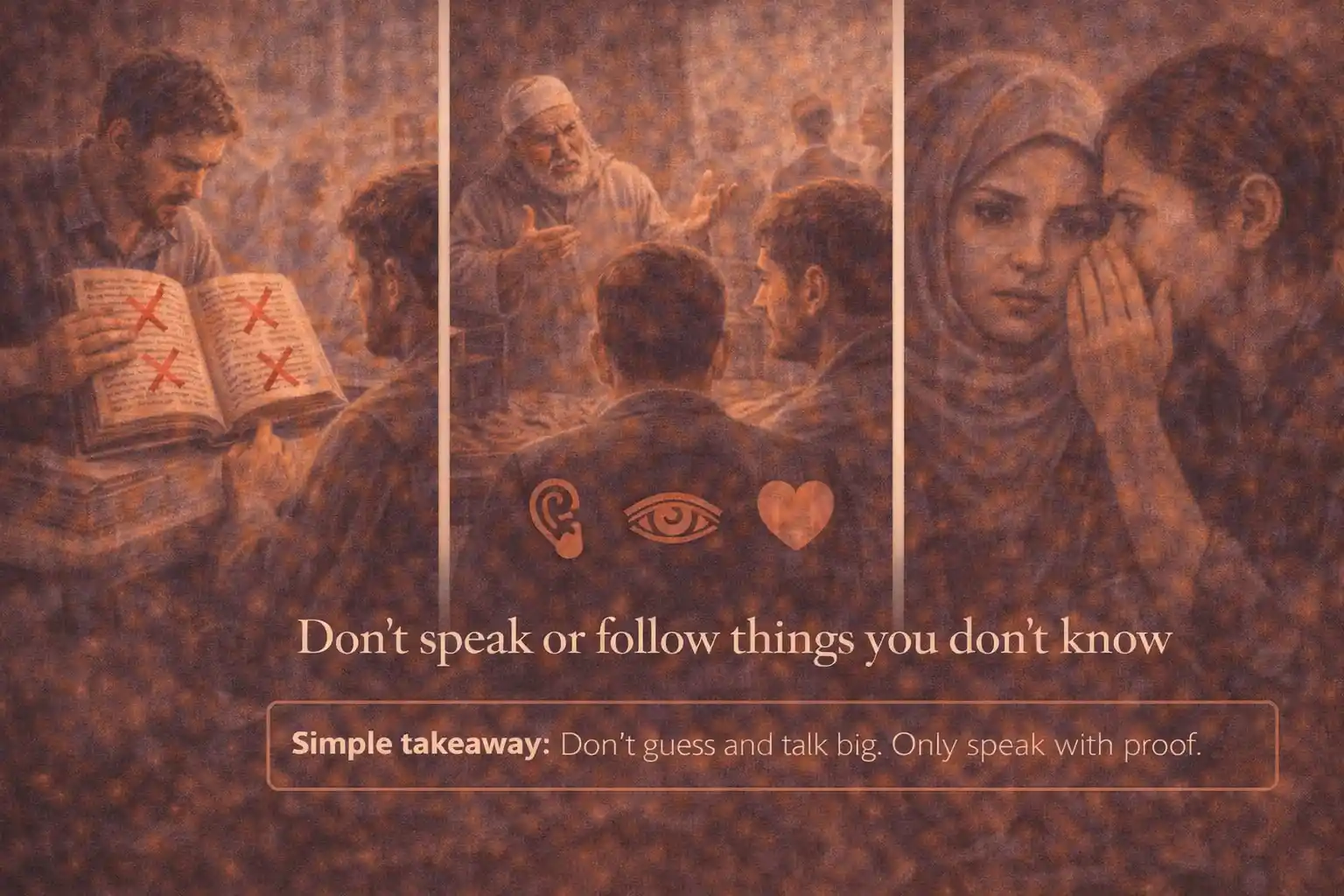
31. And do not kill your children for fear of poverty. We provide for them and for you. Indeed, the killing of them is a great sin. 32. And do not come near to adultery. Indeed, it is an abomination and an evil way. 33. And do not kill a person, whom Allah has forbidden, except by right. And one who is killed wrongfully, We indeed have granted his heir the authority (of retribution), so let him not exceed limits in (the matter of) taking life. He shall be surely helped (by the law). 34. And do not go near the wealth of the orphan, except that it be in the best manner until he comes to his strength (maturity). And fulfill the covenant. Indeed, the covenant, will be questioned about. 35. And give full measure when you measure, and weigh with a balance that is straight. That is fair, and better in consequence. 36. And do not follow that of which you have no knowledge. Indeed, the hearing, and the sight, and the heart, each of these shall be called to account. 37. And do not walk upon the earth in arrogance. Indeed, you can never tear the earth (apart), and never can you reach to the mountains in height. 38. All such (things), its evil is hateful in the sight of your Lord. 39. That is from what your Lord has revealed to you (O Muhammad) from the wisdom. And (O mankind) do not take with Allah any other god, lest you are thrown into Hell, blameworthy, abandoned. 40. Has your Lord then chosen you for (having) sons, and has taken (for Himself) daughters from among the angels. Indeed, you utter a dreadful saying. Don’t kill your children because you’re scared you won’t have enough money. Some people panic and think: “We’re too poor. We can’t feed a baby.” Allah says: “I provide for them and for you.”
Meaning: Allah is the One who gives food, jobs, help, and ways to survive. Simple takeaway: A child is not the enemy of your money. Allah can provide for everyone. Don’t even come close to zina (sex outside marriage). Because Allah is warning you to avoid the steps that lead to it, like: Because it often: Simple takeaway: Don’t play with fire. Stay far from the path that leads to zina. Do not kill a person—Allah made human life sacred—unless there is a lawful right
(meaning: a valid, fair legal reason, not personal anger). Allah says the victim’s family/heir gets authority through the law: “Do not exceed limits.” That means: It means the victim’s side should not be ignored—justice will support them. Simple takeaway: Life is sacred. Justice must be controlled and fair—not revenge madness. If a child has no parent (orphan), and they have money/property, don’t touch it except in the best way. Until the orphan becomes mature and capable—then you give it to them. A covenant is a promise/contract—like: Allah says: you will be questioned about your promises. Simple takeaway: Don’t steal from the weakest (orphans). And don’t be the type who breaks promises. When you sell things, measure properly. Weigh properly. Don’t cheat. Because honesty: Simple takeaway: Don’t be a cheater. Give people what you promised. Don’t claim something is true when you don’t actually know. Allah says your: will be questioned. Simple takeaway: Don’t guess and talk big. Only speak with proof. Acting like: Meaning: you are not as powerful as you think. Simple takeaway: Be confident, yes—but not proud and disgusting. You’re still a human. Everything mentioned—killing, zina, ظلم, stealing orphan wealth, cheating, lying without knowledge, arrogance—Allah hates these evils. Simple takeaway: Allah is telling you clearly: these are ugly sins. Stay away. These commands are part of Allah’s revealed wisdom to the Prophet. Don’t take any other “god” with Allah. Because this is the foundation: if someone rejects Allah, they usually don’t care about Allah’s rules. Allah warns they can be thrown into Hell: Simple takeaway: Allah’s rules come from wisdom—and the biggest rule is: worship Allah alone. Some people used to claim: “Angels are Allah’s daughters.” Simple takeaway: Don’t invent stories about Allah. Allah is above human family ideas. 41. And indeed, We have fully explained in this Quran that they may take admonition, but it does not increase them except in aversion. 42. Say (O Muhammad): “If there had been (other) gods along with Him, as they say, then they would have sought a way to the Lord of the Throne.” 43. Glory be to Him, and He is high above what they say, Exalted and Great. 44. The seven heavens and the earth and whatever is therein glorify Him. And there is not a thing but glorifies His praise, but you do not understand their glorification. Indeed, He is ever Clement, Forgiving. 45. And when you recite the Quran, we place between you and those who do not believe in the Hereafter, a hidden barrier. 46. And We have placed upon their hearts coverings, lest they should understand it, and in their ears a deafness. And when you make mention of your Lord alone in the Quran, they turn on their backs in aversion. 47. We know best of what they listen to, when they listen to you and when they take secret counsel. When the wrong doers say: “You follow none but a man bewitched.” 48. Look how they put forward for you similitudes. So they have gone astray, then they can not find a way. 49. And they say: “When we are bones and fragments, shall we really be resurrected (to be) a new creation.” 50. Say (O Muhammad): “Be you stones or iron.” What is Allah saying? Why did Allah explain it so much? But what happened? Child-simple takeaway: What is Allah saying? What does that mean in simple words? Why does Allah say this? Child-simple takeaway: What is Allah saying? Why is this said? Child-simple takeaway: What is Allah saying? What does “glorify” mean? But… rocks and trees don’t talk—how do they praise? Why mention this? And why does it end with “Clement, Forgiving”? Child-simple takeaway: What is Allah saying? What does “hidden barrier” mean? Why does Allah do that? Child-simple takeaway: What is Allah describing? Why do they turn away when Allah alone is mentioned? Important child-simple point: What is Allah saying? What do the wrongdoers say? Why do they say that? Child-simple takeaway: What is Allah saying? What happens because of that? Child-simple takeaway: What are they saying? Why do they say this? Child-simple takeaway: What is Allah telling the Prophet to say? What does that mean? Why? Child-simple takeaway: 51. “Or some created thing that is yet greater in your breasts.” Then they will say: “Who shall bring us back (to life).” Say: “He who created you in the first instance.” Then they will shake their heads at you, and say: “When will it be.” Say: “perhaps it is near.” 52. On the day (when) He will call you, then you will answer with His praise, and you will think that you had not stayed (in the world) except for a little. 53. And say to My servants to speak that which is best. Indeed, Satan sows discord among them. Indeed, Satan is to mankind a clear enemy. 54. Your Lord knows you best. If He wills, He will have mercy upon you, or if He wills, He will punish you. And We have not sent you (O Muhammad) over them as a guardian. 55. And your Lord knows best of whoever is in the heavens and the earth. And indeed, We have preferred some of the prophets above others, and to David We gave the Psalms. 56. Say: “Call unto those whom you claim (to be gods) besides Him. For they have no power to remove the adversity from you, nor to shift it.” 57. Those unto whom they call upon, are themselves seeking to their Lord the means of access, as to which of them should be the nearest, and they hope for His mercy and they fear His punishment. Surely, punishment of your Lord is to be feared. 58. And there is not a township but that We shall destroy it before the Day of Resurrection, or punish it with a severe punishment. This is written down in the Book (of our decrees). 59. And nothing prevented Us from sending signs but that the people of old denied them. And We gave Thamud the she-camel, a clear sign, but they wronged her. And We send not the signs except to cause (people to) fear. 60. And (O Muhammad) when We said to you: “Indeed, your Lord has encompassed mankind.” And We did not make the vision which We have shown you except as a trial for mankind, and the tree accursed in the Quran. And We warn them, but it increases them not except in greater transgression. What are they saying? Why do they say that? What is Allah’s answer? Child-simple idea: What do they do next? What is the reply? Simple takeaway: Allah created you once, so bringing you back is not hard for Him. When is this? What will happen? What does “with His praise” mean? What will people feel about their time on earth? Child-simple idea: Simple takeaway: On that Day, dunya will feel tiny and fast, and Allah’s truth will be clear. What is Allah commanding? What does “best” mean? Why? Child-simple idea: Simple takeaway: Use good words. Bad words are a door to big fights. What is Allah saying? Why is this said? Child-simple idea: Simple takeaway: The message is delivered; you are responsible for your choice. What is Allah saying? What else? Example given: Why mention this? Simple takeaway: Allah chose prophets with different missions and gifts, and He knows everyone perfectly. What is Allah telling the Prophet to say? Then what? Child-simple idea: Simple takeaway: If something cannot help you, it is not a god. Only Allah has real power. What does this mean? Allah says: Child-simple idea: Simple takeaway: Don’t go through “middle-men” as if they control things. Go to Allah directly. What is Allah saying? Why mention this? “Written in the Book” means: Simple takeaway: Big cities and big power do not protect anyone from Allah’s justice. What is Allah saying? Example: What did they do? Why are signs sent? Child-simple idea: Simple takeaway: Miracles don’t help stubborn hearts. People must choose humility and truth. “Allah has encompassed mankind” means: “The vision we showed you” means: “The tree accursed in the Qur’an” (in this context): Why does Allah warn them then? But what happens to stubborn people? Child-simple idea: Simple takeaway: Warnings help humble hearts, but stubborn hearts can choose to rebel more.
People doubt resurrection and ask “how,” but Allah says the One who created you first can create you again.
On that Day, life will feel very short. Allah commands kind speech because Satan loves starting fights.
Only Allah controls mercy and punishment. False gods cannot help you, and even those people call on are Allah’s servants.
Nations are not untouchable—Allah can punish towns. Past nations rejected big signs, so warnings are enough,
but stubborn people can still choose to rebel.
61. And when We said to the angels: “Prostrate unto Adam,” so they fell prostrate except Iblis. He said: “Shall I prostrate to one whom You created from clay.” 62. He (Iblis) said: “See You, this one whom You have honored above me, if You give me respite until the Day of Resurrection, I will surely seize his offspring, (all) except a few.” 63. He (Allah) said: “Go, so whoever of them follows you, then indeed Hell will be your recompense, an ample recompense.” 64. “And entice whoever you can among them, with your voice, and make assaults on them with your cavalry and your infantry, and be a partner with them in wealth and children, and promise them.” And Satan does not promise them except deceit. 65. “Indeed, My servants, you have no authority over them. And sufficient is your Lord as a Guardian.” 66. (O mankind), your Lord is He who drives for you the ship upon the sea that you may seek of His bounty. Indeed, He is ever Merciful towards you. 67. And when distress touches you at sea, those whom you call upon vanish except Him. But when He brings you safe to land, you turn away. And man is ever ungrateful. 68. Then do you feel secure that He will not cause a part of the land to swallow you, or send a sand-storm upon you, then you will not find a protector for you. 69. Or do you feel secure that He will not return you into that (the sea) a second time, and send upon you a hurricane of wind and drown you for your ingratitude. Then you will not find for yourselves any avenger therein against Us. 70. And indeed, We have honored the children of Adam, and We have carried them on the land and the sea, and We have provided them with good things, and We have preferred them above many of those whom We created, (a sure) preference.
Allah told the angels: “Bow down to Adam.”
Iblis said something like: Child-simple takeaway: Iblis failed because of pride: “I’m better.”
He said:
He means:
Because he is jealous and angry that Adam was honored.
Child-simple takeaway: Iblis wants humans to fail out of jealousy.
Allah told Iblis:
Because life is a test:
Child-simple takeaway: If you choose Satan’s road, you choose the punishment too. Allah describes the tricks of Satan. Satan’s “voice” means his invitations, like:
It’s like saying: Satan will use many ways and many helpers to attack people, like:
Satan tries to spoil: Fake promises like:
Allah says clearly: Satan’s promises are deceit — like a trap.
Child-simple takeaway: Satan sells lies like candy—sweet at first, but poison later.
“My true servants—Satan has no authority over them.”
No. Satan can:
But he cannot force the heart of someone who holds on to Allah.
Because Allah is enough as a Guardian:
Child-simple takeaway: If you stick to Allah, Satan can’t “control” you. All people.
Allah is the One who makes the sea work for you:
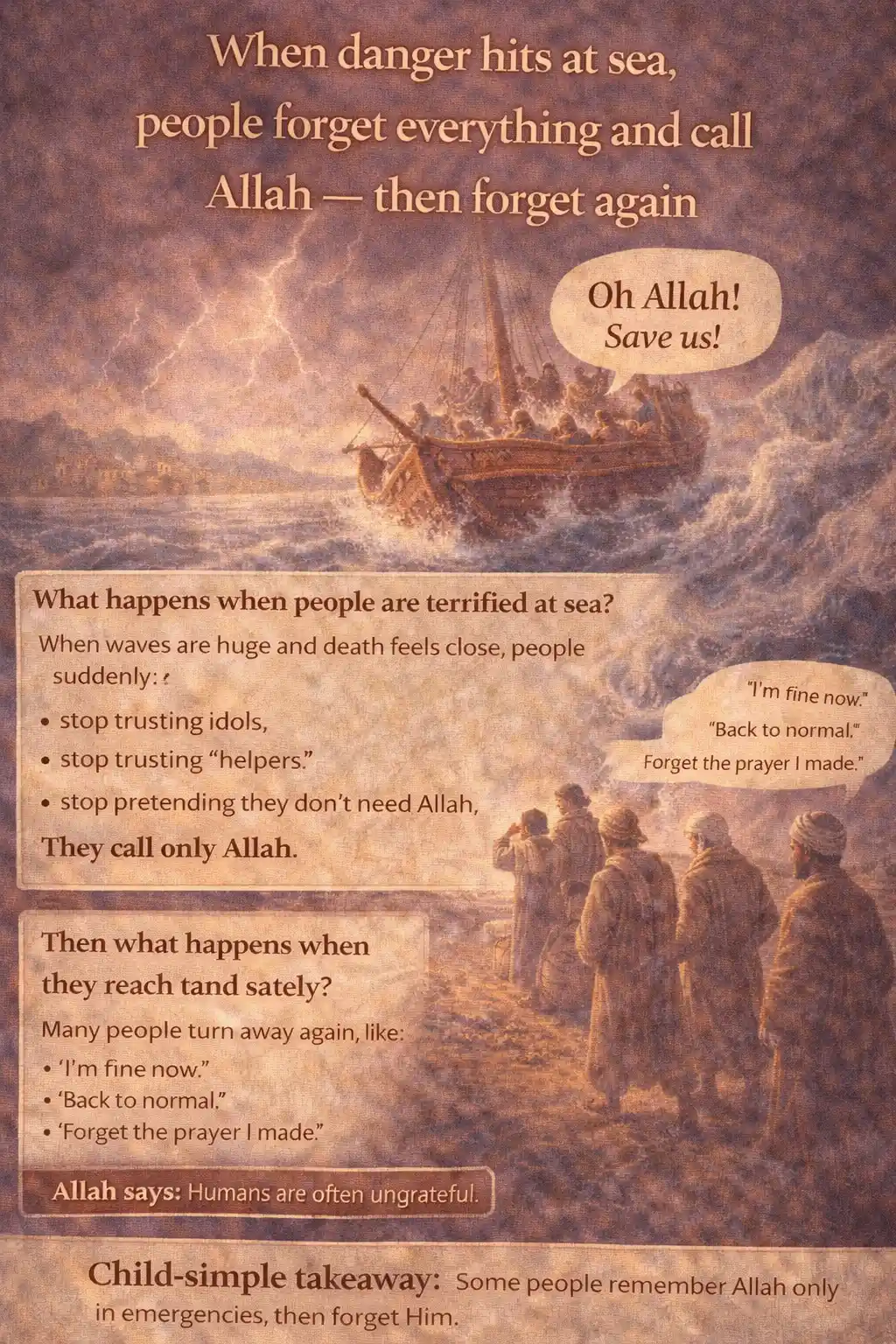
To show Allah’s mercy and help in everyday life. Child-simple takeaway: Even travel and trade are gifts from Allah. When waves are huge and death feels close, people suddenly: Many people turn away again, like:
Allah says: Humans are often ungrateful.
Child-simple takeaway: Some people remember Allah only in emergencies, then forget Him.
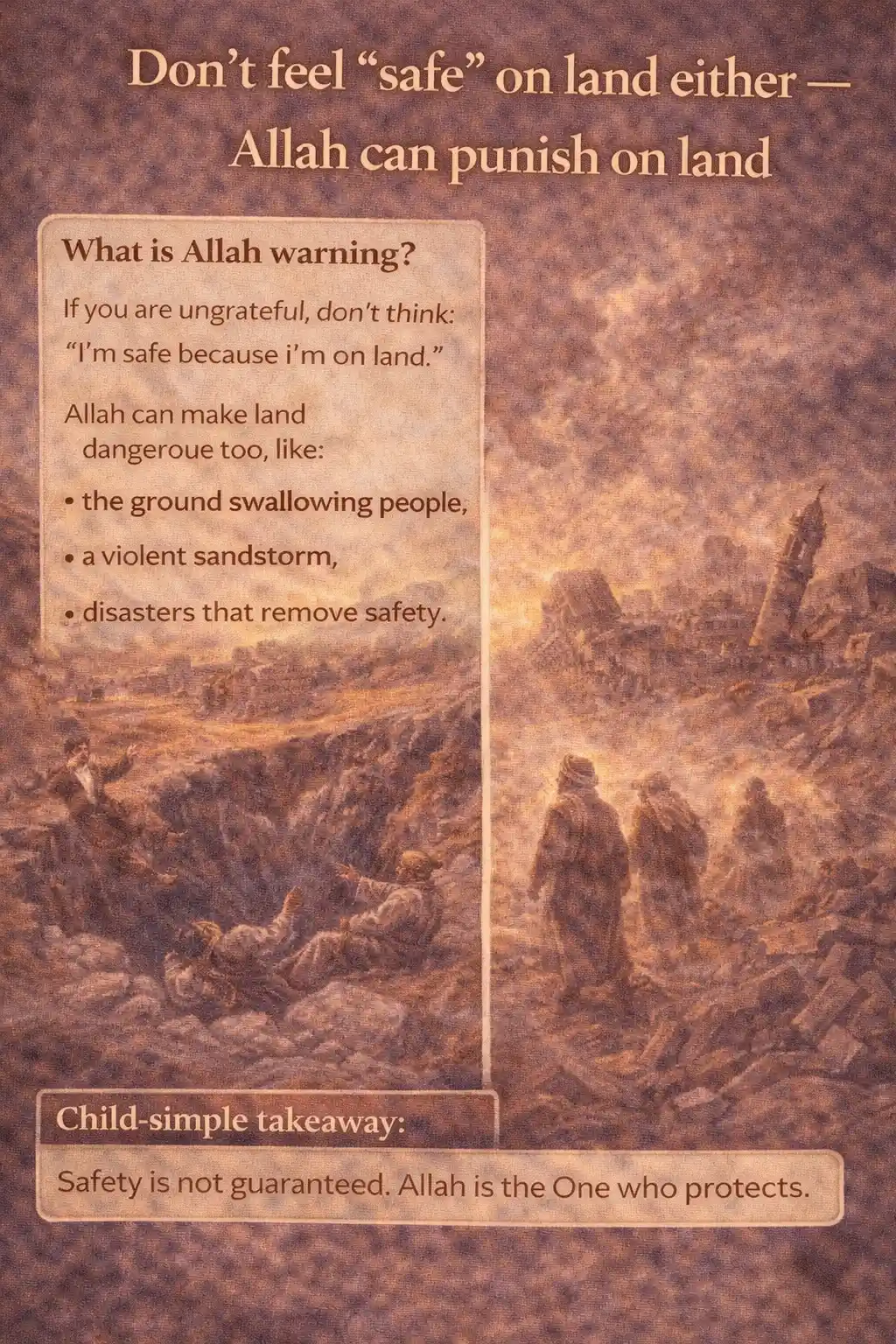
If you are ungrateful, don’t think: “I’m safe because I’m on land.”
Child-simple takeaway: Safety is not guaranteed. Allah is the One who protects. Allah can put you back into danger again:
And you won’t find someone to “take revenge for you” or save you from Allah’s decision.
Child-simple takeaway: If Allah decides something, no one can overpower Him. This is a big, beautiful ending.
Allah says: “I honored the children of Adam.”
Because Allah is saying:
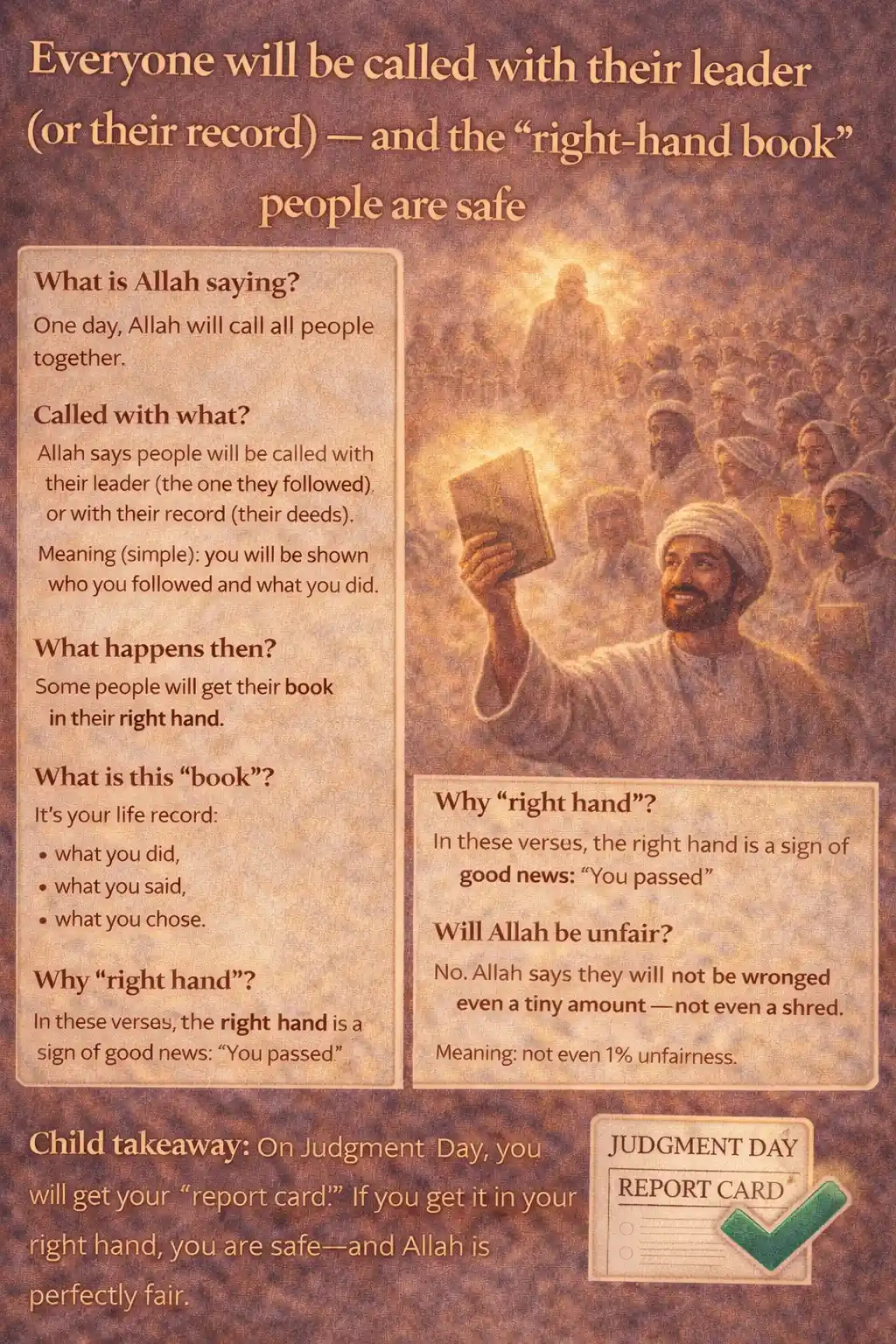
Child-simple takeaway: Allah gave humans special honor—so live in a way that fits that honor. 71. The day (when) We shall summon all mankind with their leaders (or their record of deeds). Then whoever is given his book in his right hand, such will read their book and they will not be wronged a shred. 72. And whoever is blind (to see the truth) in this (life), he will be blind in the Hereafter, and even farther astray from the path. 73. And they were about to tempt you away from that which We have revealed (the Quran) to you (O Muhammad), that you should invent other than it against Us, and then they would surely have taken you a friend. 74. And if We had not strengthened you, you might have inclined to them a little. 75. Then, We should have made you taste a double (punishment) in this life and a double (punishment) after death, then you would have found none to help you against Us. 76. And they were about to scare you off the land that they might drive you out from there. And then they would not have stayed (there) after you but a little. 77. (Such was Our) way for those whom We had sent before you (O Muhammad) among the messengers. And you will not find any change in Our way. 78. Establish prayer from the decline of the sun to the darkness of the night, and (recite) the Quran at dawn. Indeed, (reciting) the Quran at dawn is ever witnessed. 79. And at night, wake up and pray with (Quran) it, an additional prayer for you. It may be that your Lord will raise you to an honored position. 80. And say: “My Lord, cause to enter me with a true entrance, and to exit me with a true exit. And grant me supporting authority from Your presence.” One day, Allah will call all people together.
Allah says people will be called with their leader (the one they followed), or with their
record (their deeds).
Some people will get their book in their right hand. In these verses, the right hand is a sign of good news: “You passed.”
No. Allah says they will not be wronged even a tiny amount—not even a shred.
Child takeaway: On Judgment Day, you will get your “report card.” If you get it in your right hand, you are safe—and Allah is perfectly fair.
It does not mean eyes that can’t see.
If someone chooses to be blind to guidance in this life, then in the Hereafter they will be:
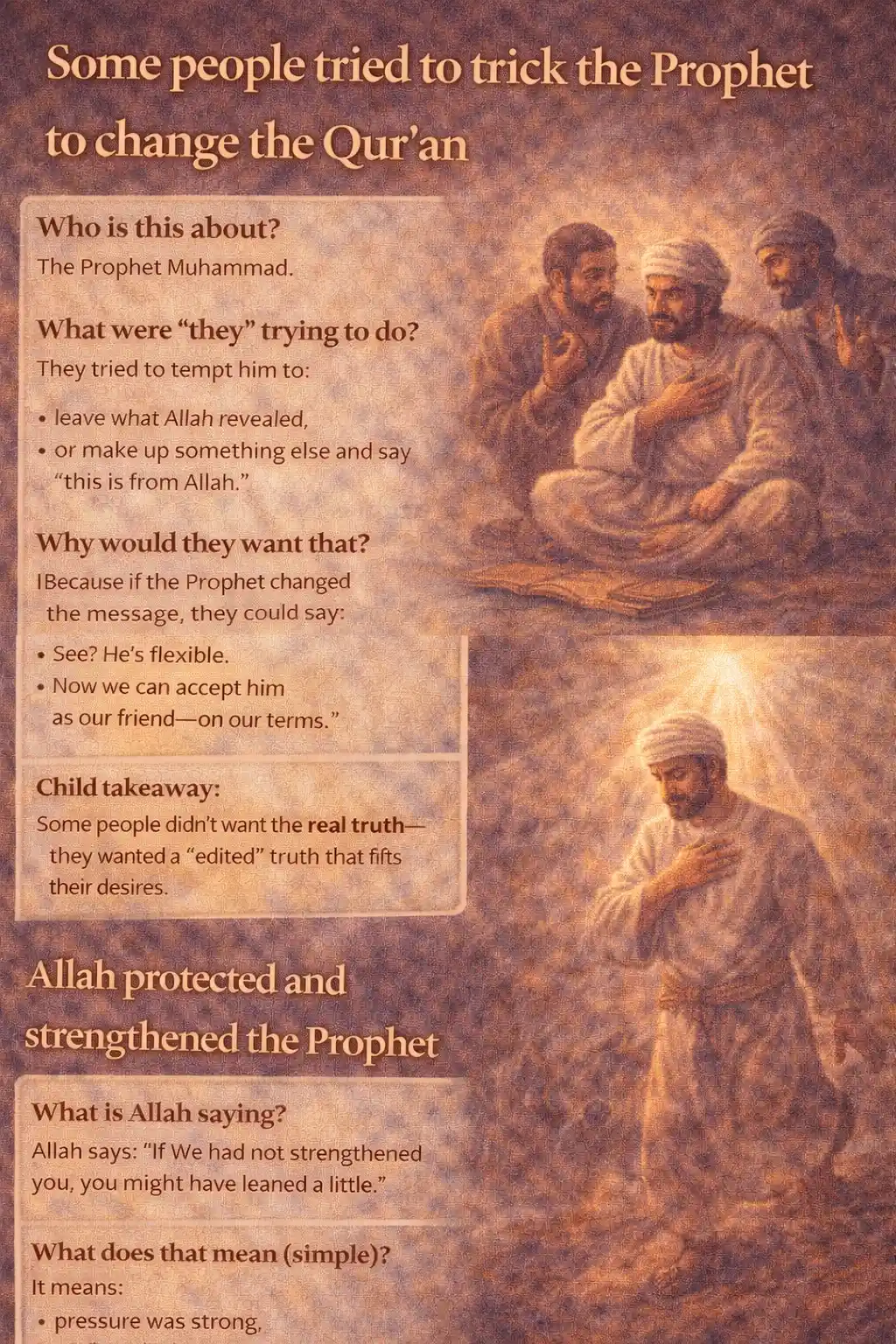
Because they trained themselves to reject truth. Child takeaway: If you keep closing your heart to truth now, you will be more lost later. The Prophet Muhammad. They tried to tempt him to:
Because if the Prophet changed the message, they could say:
Child takeaway: Some people didn’t want the real truth—they wanted an “edited” truth that fits their desires. Allah says: “If We had not strengthened you, you might have leaned a little.” Child takeaway: Even the best people need Allah’s help to stay strong. This shows how serious it is to:
It means: extremely severe consequences:
To show:
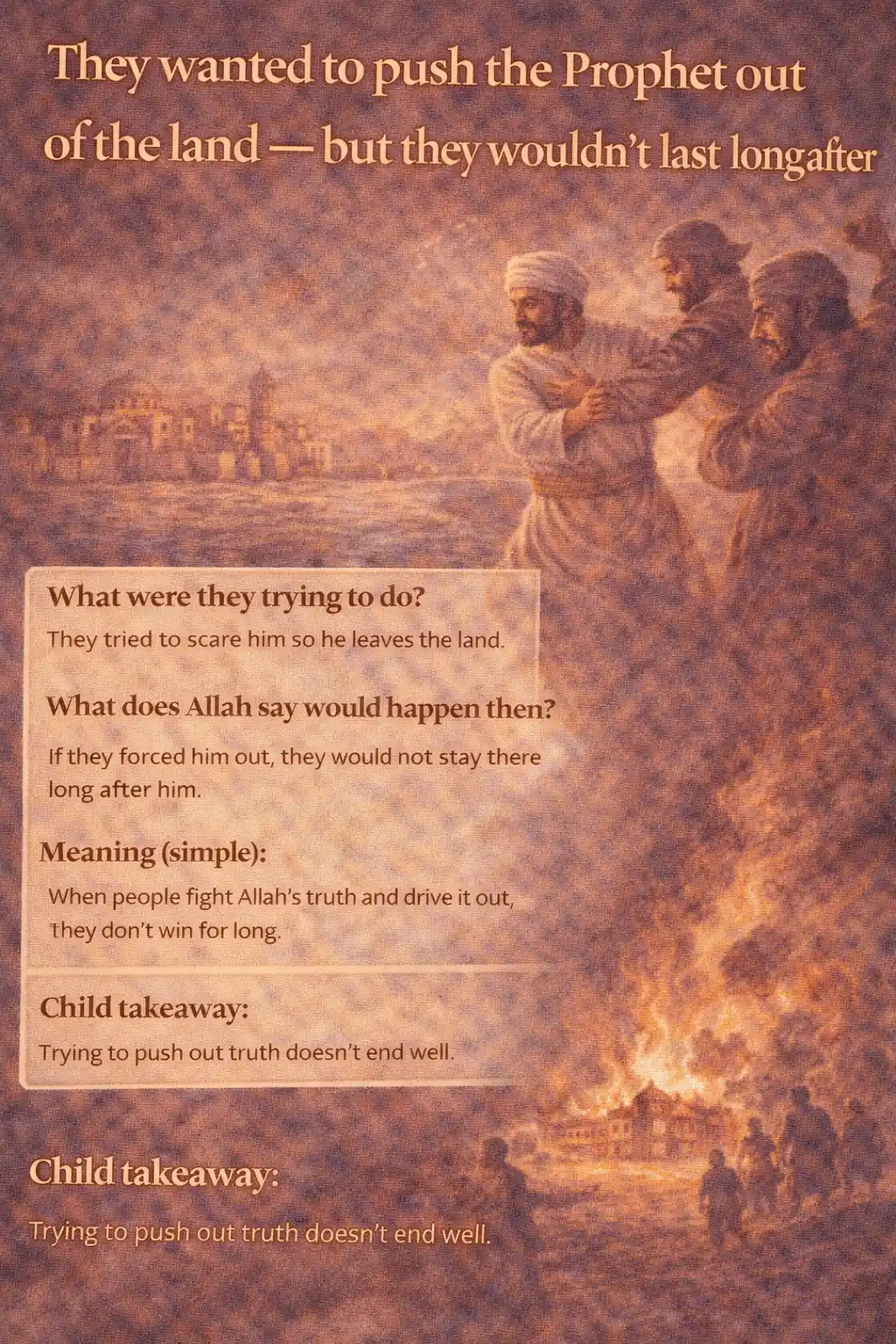
Child takeaway: Never say “Allah said” if Allah did not say it. It is extremely serious. They tried to scare him so he leaves the land.
If they forced him out, they would not stay there long after him.
Child takeaway: Trying to push out truth doesn’t end well. This is Allah’s consistent pattern with all messengers: Child takeaway: Allah’s rules of justice don’t change. Pray from: And also:
Allah says it is “witnessed.”
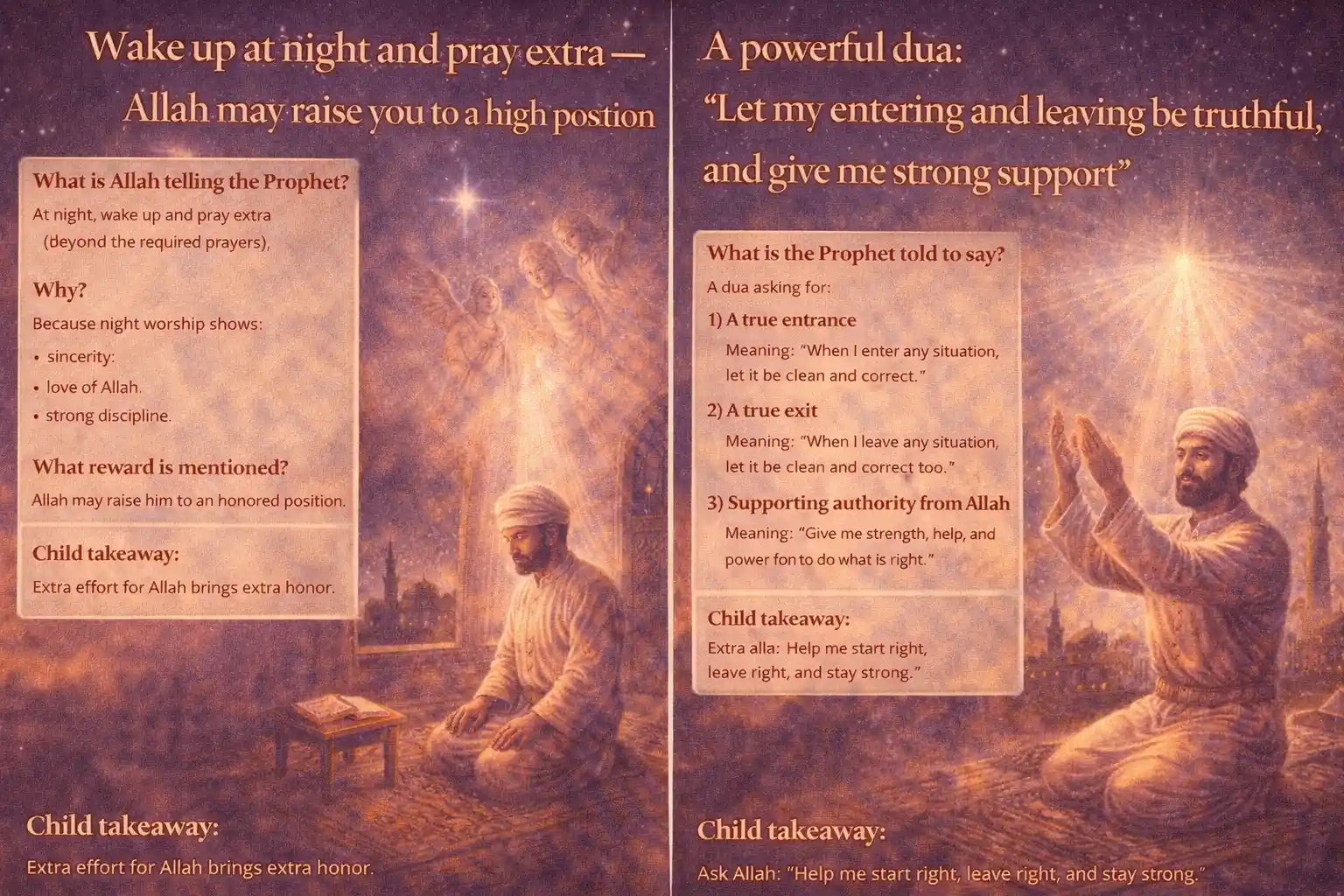
Child takeaway: Pray on time. And Fajr Qur’an is extra special. At night, wake up and pray extra (beyond the required prayers). Because night worship shows: Allah may raise him to an honored position. Child takeaway: Extra effort for Allah brings extra honor. A dua asking for: Child takeaway: Ask Allah: “Help me start right, leave right, and stay strong.”
On Judgment Day everyone will get their life record, and Allah is perfectly fair.
If you ignore truth in this life, you will be more lost later.
People tried to pressure the Prophet to change the Qur’an, but Allah strengthened him and warned how serious it is to invent lies about Allah.
Allah’s way never changes: truth is supported.
Then Allah commands prayer in its times, highlights the special dawn recitation, encourages night prayer,
and teaches a dua for truthful beginnings, truthful endings, and strong help from Allah.
81. And say: “Truth has come and falsehood has vanished away. Indeed, falsehood is ever bound to vanish.” 82. And We send down of the Quran that which is a healing and a mercy for those who believe. And it does not increase but loss to the wrong doers. 83. And when We bestow favor upon man, he turns away and drifts off to one side. And when evil touches him, he is in despair. 84. Say: “Each one does according to his rule of conduct. And your Lord knows best him who is best guided on the way.” 85. And they ask you about the soul. Say: “The soul is by the command of my Lord. And you have not been given of the knowledge except a little.” 86. And if We willed, We could surely take away that which We have revealed to you, then you would not find for you in that respect a defender against Us. 87. Except as a mercy from your Lord. Indeed, His kindness upon you is ever great. 88. Say: “Surely, if men and jinn were to get together to produce the like of this Quran, they will not (be able to) produce the like of it, even if some of them were helpers to others.” 89. And indeed, We have fully explained for mankind in this Quran every kind of similitude, but most mankind refuse (anything) except disbelief. 90. And they say: “We shall never believe you until you cause to gush forth for us from the earth a spring.”
Truth (what is real and right) has arrived.
Falsehood (lies) runs away.
Because lies don’t have real strength.
They can look strong for a while, but they always collapse.
Child idea: Truth is like light. Lies are like darkness. When light comes, darkness disappears.
The Qur’an heals and gives mercy—especially for people who believe and want guidance.
Mainly healing for the inside (the heart and mind), like:
Because some people hear truth and hate it, so they become:
Child idea: The same medicine helps the person who wants to get better—but someone who refuses it gets worse.
Some humans act like this:
Because a believer tries to stay:
Child idea: Don’t remember Allah only when you’re scared. Remember Him always.
People behave based on what they are used to—their habits, attitude, and choices.
Allah knows who is sincerely on the right path, even if people pretend.
Child idea: Two kids can hear the same lesson: one tries to improve, one refuses. Allah knows who is really trying.
They ask: “What is the soul exactly?”
The soul belongs to Allah’s command—its full reality is not in human hands.
Because humans have limited knowledge.
Not everything is meant to be fully uncovered.
Child idea: You can know many things, but not everything. Some things only Allah fully knows.
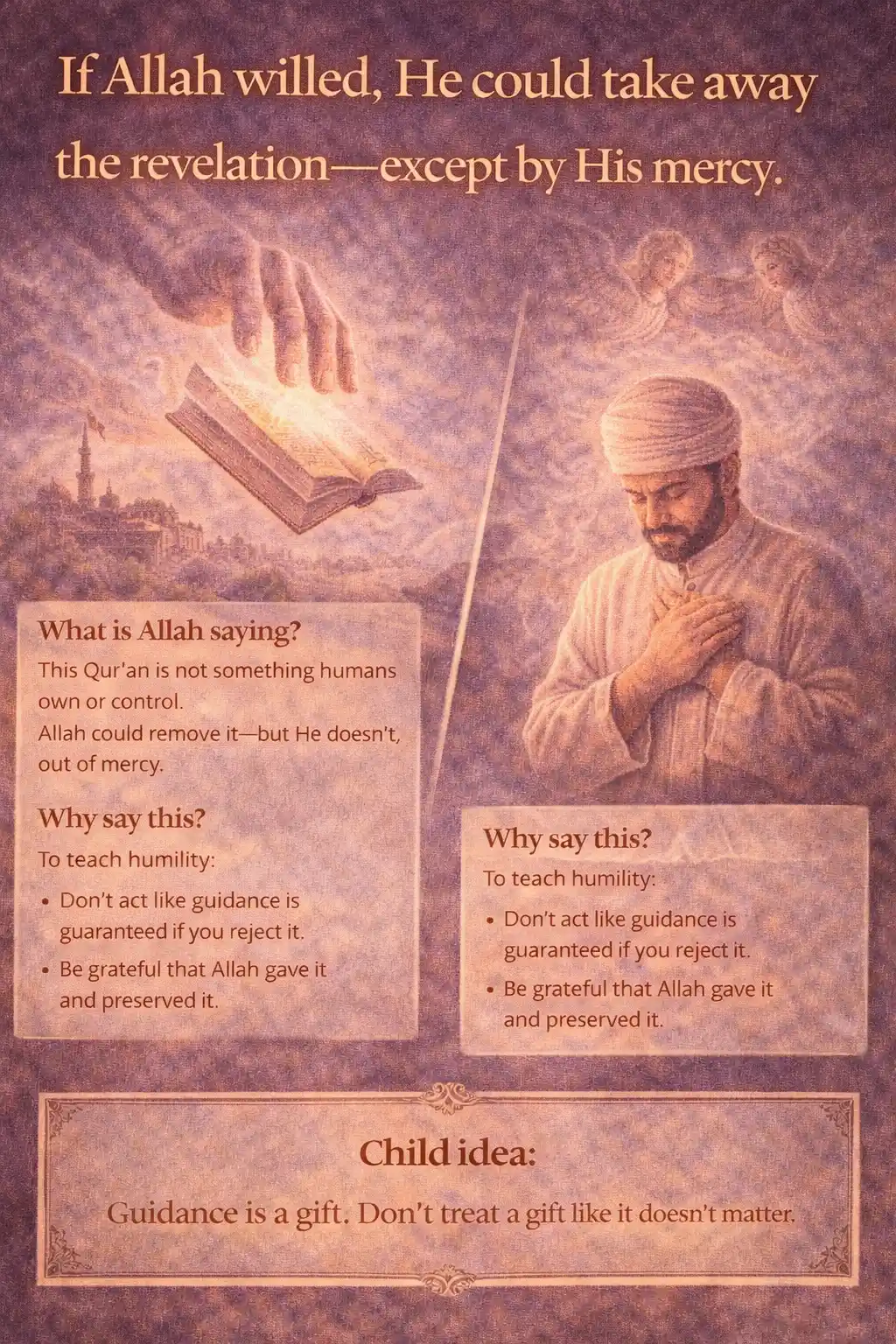
This Qur’an is not something humans own or control.
Allah could remove it—but He doesn’t, out of mercy.
To teach humility:
Child idea: Guidance is a gift. Don’t treat a gift like it doesn’t matter.
Even if everyone teamed up, they still could not match the Qur’an.
To show its unique nature and challenge the claim that it’s “made up.”
Child idea: It’s like a challenge: “Try to make something equal to it.” But they can’t.
Allah explains in many ways—different stories, examples, reminders—so people can understand.
Because the problem is not always “lack of explanation.”
Sometimes it’s stubbornness and pride.
Child idea: Even if the teacher explains perfectly, a stubborn student can still refuse.
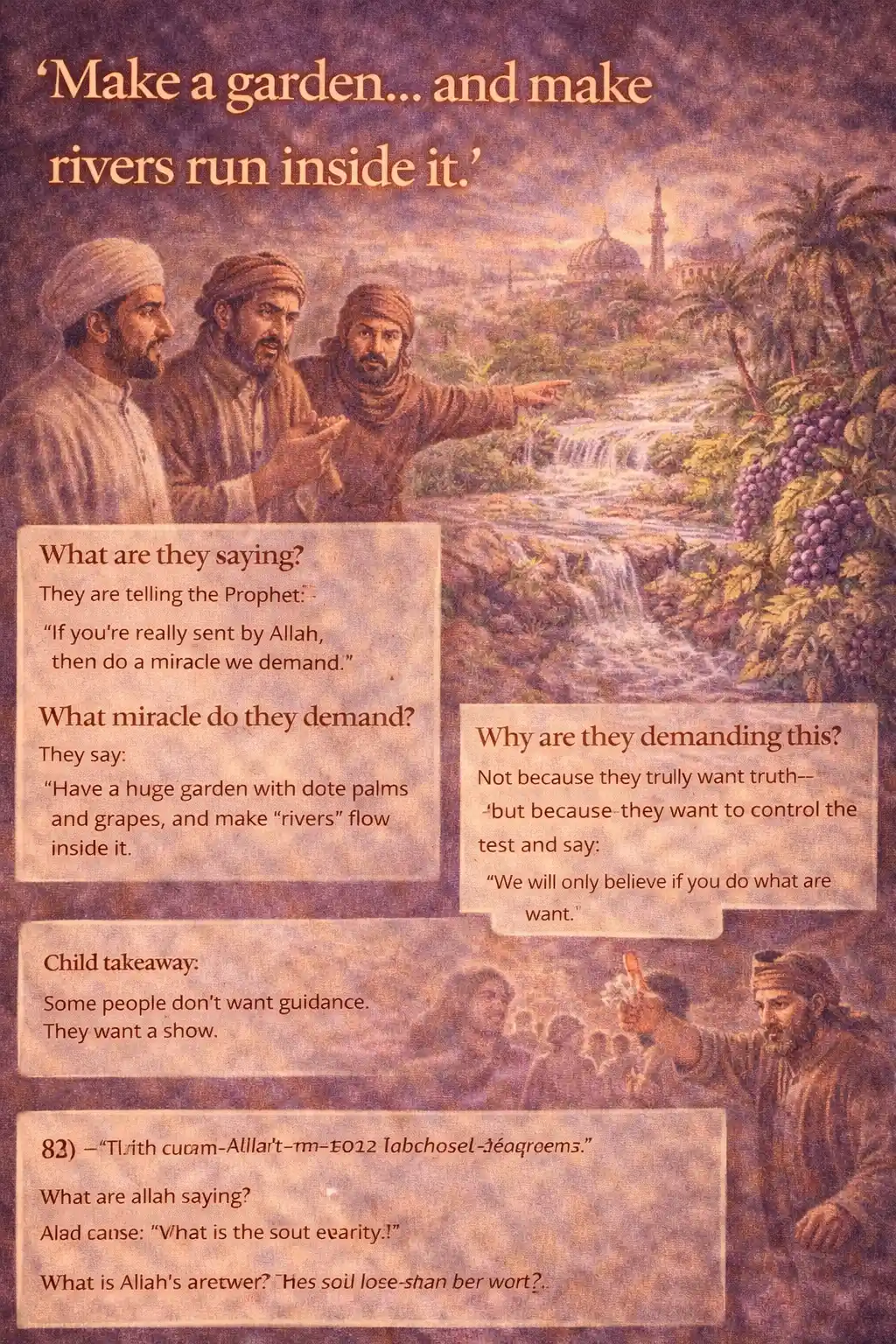
They set a demand: “Do a miracle we choose, then we’ll believe.”
It’s not honest searching for truth. It’s testing and controlling:
Child idea: A stubborn kid says: “I won’t listen unless you do what I demand.” That’s not real learning.
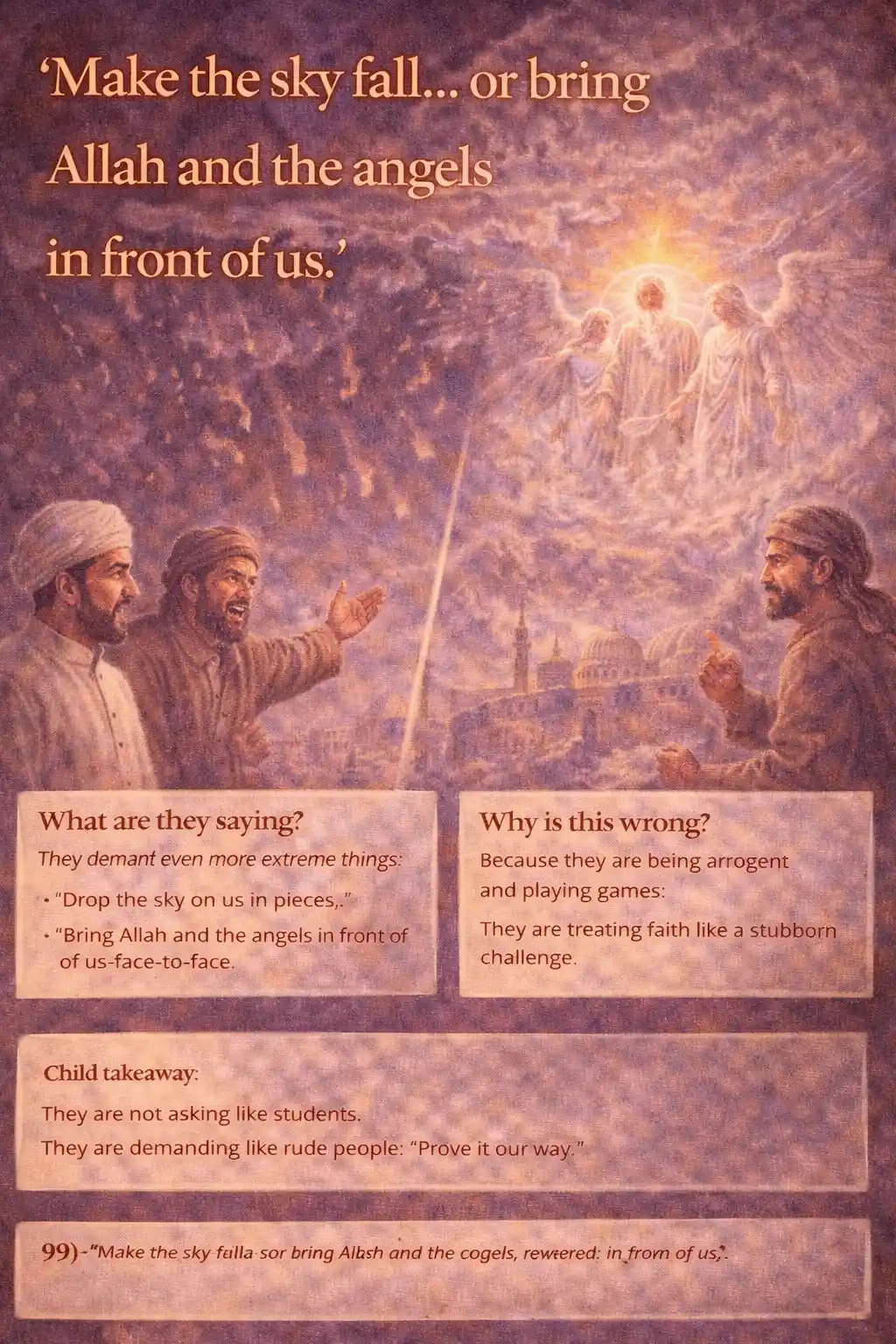
91. “Or you have a garden of date-palms and grapes, and cause rivers to gush forth, in their midst, abundantly.” 92. “Or you cause the heaven to fall upon us in pieces, as you have claimed, or you bring Allah and the angels before (us) face to face.” 93. “Or you have a house of gold, or you ascend up into heaven, and (even then) we will never believe in your ascension until you bring down to us a book that we can read.” Say (O Muhammad): “Glory be to my Lord. Am I (anything) but a man, (sent as) a Messenger.” 94. And nothing prevented mankind from believing when the guidance came to them except that they said: “Has Allah sent a human being as messenger.” 95. Say: “If there were in the earth angels walking in peace, We would surely have sent down to them an angel from the heavens as messenger.” 96. Say: “Sufficient is Allah as a witness between me and you. Indeed, He is the Knower, the Seer of His servants.” 97. And he whom Allah guides, so he is rightly guided. And he whom He sends astray, you will never find for them protectors besides Him. And We shall assemble them on the Day of Resurrection on their faces, blind, and dumb, and deaf. Their habitation will be Hell. Whenever it abates, We shall increase the flame for them. 98. That is their recompense because they disbelieved in Our verses and said: “When we are bones and fragments, shall we be raised up as a new creation.” 99. Have they not seen that Allah, who created the heavens and the earth is Able to create the like of them. And He has decreed for them an appointed term, whereof there is no doubt. But the wrong doers refuse (anything) except disbelief. 100. Say: “If you owned the treasures of the mercy of my Lord, behold, you would surely hold them back for fear of spending.” And man is ever grudging. They demanded: “Have a huge garden of date-palms and grapes, and make rivers flow inside it.” They demanded: “Drop the sky on us in pieces… bring Allah and the angels face-to-face.” They demanded: “Get a house of gold… ascend to heaven… bring down a book we can read.” They said: “Has Allah sent a human being as messenger?” If angels walked on earth, an angel messenger would be sent. “Sufficient is Allah as a witness between me and you.” Allah guides whom He wills; those left to rejection will find no protectors besides Him. They said: “When we are bones and fragments, shall we be raised again?” Allah who created the heavens and earth is able to create you again. If you owned Allah’s mercy treasures, you would hold them back out of fear of spending. 101. And indeed, We gave to Moses nine clear signs. Ask then the Children of Israel, when he came to them, then Pharaoh said to him: “Indeed, I consider you, O Moses, one bewitched.” 102. He (Moses) said: “Certainly, you know that no one has sent down these (signs) except the Lord of the heavens and the earth as evidence. And indeed I think of you, O Pharaoh, as doomed.” 103. So he intended to scare them away from the land, then We drowned him and those with him, all together. 104. And We said, after him, to the Children of Israel: “Dwell in the land, then when the promise of the Hereafter comes to pass, We shall bring you forth as one gathering.” 105. And with truth have We sent it (Quran) down, and with truth has it descended. And We have not sent you but a bearer of good tidings and a warner. 106. And (it is) a Quran that We have divided (into parts), that you may recite it to mankind at intervals. And We have sent it down as a successive revelation. 107. Say: “Believe in it, or do not believe.” Indeed, those who were given knowledge before it, when it is recited to them, they fall down upon their faces in prostration. 108. And they say: “Glory be to our Lord. Surely, the promise of our Lord must be fulfilled.” 109. And they fall down upon their faces, weeping, and it increases humility in them. AsSajda Paraphrase of meaning: Allah gave Musa nine clear signs, but Pharaoh still accused him of being “bewitched.” Paraphrase of meaning: Musa tells Pharaoh these signs are from the Lord of the heavens and earth, and warns him of destruction if he keeps rejecting. Paraphrase of meaning: Pharaoh tried to drive Musa and the believers out, so Allah drowned Pharaoh and his army. Paraphrase of meaning: Allah tells the Children of Israel to live in the land, and reminds that on the Day of the Hereafter everyone will be gathered. Paraphrase of meaning: The Qur’an was revealed in truth, and the Messenger’s role is to give glad tidings and warnings. Paraphrase of meaning: The Qur’an was revealed gradually so people could understand it and so it could be recited steadily. Paraphrase of meaning: Those who were given knowledge recognize the Qur’an’s truth and fall down in sujood. Paraphrase of meaning: In their prostration, they glorify Allah and affirm that Allah’s promise will surely happen. Paraphrase of meaning: They fall down weeping, and the Qur’an increases them in humility.Surah Al-Isra Explanation (17:12–20) — Child-Simple
Allah is saying: “I made night and day.” And they are signs—meaning they show Allah’s power and perfect planning.
Allah made the night dark (the “night sign is obscured”). So night becomes a time for:
Allah made the day bright (radiant). So day becomes a time for:
Night helps you rest. Day helps you work. And together they help you track time—Allah planned it perfectly.
Allah says each person’s fate/record is “fastened to their neck.”
Allah will bring out a book for every person—opened and clear.
Your choices stick to you, and later you will see them written clearly.

It will be said: “Read your book.”
Because you cannot honestly say:
On that day, your own record will be proof for you or against you.
Your choices affect you. You answer for yourself. And Allah is fair—He sends guidance before punishment.
Allah explains a pattern: when a society is heading toward ruin, often the rich/powerful become a main cause of public corruption.
Allah does not love sin. But when people insist on rejecting truth, Allah may let them go deeper into their chosen path—until the punishment becomes deserved.
When leaders become openly corrupt and people follow, society can collapse and punishment can come.
Allah has punished nations before, and nothing is hidden from Him.
This life is fast and temporary:
If they live only for dunya and reject the truth, the end is Hell:
If a person lives only for dunya and rejects the Hereafter, dunya won’t save them from judgment.

A person who:
If you truly aim for the Hereafter and try your best with belief, Allah will not waste your effort.
Allah provides for everyone in this world, but real success is the Hereafter. Dunya gifts are not automatic proof of Allah’s approval.
What is Allah saying?
More of what?
Why does Allah do that?
What about the Hereafter?
What is Allah saying?
What does “another god” mean (child simple)?
Why is it so serious?
What happens if someone does it?

What is Allah commanding?
When is kindness most important?
What does Allah forbid you to do?
What should you do instead?

What does “lower the wing” mean (child simple)?
Why should you do this?
What dua should you say?

What is Allah saying?
Why is that important?
What if you are trying to be good?
Who should you give to?
What does “his right” mean?
What else does Allah say?

What does that mean?
Why is wasting “ungrateful”?

What is Allah teaching?
What should you do then?
Why?

What does “hand fastened to your neck” mean?
What does “outspread altogether” mean?
What happens if you do either extreme?
What is provision?
What is Allah saying?
Does “more money” mean “Allah loves them more”?
Why does Allah say “All-Knower, All-Seer”?
What is Allah saying?
Why would people do that?
What does Allah answer?
Why is it called a “great sin”?
What is Allah saying?
Why does it say “don’t come near” instead of only “don’t do it”?
Why is it called “an abomination and an evil way”?
What is Allah saying?
What if someone is murdered wrongfully?
But what is the warning?
What does “he will be helped” mean?

Part A: Orphan’s wealth — What is Allah saying?
What does “best way” mean?
Until when?
Part B: Keep your covenants — What is a covenant?
Why is it serious?
What is Allah saying?
What does cheating look like?
Why is this “better in consequence”?

What is Allah saying?
What does that include?
Why?
What is arrogance here?
Why does Allah give two examples?
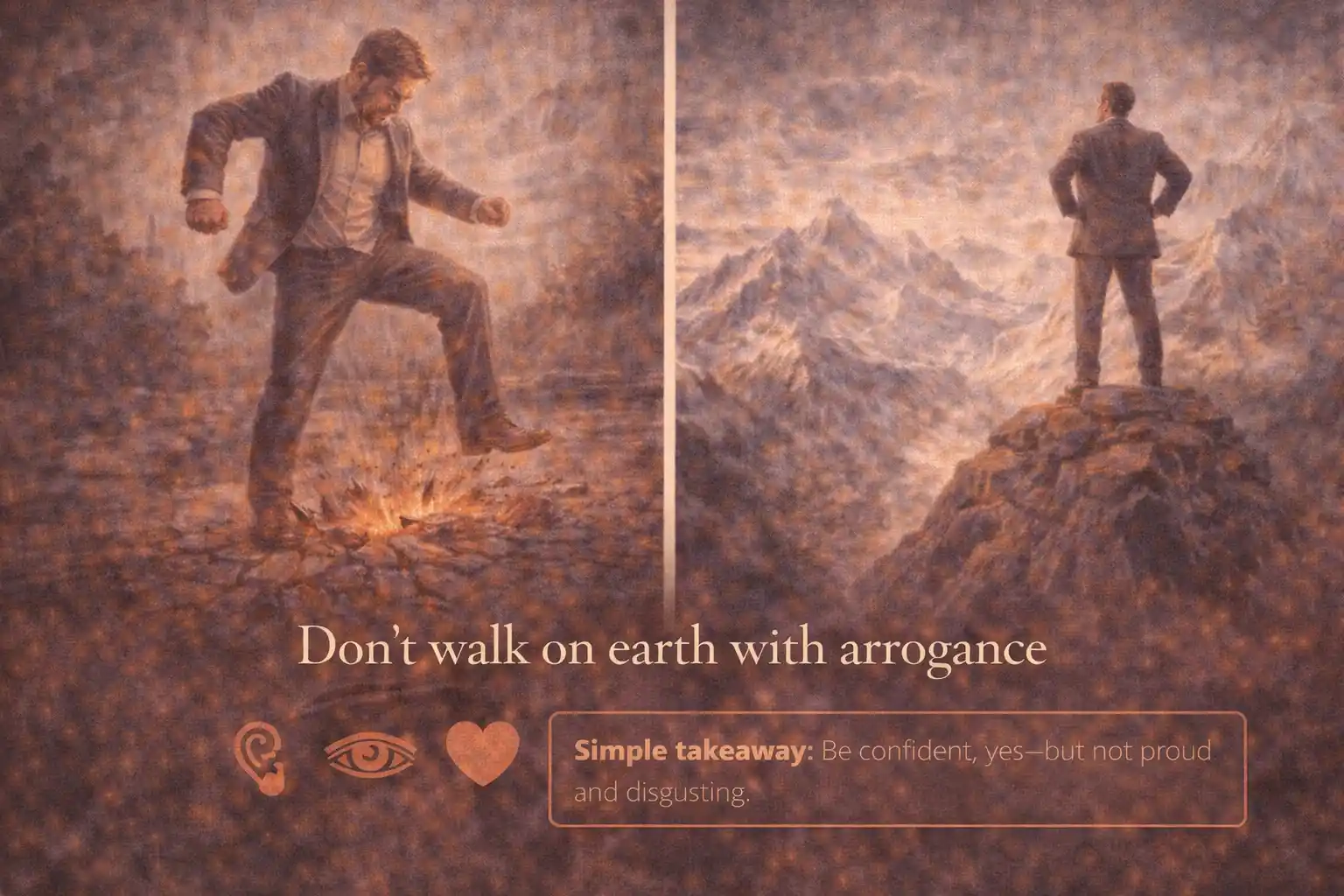
What is Allah saying?
What is Allah saying?
What is the biggest rule repeated again?
Why repeat it again?
What happens if someone insists on shirk?

What is Allah correcting?
Why is this a “dreadful saying”?
17:41–50 — Simple Explanation
Allah says: “I explained things a lot in the Qur’an, so people can learn and wake up.”
So people can understand, remember, and change for the better.
Some people don’t want to listen. Instead of becoming better, they become more annoyed and run away from it.
Even when the teacher explains perfectly, some students still refuse because they don’t want the truth.

Allah tells the Prophet: “Say: If there were other gods with Allah (like people claim), then those gods would try to reach the King of the Throne.”
If there were many gods, they would want control and authority. They would compete, argue, or fight over who is the real boss.
To show the idea is not logical: real power cannot be divided between “many gods” without conflict.
If there were many bosses of the universe, the universe would become chaos. The universe is stable, so the Boss is One.
Allah is perfect and above what people wrongly say about Him.
Because people invent false stories about Allah. Allah says: “That is not true. I am higher and greater than that.”
Don’t speak about Allah with made-up ideas. Allah is greater than human guessing.
The heavens, the earth, and everything inside them glorify Allah.
It means they show Allah is perfect, and they “praise” Him in their own way.
Allah says: they praise Allah in a way you do not understand. Not everything praises with human words.
To show: Allah’s greatness is so real that all creation is in submission to Him.
Because even when people deny Him, Allah still gives time and chances to repent.
Everything is “obeying Allah” in its own way, even if you can’t hear it.

When the Prophet recites Qur’an, Allah places a hidden barrier between him and people who reject the Hereafter.
Not a wall you can see—more like a barrier in understanding and acceptance. They hear words, but it doesn’t enter their heart.
Because they are refusing truth on purpose, so they end up blocked from benefiting.
If someone keeps saying “I refuse,” their heart becomes like a locked door.

Some people become so stubborn that their hearts get “covered” (they don’t understand),
their ears become “deaf” (they don’t truly listen), and when Allah is mentioned alone, they turn away.
Because they don’t want pure worship. They prefer their own ideas, idols, or traditions.
This is not about “they can’t hear sound.” It means: they refuse to accept.

Allah knows what they listen to, when they listen, and what they whisper secretly.
They say: “You are following a man who is bewitched (magic).”
Because they don’t want to admit the Qur’an is true, so they try to “explain it away” with insults.
When people can’t beat the truth, they sometimes attack the person instead.
They make fake labels and strange comparisons about the Prophet.
They go astray, and then they can’t find the right path.
If you keep lying about what’s true, you will confuse yourself and get lost.
“When we become bones and broken pieces, will we really be created again?”
They think resurrection is impossible because they only look at what they see now.
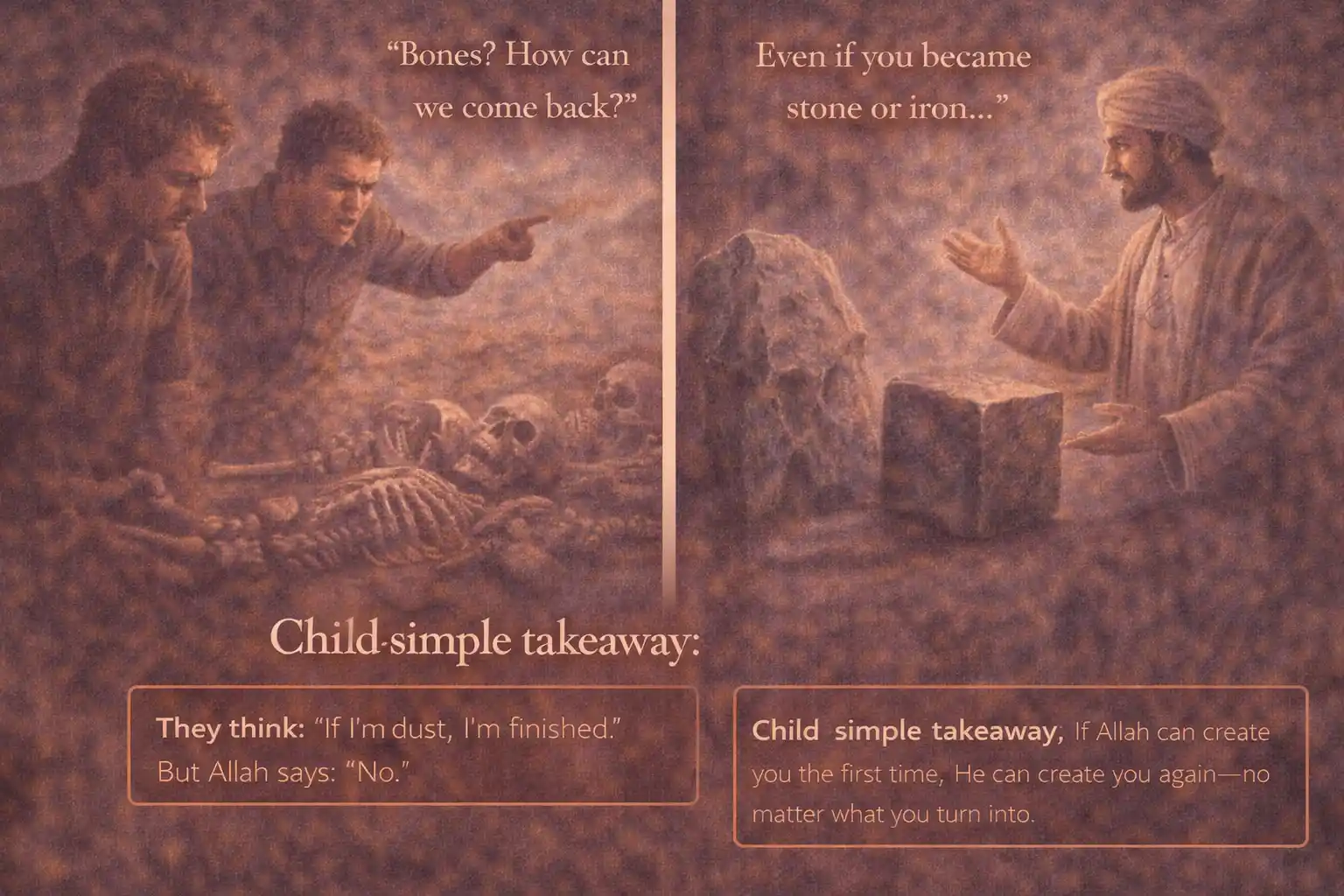
They think: “If I’m dust, I’m finished.” But Allah says: “No.”
“Even if you were stones or iron…”
Even if you became something hard and “impossible” in your mind—Allah can still bring you back.
Because Allah is the Creator. Creating again is not hard for Him.
If Allah can create you the first time, He can create you again—no matter what you turn into.
51) “Even if you became something ‘bigger’… who will bring us back?”
Some people argue like this:
“Okay, maybe Allah can bring back bones… but what if we became stone, iron, or something even harder and bigger—then what?”
Because they are trying to make resurrection sound “impossible.”
They are basically saying: “We don’t believe Allah can bring us back.”
Allah tells the Prophet to say:
“The One who created you the first time will bring you back again.”
If someone built a toy robot from nothing, making it again is easier than making it the first time.
They “shake their heads” (like mocking), and ask: “When will it happen?”
“Maybe it is near.” Meaning:
52) The day Allah calls you, you will answer, and life will feel very short
On the Day of Resurrection.
Allah will call people back to life. And they will respond (they will have no choice).
People will realize Allah is the True King, and they will respond in a way that shows Allah is right and perfect.
They will think: “We were in the world only a little while.”
Like when you play a game for hours, then suddenly it’s night, and you say: “Wait… it felt so fast.”
That’s how short dunya will feel compared to the next life.
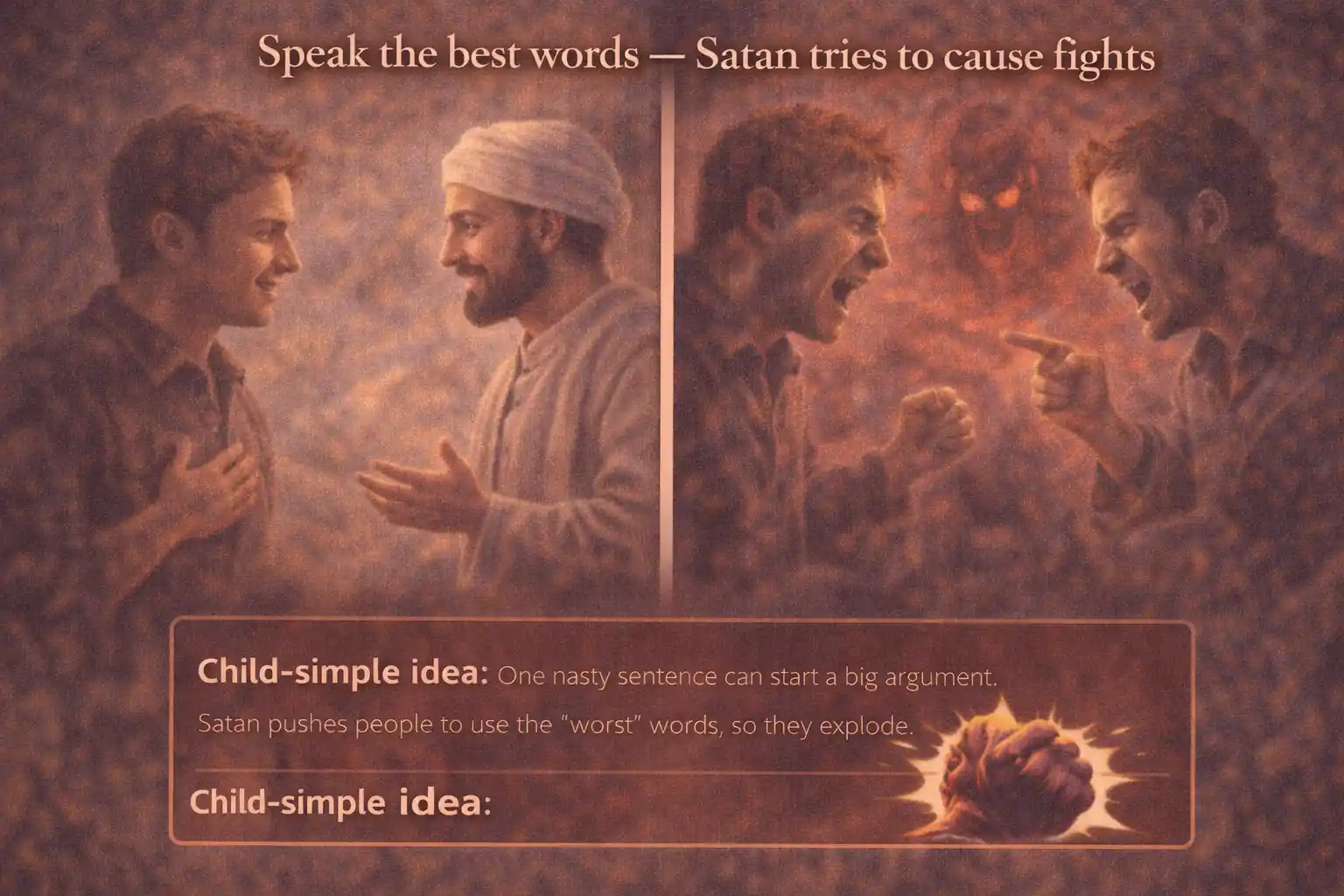
53) Speak the best words — Satan tries to cause fights
Allah tells His servants: speak in the best way.
Because Satan loves to do this:
take a small rude word, turn it into a big fight, and break families and friendships.
One nasty sentence can start a big argument. Satan pushes people to use the “worst” words so they explode.
54) Allah knows you best — and the Prophet is not your “controller”
Allah knows people best. Allah decides who gets mercy and who gets punishment.
Because guidance is not forced. Allah is reminding:
A teacher can explain the lesson, but the teacher cannot force your brain to accept it.
You still choose whether to listen.
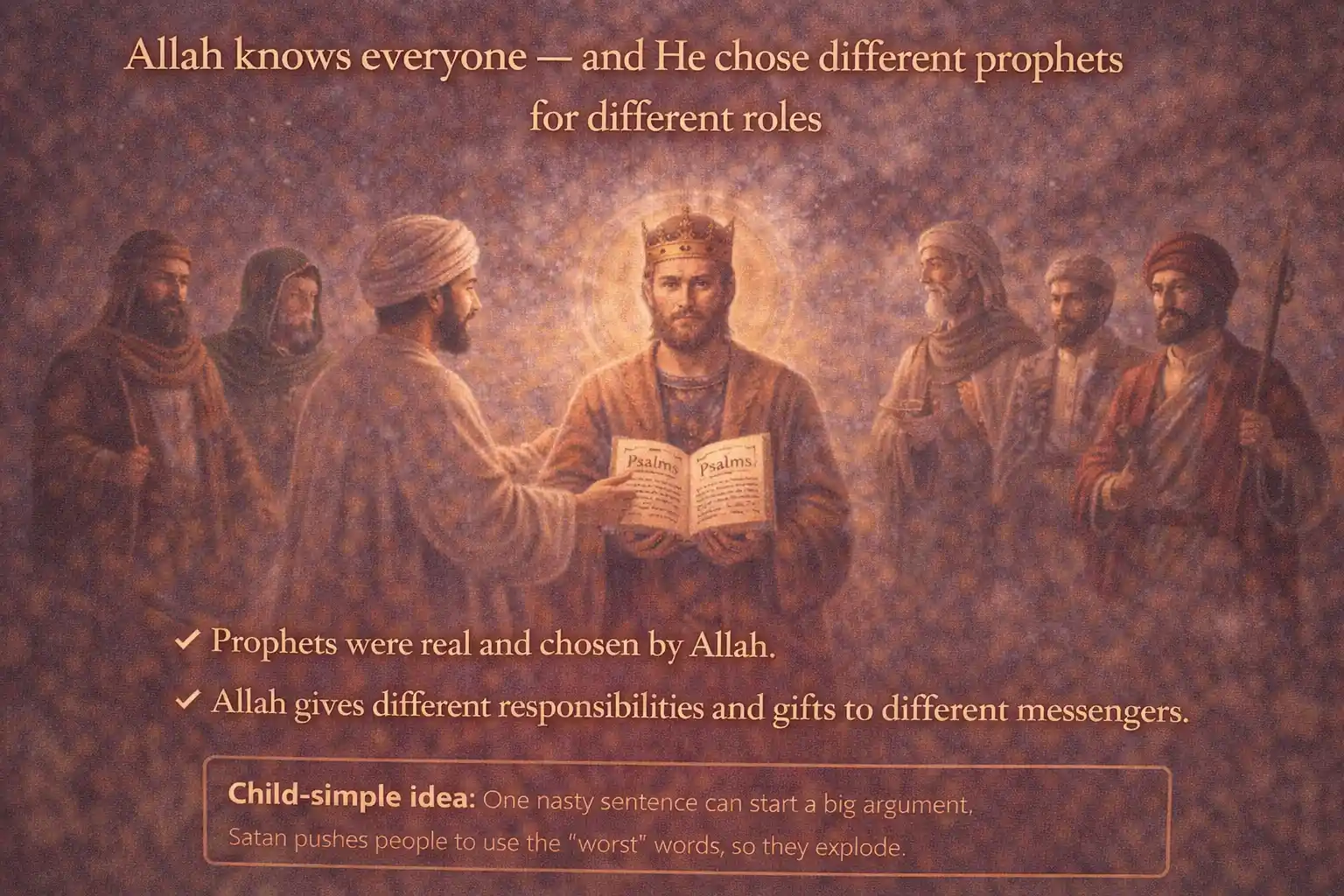
55) Allah knows everyone — and He chose different prophets for different roles
Allah knows all creation in the heavens and earth.
Allah says He gave some prophets special gifts/positions above others.
David (Dawud) was given the Psalms (Zabur).
To show:
56) Call your “other gods” — they can’t remove your trouble
Tell people: “Call the ones you worship besides Allah.”
Allah says those “gods”:
It’s like calling a toy to save you from a fire. The toy cannot help.
Only the real rescuer can help.

57) Even the ones they call are themselves trying to get close to Allah
Some people call on “holy figures” or “saints” or “angels” thinking they control things.
Imagine you ask another student for permission like he is the teacher.
But that student also has to ask the teacher.
So why not go straight to the teacher?

58) Every town will face destruction or punishment before the Final Day
No place is “untouchable.” Before the Day of Resurrection:
To warn people:
Allah already knows what will happen and has a decree for it.

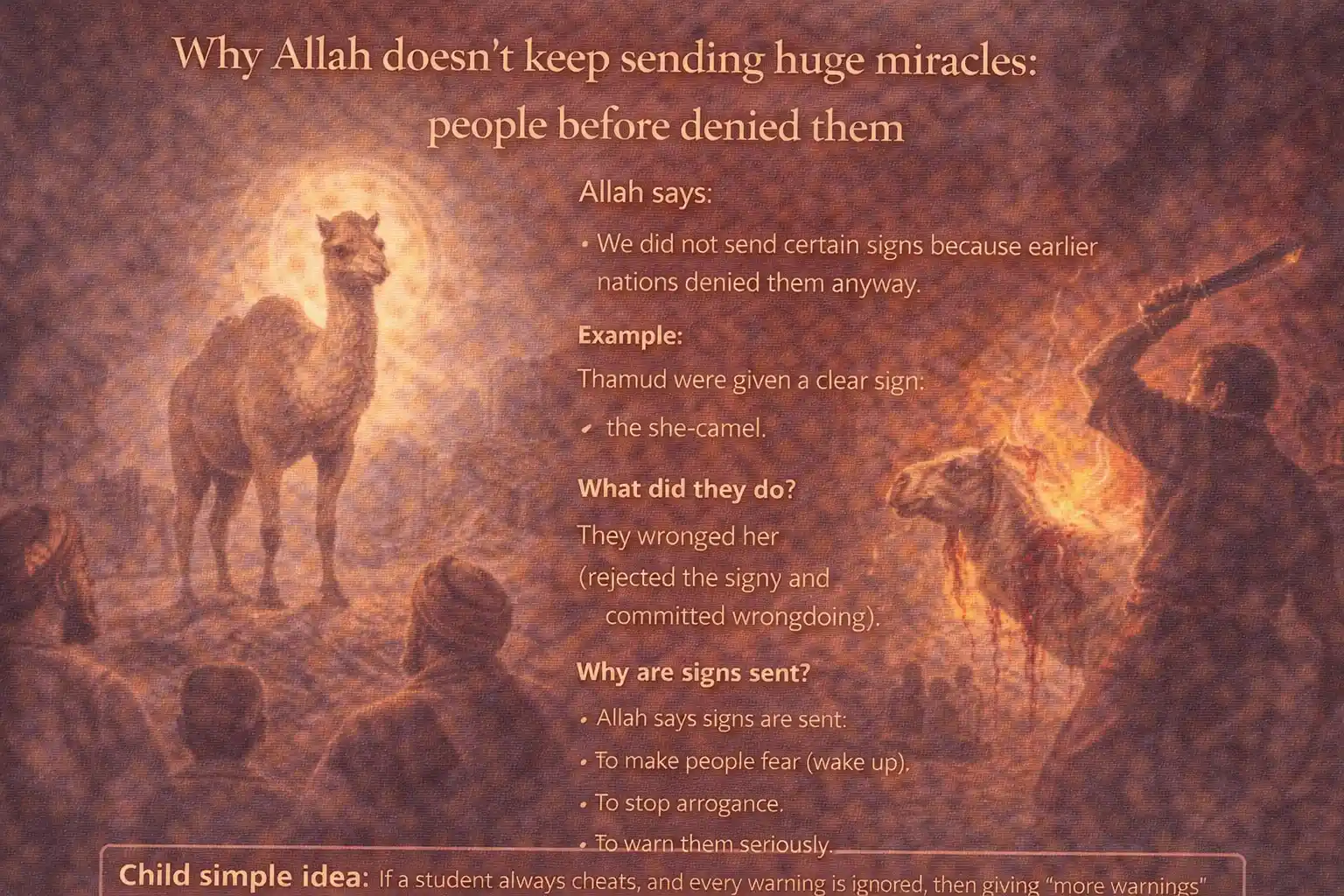
59) Why Allah doesn’t keep sending huge miracles: people before denied them
Allah says: We did not send certain signs because earlier nations denied them anyway.
Thamud were given a clear sign: the she-camel.
They wronged her (rejected the sign and committed wrongdoing).
Allah says signs are sent:
If a student always cheats, and every warning is ignored, then giving “more warnings” doesn’t help unless the student changes.
60) The vision shown to the Prophet was a test, and warnings can increase rebellion
Allah has full control and knowledge over people. Nobody escapes Allah.
Allah showed the Prophet something true, and it became a test:
A warning sign mentioned in the Qur’an. The point here is:
some people react to warnings by mocking instead of learning.
Allah warns so people can wake up.
Allah says: warnings increase them only in more transgression.
Like when a parent says “Stop that or you’ll get hurt,” a stubborn kid might say,
“I don’t care!” and does it even more.
One child-simple summary (51–60)
17:61–70 — Iblis, Human Tests, and Allah’s Mercy
61) Angels were told to bow to Adam — Iblis refused
Who is in the verse?
What did Allah command?
This bowing was not worship. It was a sign of respect and obedience to Allah’s command.
What happened?
Why did Iblis refuse?
“Why should I bow to someone made from clay?”
He looked down on Adam and thought he was better.

62) Iblis asks for time to mislead humans
What did Iblis say to Allah?
“Look at this human you honored above me. If You let me live until Judgment Day,
I will take control of most of his children, except a few.”
What does “take control” mean (simple)?
“I will trick them, pull them, and try to lead them away from Allah.”
Why is he doing this?
63) Allah allows the test — and warns Iblis
What did Allah say?
“Go. Whoever follows you, Hell will be the payment for you and them.”
Why does Allah allow Iblis to try?
64) Satan’s methods: tempt, attack, join your money/kids, and make fake promises
A) “Entice with your voice”
B) “Cavalry and infantry”
C) “Be a partner in wealth and children”
D) “Promise them”
65) Satan cannot control Allah’s true servants
What is Allah saying?
Does Satan force people?
Why?

66) Allah lets ships move on the sea so you can get provision
Who is being spoken to?
What is Allah reminding?
Why mention this?

67) When danger hits at sea, people call Allah — then forget again
What happens when people are terrified at sea?
Then what happens when they reach land safely?
68) Don’t feel “safe” on land either — Allah can punish on land
What is Allah warning?
How can land become dangerous?
69) Don’t feel safe that you won’t go back into the sea and be punished
What is Allah warning?

70) Allah honored the children of Adam
What is Allah saying?
How did Allah honor humans?
Why say this after talking about Satan and punishment?
One child-simple summary (61–70)
17:71–80 — Simple Explanation (Child Level)
71) Everyone will be called with their leader (or their record) — and the “right-hand book” people are safe
What is Allah saying?
Called with what?
Meaning (simple): you will be shown who you followed and what you did.
What happens then?
What is this “book”?
Why “right hand”?
Will Allah be unfair?
Meaning: not even 1% unfairness.

72) If you were “blind” to truth here, you will be “blind” there too
What does “blind” mean here?
It means heart-blind:
What is Allah warning?
Why?

73) Some people tried to trick the Prophet to change the Qur’an
Who is this about?
What were “they” trying to do?
Why would they want that?
“See? He’s flexible. Now we can accept him as our friend—on our terms.”
74) Allah protected and strengthened the Prophet
What is Allah saying?
What does that mean (simple)?
75) If the Prophet changed Allah’s message, the punishment would be very severe
What is Allah teaching?
What is “double punishment”?
Why say this?

76) They wanted to push the Prophet out of the land — but they wouldn’t last long after
What were they trying to do?
What does Allah say would happen then?
Meaning (simple): When people fight Allah’s truth and drive it out, they don’t win for long.
77) Allah’s way never changes: truth is supported, and wrong eventually falls
What is Allah saying?
78) Establish prayer in its times — and Qur’an at dawn is special
What is Allah commanding?
Why mention dawn specifically?
Meaning: it is special—seen and recorded (by angels).
Also dawn is quiet, clean, focused.

79) Wake up at night and pray extra — Allah may raise you to a high position
What is Allah telling the Prophet?
Why?
What reward is mentioned?
80) A powerful dua: “Let my entering and leaving be truthful, and give me strong support”
What is the Prophet told to say?
Meaning: “When I enter any situation, let it be clean and correct.”
Meaning: “When I leave any situation, let it be clean and correct too.”
Meaning: “Give me strength, help, and power to do what is right.”
One simple summary (71–80)
17:81–90 — Child-Simple Explanations
81) “Truth has come, and falsehood disappears.”
What is Allah saying?
Why does falsehood vanish?
82) “The Qur’an is healing and mercy for believers.”
What is Allah saying?
Healing of what?
Why does it increase “loss” for wrongdoers?

83) “When good comes, people turn away; when bad comes, they despair.”
What is Allah saying?
Why is this wrong?

84) “Everyone acts according to their way; Allah knows who is truly guided.”
What is being said?
What is the lesson?

85) “They ask about the soul. Say: the soul is from my Lord’s command, and you know only a little.”
What are they asking?
What is Allah’s answer?
Why say “you know only a little”?

86–87) “If Allah willed, He could take away the revelation—except by His mercy.”
What is Allah saying?
Why say this?
88) “If humans and jinn worked together, they couldn’t produce something like this Qur’an.”
What is Allah saying?
Why say this?
89) “We explained many examples, but most people still refuse and disbelieve.”
What is Allah saying?
So why do they still reject?
90) “They say: We won’t believe unless you make a spring come out of the ground.”
What are they doing?
What is wrong with that attitude?
Child-Simple Explanation (17:91–100)
Some people don’t want guidance. They want a show.
They were not asking like students. They were demanding like rude people: “Prove it our way.”
A messenger is like a delivery person: he brings the message, he doesn’t control the universe.

They rejected truth for a silly reason: “Too normal to be true.”
A teacher is usually the same “type” as the students. Humans need a human example.

Even if people deny, Allah knows the truth perfectly.
Rejecting truth has consequences. No fake helper can protect you from Allah’s judgment.

They chose rejection and mocking, not honest searching.
If Allah can create the universe, bringing you back is easy.
People can be very stingy. Allah’s mercy is not like human stinginess.
Some people demanded miracles to control belief, but they were not sincere. They rejected the Prophet just because he was human,
even though humans need a human messenger. Allah is enough as a witness. Those who reject guidance and mock resurrection will face
humiliation and punishment. Allah who created the universe can recreate humans easily. And humans are often stingy—unlike Allah’s vast mercy.
Qur’an-Only Explanation (17:101–109)

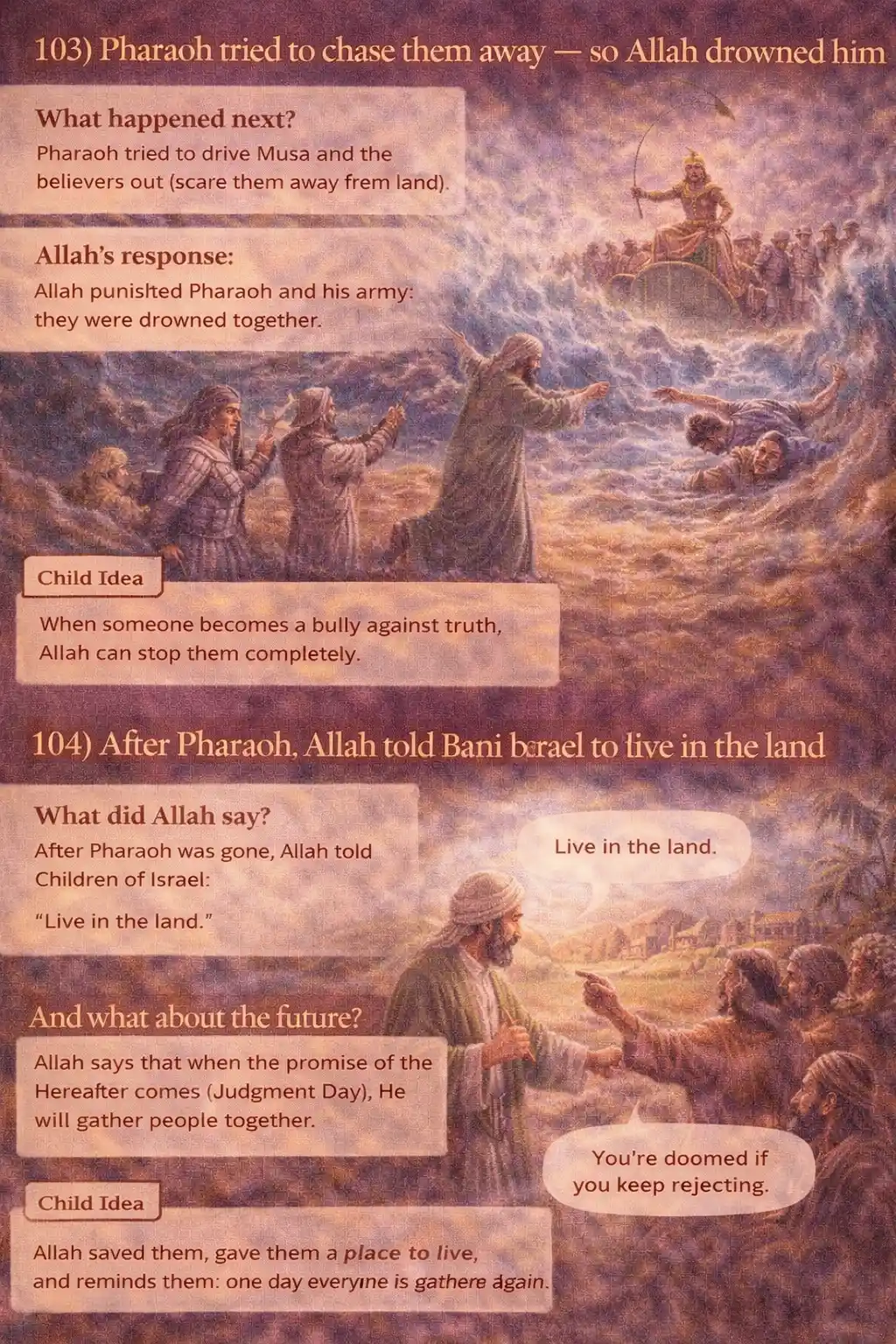

Allah gave Musa strong miracles, but Pharaoh mocked and acted like a bully, so Allah drowned him. Then Allah tells Bani Israel to live safely and reminds everyone of Judgment Day.
The Qur’an came down as true guidance, in parts, so people can learn slowly. Sincere people recognize it, make sujood, and even cry because it makes them humble.

110. Say: “Call upon Allah, or call upon the Beneficent. By whichever (name) you call upon. To Him belong the best names. And (O Muhammad), do not recite (too) loudly in your prayer, and be not (too) quiet in it, but seek between it a way.”
111. And say: “Praise be to Allah, who has not taken to Himself a son, and He has no partner in the sovereignty, and He has no (need of) a protector out of weakness. And magnify Him with all magnificence.”
Verses 110–111 (Child-Simple Explanation)
- Verse 110 — “Call upon Allah, or call upon the Beneficent… and don’t pray too loudly or too quietly.”
1) “Call upon Allah, or call upon the Beneficent (Ar-Rahman)”
- Meaning (very simple): Allah is the same God, even if you use different beautiful names for Him.
- If you say: “Allah” — you are calling the One true God.
- If you say: “Ar-Rahman (The Most Merciful / Beneficent)” — you are still calling the same God.
Child example: It’s like how one person can be called by different good titles:
- “Dad”
- “Father”
- “My hero”
Different words, same person.
2) “To Him belong the best names”
- Meaning (very simple): Allah has the most perfect names because Allah is perfect.
- These names describe real perfection, like:
- The Most Merciful
- The All-Knowing
- The All-Powerful
- The Creator
- Important child point: These names are not random nicknames. They describe who Allah truly is.
3) “Do not recite too loudly in your prayer, and be not too quiet… but between it a way.”
- Meaning (very simple): When you pray, don’t shout and don’t whisper so much that nobody (including you) can hear. Use a balanced voice.
- Too loud can disturb others, or turn prayer into showing off.
- Too quiet can make you lose focus, forget words, or not understand what you’re saying.
- Best way: calm, respectful, clear.
Child example: Imagine you’re reading something important:
- If you shout, everyone gets annoyed.
- If you whisper, even you can’t hear properly.
- So you read in a normal, gentle voice.
That’s what “between it a way” means: moderation.

- Verse 111 — “Praise be to Allah… He has not taken a son… no partner… no protector out of weakness…”
This verse teaches who Allah is—and who Allah is not.
1) “Praise be to Allah”
- Meaning (very simple): Allah deserves thanks and praise because everything good comes from Him.
Child example: We thank someone who gives us even one gift. Allah gives life, food, protection, and guidance—so Allah deserves the greatest praise.
2) “Who has not taken to Himself a son”
- Meaning (very simple): Allah does not have children.
- Why? Because having a child usually means:
- you need someone to continue your family,
- you grow old and need help,
- you are not enough on your own.
- But Allah is perfect, never gets weak, and never needs help. So Allah does not need a son.
Child example: Humans have kids because humans are limited. Allah is not limited.
3) “And He has no partner in the sovereignty”
- Meaning (very simple): Allah does not share His rule over everything with anyone.
- No other god is “co-owner.”
- No one helps Allah run the universe.
- Allah is the only true King of everything.
Child example: Imagine a kingdom where two kings fight over decisions. It becomes messy. Allah’s kingdom is perfect and never chaotic—because Allah alone rules.
4) “And He has no protector out of weakness”
- Meaning (very simple): Allah does not need a bodyguard or helper because Allah is never weak.
- Humans need protection because:
- we can get hurt,
- we can get tired,
- we can be defeated.
- Allah cannot be defeated, cannot be harmed, and never gets tired.
Child example: A person might need security guards. But Allah needs nobody—Allah is always fully powerful.
5) “And magnify Him with all magnificence”
- Meaning (very simple): Treat Allah as the Greatest—because He truly is the Greatest.
- This includes:
- speaking about Allah with respect,
- not lowering Allah to human ideas,
- remembering Allah is above everything.
Child example: If something is truly the greatest, you don’t speak about it carelessly. Allah is greater than everything—so we honor Him greatly.
You can call God “Allah” or “Ar-Rahman”—they are names of the same perfect God. Allah has the best names. When you pray, don’t shout and don’t whisper; pray in a calm middle voice. Allah deserves all praise. Allah has no son, no partner, and no helper because Allah is never weak. Allah is the greatest, so we should honor Him as the greatest.
