Qur’an-Only Explanation (16:112–128) — Simple, Detailed
- 112 — A safe town became hungry and fearful
What it says (simple):
Allah gives an example of a town that had safety, comfort, and food coming to it in abundance from everywhere.
But they denied Allah’s blessings, so Allah made them taste severe hunger and fear.
Why Allah says this:
To teach a rule of life: when people turn blessings into arrogance, denial, oppression, or corruption,
blessings can be removed—not because Allah is unfair, but because people destroy the moral foundation that keeps societies stable.
Example (easy):
A country is stable and wealthy. People become proud and ungrateful. ظلم (injustice) spreads, morals collapse, leaders exploit,
crime rises, trust breaks, and the economy weakens. Even if they used to live comfortably, people start feeling unsafe and struggling.
Takeaway:
Blessings are not “guaranteed forever.” Gratitude + obedience protects blessings.
- 113 — A messenger came, they rejected, then punishment came
What:
A messenger came from among them (so they could understand him), but they denied him.
Then punishment seized them while they were wrongdoers.
Why:
Allah is showing they were not punished “randomly.” They received warning first, then still chose denial and wrongdoing.
Example:
People are warned again and again: “Stop ظلم, stop corruption, return to truth.”
They mock the warning and continue—then consequences arrive.
Takeaway:
Allah sends guidance first. Rejecting it repeatedly has consequences.
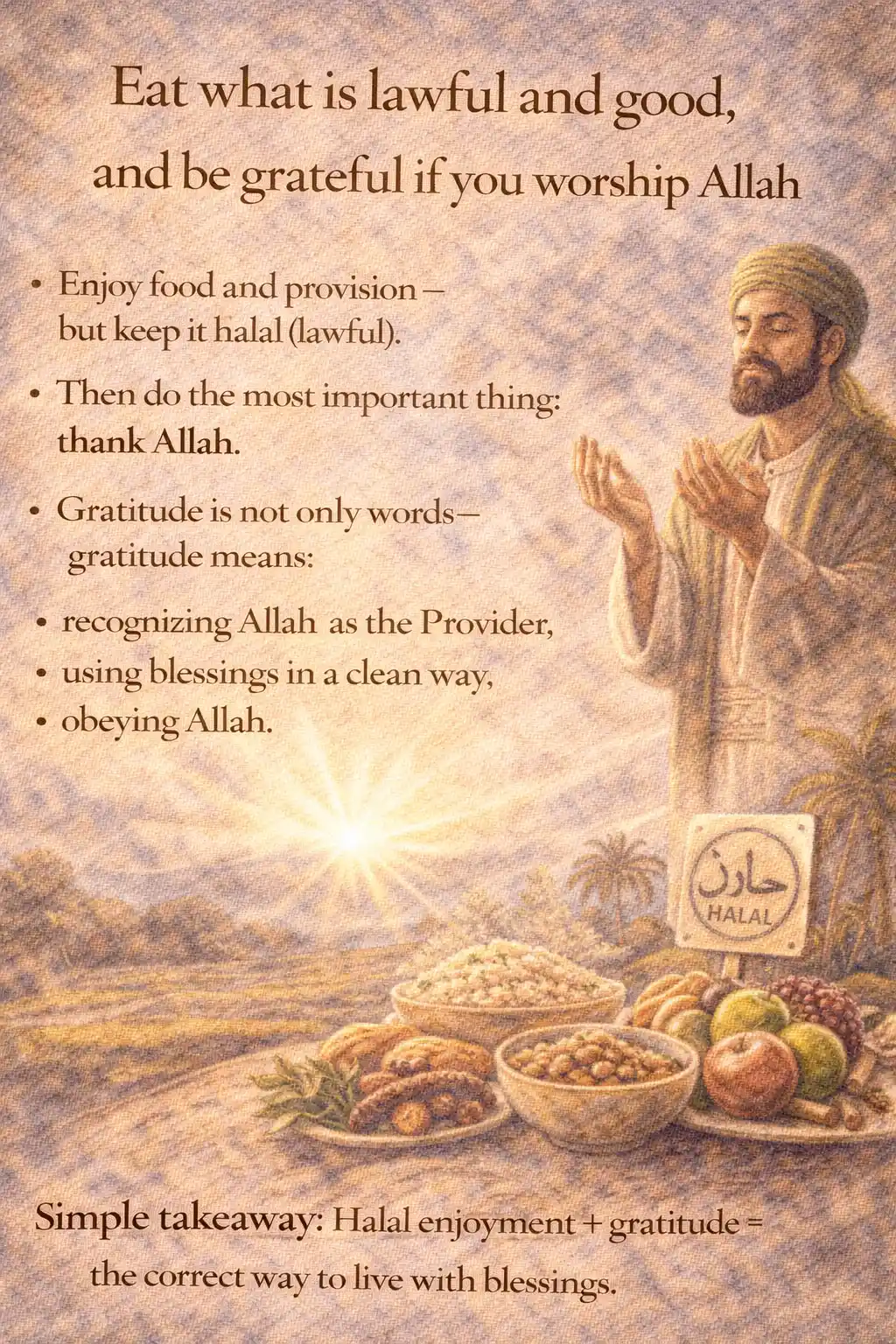
- 114 — Eat halal and good, and be grateful
What:
Eat from the lawful good things Allah provided, and thank Allah’s bounty if you truly worship Him.
Why:
Blessings are not only to “enjoy.” They are a test: will you use them cleanly and thankfully, or arrogantly and sinfully?
Example (gratitude in action):
- saying Alhamdulillah,
- using food/money/health in halal ways,
- not harming others,
- not wasting,
- not becoming proud.
Takeaway:
Halal enjoyment + gratitude is the correct relationship with blessings.
- 115 — What is forbidden + the emergency exception
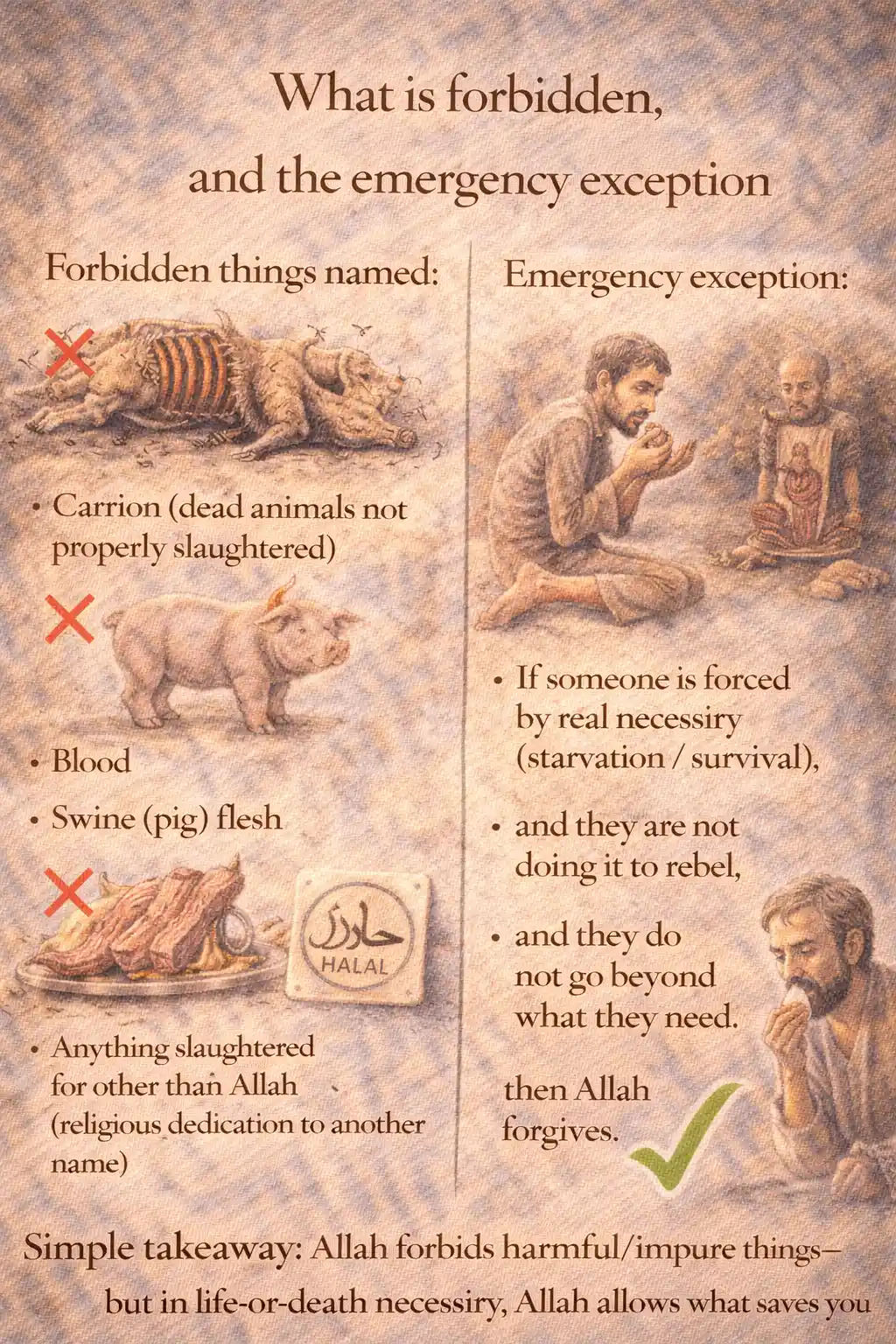
What is forbidden (named clearly):
- carrion (dead animals not properly slaughtered),
- blood,
- pig flesh,
- meat dedicated to other than Allah (slaughtered in another name).
Emergency exception:
If someone is forced by real necessity (survival), not rebelling, and not exceeding what they need—Allah forgives.
Why:
Allah protects people from impurity/harm and shows mercy: Islam is not “die to follow a rule.”
Necessity is different from choice.
Takeaway:
Allah forbids harmful things, but necessity is treated with mercy.
- 116 — Don’t invent halal/haram and blame Allah
What:
Don’t say “this is halal” and “this is haram” from your own tongue, then claim it is Allah’s law.
That is lying about Allah.
Why:
Making up religious rules creates confusion, oppression, and fake “religion.”
It becomes a way to control people through superstition or personal interests.
Example:
Someone says: “Allah forbids prawns,” or “Allah forbids X,” with no proof—then judges people for it.
That is dangerous because it turns personal/cultural opinions into “Allah’s command.”
Takeaway:
Only Allah has the right to declare what is truly halal and haram.
- 117 — Short enjoyment now, painful punishment later
What:
Those who invent lies about Allah may enjoy briefly, but painful punishment awaits.
Why:
Dunya is temporary. Some people use religion for power, ego, or money and think they “won.”
Allah says: it is only a brief enjoyment.
Takeaway:
Temporary success is not safety. The real outcome is the Hereafter.
- 118 — Extra restrictions for Jews were not ظلم
What:
Allah says: some extra restrictions were given to the Jewish community (mentioned earlier).
Allah did not wrong them; they wronged themselves.
Why (simple):
Meaning: some restrictions came as consequence/discipline after persistent disobedience—not because Allah is unfair.
Easy example:
Like a child who keeps disobeying: rules become stricter as discipline, not ظلم.
Takeaway:
When people insist on wrongdoing, consequences and stricter rules can come—without Allah doing ظلم.
- 119 — Repentance after ignorance: Allah forgives
What:
Whoever does evil in ignorance, then repents and follows it with righteous deeds—Allah is Forgiving and Merciful.
Why:
Allah’s goal is not to “trap people.” The goal is that people return, clean themselves, and change.
Takeaway:
Your past does not have to define you. Real repentance + change is accepted.
- 120–123 — Abraham as the model of pure worship
120 — “Abraham was a whole community” (by himself):
Abraham stood so firmly on truth that it’s like he was an entire nation of faith alone.
Truth is not measured by majority.
121 — Thankful for Allah’s bounties:
He recognized blessings and responded with gratitude and obedience—so Allah chose him and guided him.
122 — Good in this world, and righteous in the Hereafter:
Allah rewards sincerity in both worlds.
123 — Follow Abraham’s religion:
The core message: pure devotion to Allah alone, no shirk.
Takeaway:
Abraham is the model: pure worship, gratitude, and firmness even when alone.
- 124 — The Sabbath was prescribed for those who differed about it
What (simple):
The Sabbath became a rule for those who argued and differed about it.
Allah will judge between them on the Day of Resurrection about what they disputed.
Why:
When people fight over truth, twist commands, or disobey, a rule can become a clear test and a judgment point.
Takeaway:
Disputes don’t escape Allah. Allah judges what people argued over and how they behaved.
- 125 — Call to Allah with wisdom and best manners
What:
Invite to Allah with wisdom, good instruction, and argue in the best way.
Why:
Truth is not delivered properly through ego, insults, and anger.
People understand better when the message is clear and respectful.
Example:
Instead of: “You’re stupid,” you say: “Let’s look at what Allah says and reason carefully.”
Takeaway:
How you speak matters. Truth + good method.
- 126 — Justice is allowed; patience is better
What:
If you punish, punish only equal to what was done to you (no excess).
But if you endure patiently, that is better for the patient.
Why:
This blocks ظلم and revenge spirals. Justice is permitted, but patience is spiritually higher.
Takeaway:
No transgression. Fairness is the minimum; patience is the higher path.
- 127 — Be patient; don’t be crushed by their plots
What:
Be patient—and your patience is from Allah. Don’t grieve and don’t feel trapped by what they plot.
Why:
The Prophet’s job is clear delivery, not emotional destruction from people’s rejection.
Takeaway:
Do your duty, trust Allah, and don’t panic over opponents.
- 128 — Allah is with those who fear Him and those who do good
What:
Allah supports those with taqwa (God-consciousness) and ihsan (doing good with sincerity).
Takeaway:
If you want Allah’s support: taqwa + doing good.
The main message of 16:112–128 (one simple summary):
A society can lose safety and provision when it denies Allah and rejects guidance.
Allah commands halal living, gratitude, and honesty—especially not inventing religion.
He opens the door of repentance, gives Abraham as the model of pure worship,
and teaches the Prophet to call with wisdom. Justice is allowed, patience is better,
and Allah supports those who fear Him and do good.
on when it denies Allah and rejects guidance. Allah commands halal living, gratitude, and honesty—especially not inventing religion. He opens the door of repentance, gives Abraham as the model of pure worship, and teaches the Prophet to call with wisdom. Justice is allowed, patience is better, and Allah supports those who fear Him and do good.