Surah Al-Hijr (Chapter 15)

Qur'an-only explanation – warnings against denial, the preservation of the Reminder, and the truth behind mockery and false “magic” claims.
Surah Al-Hijr emphasises:
Qur'an Preservation Accountability Warning
Verses 1–15
Clear Qur’an, denial’s distractions, decree of nations, and the “bewitched” excuse

1. Alif. Lam. Ra. These are the verses of the Book and a clear Quran.

2. Perhaps those who disbelieve will wish if they were Muslims.

3. Leave them to eat and enjoy, and let false hope distract them. Soon they will come to know.

4. And We did not destroy any township but that for it there was a known decree.

5. No nation can precede its term, nor will they ever postpone it.

6. And they say: “O you upon whom the admonition has been sent down, surely you are indeed a mad man.”

7. “Why do you not bring the angels to us if you are among the truthful?”

8. We do not send down the angels except with truth, and they (the disbelievers) would not then be reprieved.

9. Certainly We, it is We who have sent down the admonition (the Quran), and certainly We are indeed its guardian.

10. And surely, We sent (messengers) before you (O Muhammad) among the factions of the former people.

11. And never came to them any messenger except that they did ridicule him.

12. Thus do We make it enter into the hearts of the criminals.

13. They would not believe in it, and indeed the example of the former people has gone before.

14. And (even) if We opened to them a gate from the heaven and they continued therein to ascend,

15. They would say: “Our eyes have only been dazzled. Nay, but we are a people bewitched.”

Surah Al-Ḥijr (15:1–15) — Simple Explanation

15:1 — “Alif. Lam. Ra. These are the verses of the Book and a clear Quran.”

A) What it says

The surah opens with disconnected letters, then says the Qur’an is clear. Source: Quran.com

B) What it means (simple)

  • “Alif-Lam-Ra” are among the muqaṭṭaʿāt (disconnected letters) that appear at the start of some surahs. The Qur’an itself does not explicitly explain their meaning. Source: Wikipedia
  • Then Allah states: these are verses of the Book (revelation) and a clear Qur’an—clear in guidance and message. Source: Quran.com

C) Real-life lesson

The opening tells you: “Pay attention—this message is serious and meant to be understood.”

15:2 — “Perhaps those who disbelieve will wish if they were Muslims.”

A) What it says

Disbelievers will one day wish they had submitted. Source: Quranic Arabic Corpus

B) What it means (simple)

There will come a time when reality becomes undeniable—then regret hits: “I should have submitted to God.”

C) Real-life lesson

Regret often comes after the consequences appear. The verse warns: don’t wait until it’s too late.

15:3 — “Leave them to eat and enjoy, and let false hope distract them. Soon they will come to know.”

A) What it says

Let them live, enjoy, and be distracted by hope; they will soon know. Source: Quran.com

B) What it means (simple)

This is not praise. It is a warning: “They’re busy enjoying life, thinking they have plenty of time—soon they’ll learn the truth.”

C) Real-life lesson

A person can look “fine” while heading toward disaster—because comfort can hide danger.

15:4 — “We did not destroy any township but that for it there was a known decree.”

A) What it says

No community was destroyed randomly; it happened by a known decree. Source: Quran

B) What it means (simple)

Allah’s judgment is not chaotic. Communities are not ended without a defined measure and decision.

C) Real-life lesson

Consequences are not “random bad luck” in the Qur’anic worldview—there is order, justice, and timing.

15:5 — “No nation can precede its term, nor will they ever postpone it.”

A) What it says

A nation cannot bring its end earlier or delay it beyond its appointed term. Source: Quran

B) What it means (simple)

There is a set limit. When it comes, it comes—no escaping it.

C) Real-life lesson

People often think, “Nothing will happen.” The Qur’an says: time is running on a schedule you don’t control.

15:6 — “O you upon whom the admonition has been sent down, surely you are indeed a mad man.”

A) What it says

They insult the Prophet and call him mad. Source: Quran

B) What it means (simple)

When people don’t want truth, they often attack the messenger instead of addressing the message.

C) Real-life lesson

Mockery is a common defense when someone feels exposed by the truth.

15:7 — “Why do you not bring the angels to us if you are among the truthful?”

A) What it says

They demand angels as “proof.” Source: Quran

B) What it means (simple)

It’s not a sincere request. It’s a way to set an impossible condition: “We’ll only believe if you produce something spectacular.”

C) Real-life lesson

Some people don’t want evidence—they want an excuse to keep rejecting.

15:8 — “We do not send down the angels except with truth, and they would not then be reprieved.”

A) What it says

Angels don’t come down “for entertainment”; when they come, it is with decisive truth—then no extra delay. Source: Quran.com

B) What it means (simple)

  • Angelic appearance is linked to final decisions, not casual demonstrations.
  • Another verse explains the same logic: if an angel were sent as demanded, the matter would be settled and they wouldn’t be given more time. Source: Quran.com

C) Real-life lesson

People who demand “one last sign” may be asking for something that would actually end the test.

15:9 — “We sent down the admonition (the Qur’an), and We are its guardian.”

A) What it says

Allah revealed the Qur’an and will preserve it. Source: Quran.com

B) What it means (simple)

  • The Qur’an is not left to be lost, erased, or replaced. Allah takes responsibility for its preservation. Source: Quran.com
  • This fits with another Qur’anic principle: Allah takes charge of ensuring the recitation is gathered and delivered correctly. Source: Quran.com

C) Real-life lesson

The foundation of guidance is protected—so the problem is not “lack of access to truth,” but whether people accept it.

15:10 — “We sent messengers before you among the factions of former peoples.”

A) What it says

Messengers were sent before to many groups. Source: Quran.com

B) What it means (simple)

Muhammad is not the first messenger. This is a continuation of a long pattern of guidance.

C) Real-life lesson

Truth doesn’t start with your era. People have been tested with guidance repeatedly.

15:11 — “No messenger came to them except that they ridiculed him.”

A) What it says

People mocked messengers consistently. Source: Quran.com

B) What it means (simple)

Ridicule is historically normal when truth challenges power, pride, or lifestyle.

C) Real-life lesson

If you see believers mocked, the Qur’an frames it as an old, repeating pattern—not proof the message is false.

15:12 — “Thus do We make it enter into the hearts of the criminals.”

A) What it says

Disbelief (or rejection) sinks into the hearts of the guilty. Source: Quran.com

B) What it means (simple)

  • When someone keeps choosing wrongdoing and arrogance, rejection becomes internal—like it “soaks in.”
  • The Qur’an describes this principle elsewhere: when they refuse initially, their hearts and perception get turned away; and their “disease” increases. Source: Quran.com

C) Real-life lesson

Repeated rejection is not neutral. It changes a person. Over time, they can lose the ability to see clearly.

15:13 — “They would not believe in it, and the example of the former people has gone before.”

A) What it says

They still won’t believe, despite past examples of destroyed peoples. Source: Quran.com

B) What it means (simple)

History already showed what happens when people persist in arrogant denial—yet they still repeat it.

C) Real-life lesson

Many people don’t learn from warnings or history; they assume, “It won’t happen to me.”

15:14 — “Even if We opened for them a gate from heaven and they continued to ascend…”

A) What it says

Even if they literally ascended through a heavenly gate… Source: Quran.com

B) What it means (simple)

Allah is describing extreme evidence—beyond normal miracles.

C) Real-life lesson

The issue is not always “lack of proof.” Sometimes the issue is the heart’s refusal.

15:15 — “They would say: Our eyes have been dazzled… we are bewitched.”

A) What it says

Even then, they’d claim it was illusion or magic. Source: Quran.com

B) What it means (simple)

A person determined to deny will reinterpret anything—no matter how clear—into an excuse (“hallucination,” “trick,” “magic”).

C) Real-life lesson

Evidence doesn’t help someone who has already decided the answer. Sincerity matters.


The overall message of 15:1–15 (in one simple summary)

  • The Qur’an is clear guidance (not confusion). Source: Quran.com
  • Enjoyment and false hope can distract people until regret hits. Source: Quran.com
  • Rejection can harden into a permanent mindset—so even miracles won’t convince.
Key point: The opening of Surah 15 teaches that denial is often a lifestyle (distraction + mockery + false hopes), and that even extreme “signs” do not guide a heart that refuses sincerity. The Qur’an’s Reminder is declared protected by Allah Himself.
Verses 16–25
Cosmic order, guarded sky, measured provision, and the certainty of gathering

16. And indeed, We have set within the heaven mansions of stars, and We have beautified it for the beholders.

17. And We have guarded it from every accursed devil.

18. Except him who steals the hearing (eavesdrop), he is then pursued by a clear flaming fire.

19. And the earth, We have spread it out, and We have placed therein firm mountains, and We have caused to grow therein all kinds of things in due proportion.

20. And We have made for you therein means of livelihood, and (for) those for whom you are not providers.

21. And there is not a thing, but that with Us are its treasuries. And We do not send it down except in a known measure.

22. And We send the winds fertilizing, then We send down water from the sky, then We give it you to drink. And you are not the guardians of its stores.

23. And certainly We, We it is who give life, and cause death, and We are the Inheritors.

24. And certainly, We know the preceding (generations) among you, and certainly We know those who will come later.

25. And indeed, it is your Lord who will gather them. Indeed, He is All Wise, All Knowing.

Surah Al-Ḥijr (15:16–25) — Simple, Detailed Explanation

15:16 — “We have set within the heaven mansions of stars, and We have beautified it for the beholders.”

What is being described (what / where)

Allah says He placed “burūj” in the sky—commonly translated as constellations / star formations / great star patterns—and made the sky beautiful to look at. Source: Quran.com

Who benefits (for whom)

“For the beholders” means anyone who looks up—believers and disbelievers—can see the beauty and order.

Simple reality picture

The night sky is not presented as random decoration. In this verse, it is presented as a deliberate, visible sign and an adornment (beautification). Source: Quran.com

15:17 — “And We have guarded it from every accursed devil.”

Who is being mentioned

“Devil” (shayṭān) in the Qur’an refers to rebellious beings that push toward evil and rebellion—including devils from the jinn.

Here the verse says they are “accursed” (rajīm), meaning rejected/banished from good and not welcome in that protected realm. Source: Quran.com

Where is being guarded

The guarded area is the heaven/sky realm that Allah is referring to here. Source: Quran.com

What “guarded” implies (very practical meaning)

This is like saying: “This domain is secured.”

Not everything is open-access. There is a boundary that devils are not allowed to cross freely.

15:18 — “Except him who steals the hearing (eavesdrop), he is then pursued by a clear flaming fire.”

Illustration for Surah Al-Hijr 15:18

This verse is about a very specific situation: unauthorized listening near the protected heavenly realm.

1) Who is eavesdropping?

The Qur’an explains this clearly elsewhere: it is they (from the jinn/devils) who try to access the heaven for information.

In Surah Al-Jinn, they say: “We tried to reach heaven for news…” Source: Quran.com

And: “We used to take up positions there for eavesdropping…” Source: Quran.com

So the “eavesdropper” is a rebellious being (from the jinn/devils) attempting unauthorized listening. Source: Quran.com

2) Where are they eavesdropping?

They are eavesdropping “there” in relation to heaven—meaning they try to get close enough to the heavenly realm to intercept information. Source: Quran.com

The Qur’an also describes that they cannot listen to “the highest assembly (of angels)”—a protected gathering/realm associated with angels. Source: Quran.com

3) What are they trying to hear?

The Qur’an’s picture is not “casual gossip.” It is news/information from that protected realm, associated with the angels and what is decreed/commanded there. (The Qur’an does not lay out a full technical blueprint, but it clearly frames it as “news” and a protected “highest assembly.”) Source: Quran.com

4) What happens when they attempt it?

They are pursued by a “visible flare / piercing flare / clear flaming fire” (shihāb). Source: Quran.com

Another Qur’anic verse states the same idea even more explicitly: Allah made stars like lamps and made them “missiles” for stoning eavesdropping devils. Source: Quran.com

And Surah Al-Jinn says that whoever tries now finds a flare lying in wait. Source: Quran.com

Simple analogy

Think of it like restricted airspace around a secure facility:

  • Some intruders try to sneak close to intercept signals.
  • The area is protected by guards and defensive “projectiles” that drive them away.

Source: Quran.com

15:19 — “The earth, We have spread it out, placed firm mountains, and caused everything to grow in due proportion.”

What / where

Allah says He made the earth extended/spread—meaning a place you can live on, move across, and build upon. Source: Quran.com

He placed firm mountains—stable features of the earth. Source: Quran.com

He caused all kinds of growth “in perfect balance / due proportion.” Source: Quran.com

What “due proportion” means in simple terms

Growth is not chaotic. It comes with measures: seasons, quantities, ecosystems, and limits—enough for life to function. Source: Quran.com

15:20 — “We made in it means of livelihood for you, and for those whom you do not provide for.”

What is “means of livelihood”?

Everything humans live from: food systems, water access, animals, plants, soil productivity, trade resources, skills and work opportunities—all of it ultimately depends on what the earth contains and produces. Source: Quran.com

Who are “those you do not provide for”? (very concrete examples)

This phrase is powerful because it points out that humans are not the provider for most living beings, yet they still eat and survive: Source: Quran.com

  • Wild animals that you never feed
  • Birds, fish, insects
  • Countless people you personally never support
  • Even systems of nature that keep life going without your control

Core meaning

You benefit from a world where provision reaches many creatures without you being the source. That points to Allah as the true Provider. Source: Quran.com

15:21 — “There is not a thing but that with Us are its treasuries; and We do not send it down except in a known measure.”

What are “treasuries”?

A “treasury” is where reserves are stored. The verse is saying: The reserves/sources of everything that exists and benefits creation are with Allah. Source: Quran.com

What does “send it down” mean here?

It means Allah releases provision/resources into the world—rain, growth, outcomes, opportunities—not infinitely, but in measured amounts. Source: Quran.com

Very simple reality

People often think provision is purely human-controlled. This verse re-centers it: supply is ultimately released on Allah’s measure, not ours. Source: Quran.com

15:22 — “We send the winds fertilizing, then send down water from the sky, then give it to you to drink—and you are not the guardians of its stores.”

Illustration for Surah Al-Hijr 15:22

Step-by-step chain (very concrete)

  1. Winds are sent and described as “fertilizing”. Source: Quran.com
    • Winds help pollination (moving pollen between plants).
    • Winds help carry and drive cloud systems, leading to rainfall.
  2. Rain is sent down from the sky. Source: Quran.com
  3. You drink it (human survival depends on it). Source: Quran.com
  4. You are not the guardians of its stores. Source: Quran.com

    Meaning: you do not control the planet’s water reserves. You might store some water locally, but you do not own or control the sky, the clouds, the rainfall timing, or the total reserves.

Simple takeaway

Even the most basic daily need—water—depends on a system bigger than human control. Source: Quran.com

15:23 — “Surely We give life and cause death, and We are the Inheritors.”

What “give life” means (specific)

Allah is the One who originates living beings, sustains their life, and brings them into existence. Source: Quran.com

What “cause death” means (specific)

Death is not outside His authority; it happens by His decree. Source: Quran.com

What “We are the Inheritors / Eternal Successor” means (simple but exact)

When everyone dies and everything people “own” disappears, Allah remains.

So ultimately, nothing truly stays with people—all returns to Allah’s ownership and authority. Source: Quran.com

15:24 — “We certainly know those who have gone before you and those who will come after.”

Who are “those who went before” and “those who will come after”?

This includes entire generations—past nations, present people, and future people. Source: Quran.com

What “We know” implies (specific)

Allah’s knowledge includes:

  • who lived before you
  • who lives now
  • who will live later
  • and what each group did, chose, hid, and showed

Source: Quran.com

15:25 — “Your Lord alone will gather them together for judgment. He is All-Wise, All-Knowing.”

What does “gather them” mean?

All people—across all generations—will be brought together for accountability. Source: Quran.com

Why mention “All-Wise, All-Knowing”?

  • All-Knowing: Nothing about anyone’s life is missing from His knowledge.
  • All-Wise: Judgment will not be random or unfair; it will be placed correctly and meaningfully.

Source: Quran.com


One simple summary of 15:16–25

  • The unseen realm is protected: devils cannot freely access it; attempts to eavesdrop are repelled. Source: Quran.com
  • Your daily world is managed by measured provision: earth, mountains, growth, livelihoods, wind, rain, life, death—and a final gathering for judgment.
Verses 26–44
Creation of man and jinn, Iblis’s refusal, and the limits of Satan’s authority

26. And indeed, We created man from sounding clay, from mud moulded into shape.

27. And the jinn, We had created before, from the fire of a scorching wind.

28. And when your Lord said to the angels: “Indeed I will create a man from sounding clay, from mud moulded into shape.”

29. “So when I have fashioned him and have breathed into him of My Spirit, then fall down, prostrating yourselves to him.”

30. So the angels fell prostrate, all of them together.

31. Except Iblis. He refused to be with those who prostrated.

32. He said: “O Iblis, what is (matter) with you that you are not with those who prostrate.”

33. He said: “Never would I prostrate to a man whom You created from sounding clay, from mud moulded into shape.”

34. He said: “Then get out from here. Indeed, you are rejected.”

35. “And indeed, the curse shall be upon you until the Day of Recompense.”

36. He said: “My Lord, then reprieve me until the day they will be resurrected.”

37. He said: “So indeed, you are of those reprieved.”

38. “Until the Day of the appointed time.”

39. He said: “My Lord, because You have sent me astray, I shall indeed adorn (the path of error) for them on the earth, and I shall indeed mislead them all.”

40. “Except your sincere slaves among them.”

41. He said: “This is the path to Me, (leading) straight.”

42. “Certainly My slaves, you shall have no authority over them, except those who may follow you from among the misguided.”

43. “And certainly, Hell is the promised place for them all.”

44. “There are seven gates in it. To each gate, a portion of them has been designated.”

Surah Al-Ḥijr (15:26–44) — Simple, Detailed Explanation

15:26 — “We created man from sounding clay, from mud moulded into shape.”

What is being said (very concrete)

Allah describes the material origin of the first human creation as clay that becomes dry/sounding (the kind that can “ring” when tapped), coming from dark mud that was formed/moulded. Source: Quran.com

What it means (simple)

Humans come from a humble earth-like origin—not from something “divine,” not from something “superior.”

The Qur’an is grounding human pride: your beginning is from earth material, shaped by Allah. Source: Quran.com

15:27 — “And the jinn, We created before, from the fire of a scorching wind.”

Who are the jinn (basic definition)

Jinn are a separate created category from humans. Here Allah tells you their origin substance is different.

What “fire of a scorching wind” means (concrete idea)

Their origin is described as fire, with a hot/scorching quality. Source: Quran.com

Key detail

The Qur’an is making a contrast: humans from clay, jinn from fire. Source: Quran.com

15:28 — Allah said to the angels: “I will create a man from sounding clay…”

Who is being spoken to

Allah speaks to the angels and announces the creation of a human. Source: Quran.com

Why this matters

This is not random: the Qur’an is showing that human creation is a planned act—declared, intended, and carried out by Allah.

15:29 — “When I have fashioned him and breathed into him of My Spirit, then fall down prostrating.”

1) “Fashioned him”

“Fashioned” means Allah formed the human—giving him a designed form, not a shapeless lump. Source: Quran.com

2) “Breathed into him of My Spirit”

This phrase can confuse people, so here is the Qur’an-based clarity:

  • The Qur’an also uses this wording elsewhere for human creation. Source: Quran.com
  • And the Qur’an explicitly says the true nature of the spirit is not fully given to humans: “The spirit is from the command of my Lord, and you have been given but little knowledge.” Source: Quran.com

Simple meaning without speculation

Allah is describing the moment the human becomes a living, aware being by Allah’s command—life is not “self-generated.” The exact “how” of the spirit is not fully explained to humans. Source: Quran.com

3) “Prostrate”

Allah commands the angels: prostrate to the human (Adam). Source: Quran.com

Important Qur’anic framing

This prostration is an act of obedience to Allah’s command, not the angels “worshipping Adam.” The Qur’an shows it is a commanded act in multiple places. Source: Quran.com

15:30 — “So the angels fell prostrate, all of them together.”

Illustration for Surah Al-Hijr 15:30

What this shows

Angels obey Allah’s command completely and collectively. Source: Quran.com

15:31 — “Except Iblis. He refused…”

Who is Iblis?

The Qur’an clarifies directly that Iblis was from the jinn, not an angel: “…except Iblis, who was one of the jinn…” Source: Quran.com

What he did

He refused to obey the command. Source: Quran.com

15:32 — Allah: “O Iblis, what is with you that you are not with those who prostrate?”

What is happening here (very specific)

Allah questions Iblis—not because Allah needs information, but to expose the reason for his refusal and establish the injustice of his pride. Source: Quran.com

15:33 — Iblis: “I will not prostrate to a man You created from clay…”

Iblis’ argument (simple)

He rejects Adam based on the material origin: “clay.” Source: Quran.com

The Qur’an shows Iblis elsewhere saying the comparison openly: “You created me from fire and him from clay.” Source: Quran.com

Core problem

His refusal is not “lack of evidence.” It is arrogance: he believes his origin makes him better. Source: Quran.com

15:34 — Allah: “Get out from here. You are rejected.”

What “rejected” means (specific)

Iblis is expelled from honor/position and declared unfit to remain where he was, because he chose rebellion. Source: Quran.com

15:35 — “The curse shall be upon you until the Day of Recompense.”

What “curse” means here (simple)

Being under Allah’s curse means being cut off from divine favor/mercy as a consequence of rebellion—until the Day of Judgment. Source: Quran.com

15:36 — Iblis: “Reprieve me until the day they are resurrected.”

What he is asking for (very concrete)

He asks to stay alive / not be ended until resurrection day, so he can carry out his mission of misguidance. Source: Quran.com

15:37–38 — Allah: “You are among those reprieved—until the appointed time.”

Two precise points

  • Allah grants a reprieve. Source: Quran.com
  • It is not “forever.” It has a fixed endpoint: “the appointed time.” Source: Quran.com

Simple meaning

Even Iblis operates on Allah’s timeline, not his own.

15:39 — Iblis: “Because You allowed me to stray, I will adorn error for them on earth and mislead them all.”

Illustration for Surah Al-Hijr 15:39

What “adorn” means (very practical)

It means: make evil look attractive:

  • present sin as “fun,”
  • present disobedience as “freedom,”
  • present arrogance as “confidence,”
  • present delay as “you have time later.”

Source: Quran.com

Where he does it

“On the earth” = in human life, daily living, desires, society, habits—this is where temptation operates. Source: Quran.com

Key detail

Notice his language: he blames Allah (“because You allowed me to stray”), but the Qur’an repeatedly shows his core issue is arrogant refusal. Source: Quran.com

15:40 — “Except Your sincere servants among them.”

Illustration for Surah Al-Hijr 15:40

Who are the “sincere servants”?

People whose worship, intention, and loyalty are genuinely for Allah—not performance, not pride, not following desires first.

Very important detail

Iblis admits he cannot reach everyone. There is a protected category: sincere servants. Source: Quran.com

The Qur’an repeats the same concept elsewhere: Iblis says he will mislead all except Allah’s chosen servants. Source: Quran.com

15:41 — Allah: “This is a path to Me, straight.”

Meaning (simple)

Allah defines the real standard: the straight path is the path to Allah—not to ego, not to society’s approval, not to temptation. Source: Quran.com

15:42 — “You will have no authority over My servants, except those who follow you from among the deviants.”

This verse answers a major question: Does Satan control people?

What “no authority” means (specific)

Satan does not have forced control like a puppet-master.

His power is in temptation, suggestion, beautifying sin—but he cannot override the sincere person’s choice. Source: Quran.com

Who is vulnerable (very specific)

Those who choose to follow him—“the deviants.” Source: Quran.com

15:43 — “Hell is the promised place for them all.”

Who is “them”?

Those who follow Satan into misguidance and rebellion.

Meaning (simple)

This is a stated end result: persistent, chosen misguidance has a destination. Source: Quran.com

15:44 — “There are seven gates in it. To each gate, a portion has been designated.”

Illustration for Surah Al-Hijr 15:44

What “seven gates” means (simple but specific)

Hell is described as having multiple gates, meaning entry is structured, not chaotic. Source: Quran.com

What “a portion designated” means (simple)

“A portion designated” means that people are not admitted randomly. They are assigned—each gate has a share/group of people allocated to it.

Verses 45–60
Reward of the righteous, mercy and warning, and Abraham’s guests

45. Indeed, the righteous will be amidst gardens and springs.

46. (It will be said): “Enter therein, in peace, security.”

47. And We shall remove whatever is in their breasts of resentment. As brothers, (they will rest) on raised couches, facing each other.

48. No fatigue shall touch them therein, nor shall they be driven out of it.

49. Inform (O Muhammad) to My slaves that I am the Oft Forgiving, the Most Merciful.

50. And that My punishment, it is the painful punishment.

51. And inform them about Abraham's guests.

52. When they entered upon him and said: “Peace.” He said: “Indeed we are afraid of you.”

53. They said: “Do not be afraid, indeed we give you good tidings of a boy possessing knowledge.”

54. He said: “Do you give me good tidings of (a son) when old age has overtaken me. Of what then do you give good tidings.”

Illustration for Surah Al-Hijr 15:54

55. They said: “We bring you good tidings in truth. So do not be of the despairing.”

56. He said: “And who despairs of the mercy of his Lord, except those who are astray.”

57. He said: “What is then your business, O messengers.”

58. They said: “Indeed we have been sent to a criminal people.”

59. “Except the family of Lot. Indeed, we will save them all.”

60. “Except his wife. We have decreed that she shall be of those who remain behind.”

Illustration for Surah Al-Hijr 15:60

Surah Al-Ḥijr (15:45–60) — Simple, Detailed Explanation

  • 15:45 — The righteous will live in gardens and springs

“Indeed, the righteous will be amidst gardens and springs.”

  • Who are “the righteous”?
    People who lived with taqwā: they tried to obey Allah, avoid rebellion, and take accountability seriously.
  • What is being promised (very concrete):
    Gardens: places of life, beauty, shade, and comfort.
    Springs: flowing water—meaning ongoing refreshment and abundance. Source: Quran.com
  • Simple meaning:
    Their reward is not a vague “good feeling.” It’s described as a real, secure life of ease and pleasure. Source: Quran.com

  • 15:46 — Enter Paradise in peace and full security

“Enter therein, in peace, security.”

  • Who is being spoken to?
    The righteous, as they are admitted into Paradise. Source: Quran.com
  • What “peace” means here (simple but specific):
    They enter without fear, panic, or danger. Their situation is settled: no threats, no uncertainty.
  • What “security” means (very practical):
    Safe from harm, humiliation, loss, and terror—safe from the kinds of fear that exist in worldly life (crime, sickness, instability). Source: Quran.com

  • 15:47 — Allah removes resentment: relationships become pure

“We shall remove whatever is in their breasts of resentment… as brothers… facing each other.”

Illustration for Surah Al-Hijr 15:47
  • What is being removed?
    Resentment/bitterness/grudges that people can carry in the heart. Source: Quranic Arabic Corpus
  • Why mention this? (realistic reason)
    Even good people can have misunderstandings, hurt feelings, jealousy, and old tensions. Allah is showing: Paradise is not only comfort outside you—Allah also cleans what is inside you.
  • “As brothers… facing each other” (very concrete picture):
    No cold distance, no hidden hostility. They sit openly and peacefully—like real family—face to face, meaning no fear of betrayal or bad intentions. Source: Quran.com

  • 15:48 — No exhaustion, and no eviction: Paradise does not end

“No fatigue shall touch them therein, nor shall they be driven out of it.”

  • No fatigue:
    No exhaustion. No body “breaking down.” No burnout. No tiredness from time. Source: Quran.com
  • Not driven out:
    No eviction. No end date. No “your time is up.” Paradise is permanent security, unlike worldly comfort which always ends. Source: Quran.com

  • 15:49 — Allah announces the open door of forgiveness

“Inform My slaves that I am the Oft-Forgiving, the Most Merciful.”

  • Who is being addressed?
    The Prophet is told to announce this message broadly: Allah’s door of forgiveness is real. Source: Quran.com
  • Why it comes here:
    After describing Paradise, Allah reminds people: the way back is not closed. If you repent and return, Allah is ready to forgive.

  • 15:50 — Mercy is real, and punishment is also real

“And that My punishment, it is the painful punishment.”

  • Why mention punishment right after mercy?
    Religion is not meant to create despair (“I’m doomed anyway”) or false safety (“Nothing will happen no matter what I do”). So Allah gives the balance: Mercy is real, and accountability is also real. Source: Quran.com
Shift happening in the passage (very simple):
Allah shows the reward of the righteous (peace, security, clean hearts, no fatigue, no exit), then reminds: Allah forgives—but punishment is real for persistent rebellion.

  • The story example: Abraham’s guests (15:51–60)
  • 15:51 — Why this story is placed here

“Inform them about Abraham’s guests.”

  • This story is a real-life example of Allah’s mercy (good news, rescue) and Allah’s punishment (a criminal people judged).

  • 15:52 — Strangers greet Abraham; he feels fear

“When they entered upon him and said: ‘Peace.’ He said: ‘Indeed we are afraid of you.’”

  • Who are the guests?
    They are described as “messengers” in the dialogue, and the Qur’an elsewhere clarifies these are messenger-angels who came to Abraham. Source: Quran.com
  • Why would Abraham be afraid if they said “peace”?
    A greeting alone doesn’t remove uncertainty: they were strangers arriving unexpectedly.
  • Very practical detail the Qur’an gives elsewhere:
    Abraham brought them food, but when he saw their hands not reaching for it, he felt fear (something unusual is happening). Source: Quran.com
  • Simple conclusion:
    His fear is a normal human reaction to mysterious visitors behaving unlike normal guests.

  • 15:53 — Good news: a son with knowledge

“Do not be afraid, indeed we give you good tidings of a boy possessing knowledge.”

  • What are they giving him?
    A promise of a son.
  • “Possessing knowledge” (simple meaning):
    Not just a child—Allah is promising a child with a special quality: understanding, wisdom, guidance. Source: Quran.com

  • 15:54 — Abraham’s shock: old age makes it seem impossible

“Do you give me good tidings of (a son) when old age has overtaken me?”

  • What Abraham is saying (very plain):
    “Biologically, this seems impossible. I’m old. How can I have a child now?” Source: Quran.com
  • Important clarification:
    This is not “denying Allah”—it’s expressing shock at how unexpected it is in normal worldly cause-and-effect.

  • 15:55 — Don’t despair: the promise is true

“We bring you good tidings in truth. So do not be of the despairing.”

  • They are saying: “This is not fantasy. This is not guesswork. This is a true decree—so don’t lose hope.” Source: Quran.com

  • 15:56 — Despair is a sign of being lost

“And who despairs of the mercy of his Lord, except those who are astray.”

  • Abraham teaches: despair isn’t small. Spiritually it becomes: “Allah can’t fix this” / “Allah won’t help” / “Mercy won’t reach me.”
  • True belief keeps a person from collapsing into hopelessness.

  • 15:57 — Abraham asks: what is your mission?

“What is then your business, O messengers?”

  • He now understands they are messengers with a mission, so he asks: “What is your assignment?” Source: Quran.com

  • 15:58 — Sent to a criminal people (the people of Lot)

“Indeed we have been sent to a criminal people.”

  • Who is meant?
    The people of Lot—a community described here as criminal/wicked. Source: Quran.com
  • Simple meaning:
    Their mission includes judgment against a society that persisted in rebellion.

  • 15:59 — Rescue is prepared for the righteous

“Except the family of Lot. Indeed, we will save them all.”

  • Before punishment arrives, Allah arranges rescue for those not part of the wrongdoing. Source: Quran.com
  • This is mercy operating inside a justice event: Allah does not treat everyone identically.

  • 15:60 — Lot’s wife is excluded: family ties don’t override personal choices

“Except his wife. We have decreed that she shall be of those who remain behind.”

  • Being married to a prophet does not automatically protect someone.
  • The Qur’an uses Lot’s wife as an example: family ties do not override personal belief and choices. Source: Quran.com
  • So she is excluded from rescue because she was not truly aligned with righteousness.
The core message of 15:45–60 (very simple):
Paradise is complete safety: peace at entry, clean hearts inside, no exhaustion, and no exit. Allah’s mercy is wide and forgiveness is open—yet punishment is real for persistent rebellion. The story of Abraham’s guests proves both: good news and rescue for the righteous, and judgment for a society that insists on crime— and it shows that personal choices matter more than family ties.
Verses 61–77
Lot’s guests, the city’s corruption, and decisive judgment

61. Then when the messengers came to the family of Lot.

62. He said: “Indeed, you are people unknown (to me).”

63. They said: “But, we have brought to you that about which they have been in doubt.”

Illustration for Surah Al-Hijr 15:63

64. “And we have come to you with truth, and indeed we are truthful.”

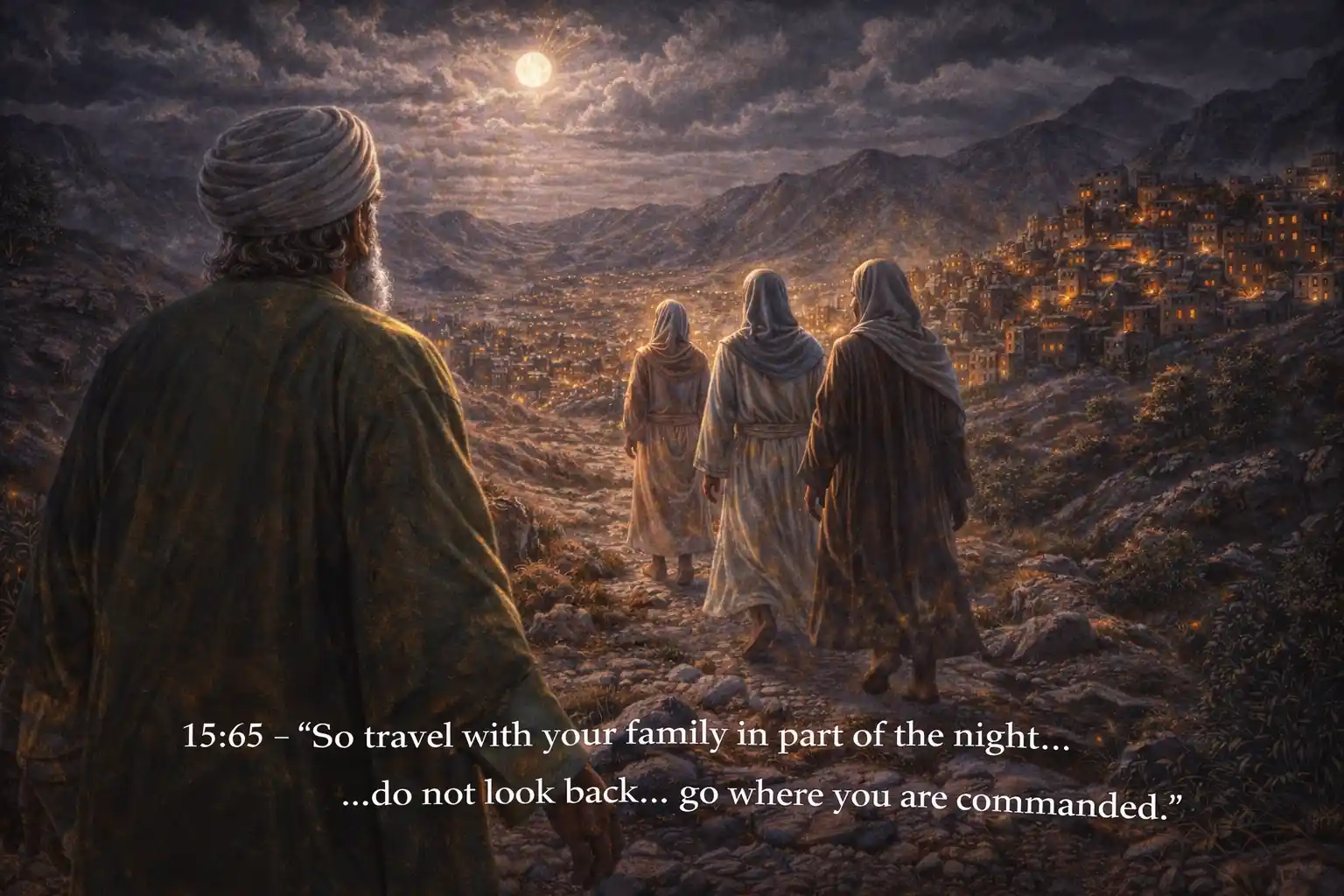
65. “So travel with your family in a part of the night, and you follow behind them. And let not anyone among you look back, and go on to where you are commanded.”

Illustration for Surah Al-Hijr 15:65

66. And We conveyed this decree to him that the root of those (sinners) was to be cut off in the early morning.

67. And the people of the city came rejoicing.

68. He (Lot) said: “Indeed, they are my guests. So do not humiliate me.”

Illustration for Surah Al-Hijr 15:68

69. “And fear Allah and disgrace me not.”

70. They said: “Have we not forbidden you from (guarding) people.”

71. He said: “Here are my daughters, if you must be doing (so).”

Illustration for Surah Al-Hijr 15:71

72. By your life (O Muhammad), indeed, they were in their wild intoxication, wandering blindly.

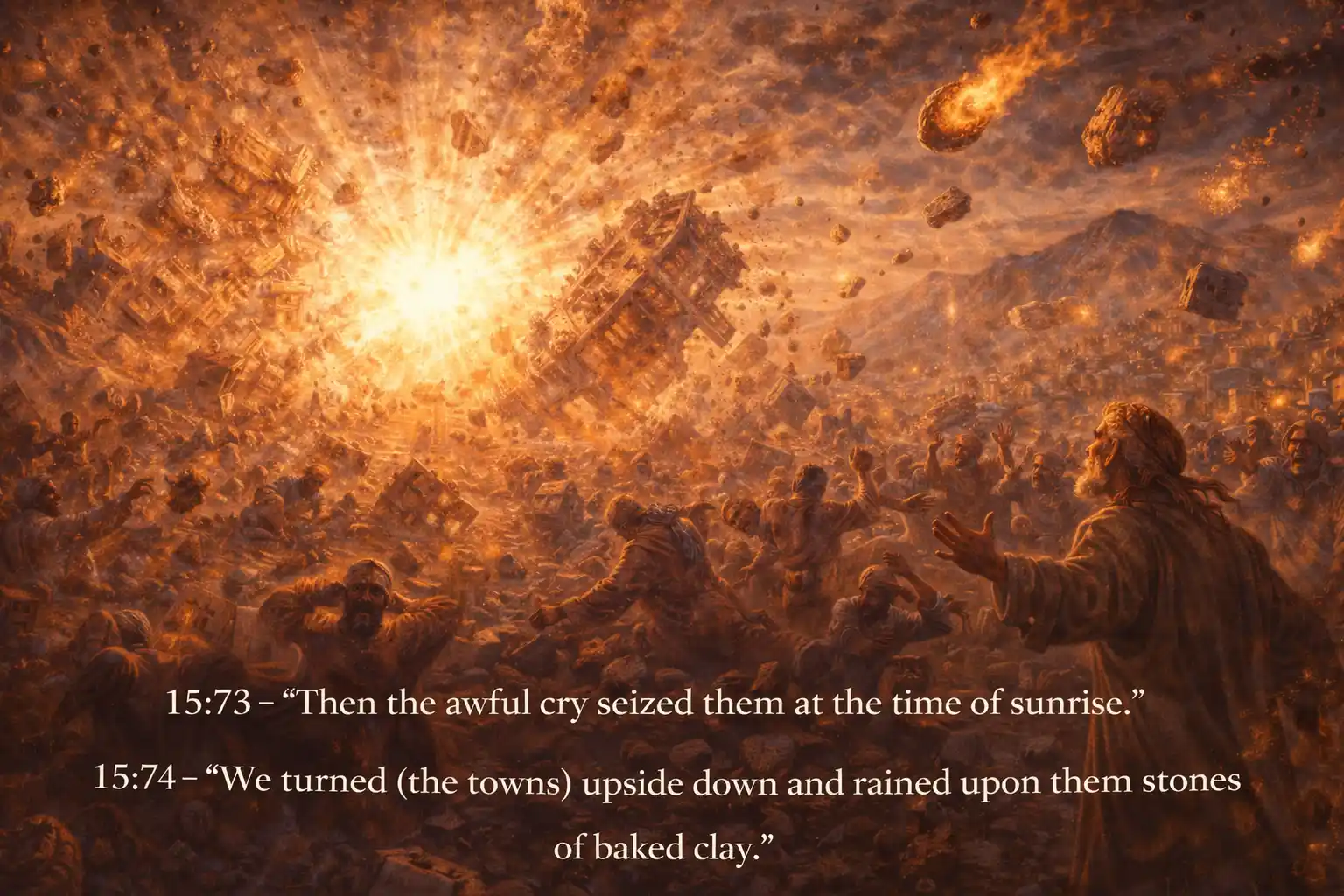
73. Then the awful cry seized them at the time of sunrise.

74. So We turned (the towns of Sodom) upside down and rained upon them stones of baked clay.

Illustration for Surah Al-Hijr 15:74

75. Surely, therein are indeed signs for those who, by signs, do understand.

76. And indeed, they (the towns) are (situated) on the high-road.

Illustration for Surah Al-Hijr 15:76

77. Surely, therein is indeed a sign for those who believe.

Surah Al-Ḥijr (15:61–77) — Simple, Detailed Explanation

  • 15:61 — The messengers arrive at Lot’s household

“Then when the messengers came to the family of Lot.”

  • Who are “the messengers”?
    They are Allah’s messengers sent with a mission (the passage itself calls them messengers repeatedly). In this story-context, they come as visitors to Lot’s household.
  • What is happening:
    A special group arrives at Lot’s home—this is the start of the final events for his people.

  • 15:62 — Lot does not recognize them (unknown visitors)

“He said: ‘Indeed, you are people unknown (to me).’”

  • What Lot means by “unknown”:
    He does not recognize them as local people or familiar travelers. He is basically saying: “I don’t know who you are.”
  • Why that matters:
    In real life, unknown visitors can be dangerous—especially in a town where Lot already knows his people behave criminally.

  • 15:63 — The messengers bring what the city doubted would ever happen

“They said: ‘But, we have brought to you that about which they have been in doubt.’”

  • Who is “they”?
    The people of Lot’s city.
  • What were they “in doubt” about?
    It refers to the threat/warning of punishment and judgment—people often doubt that consequences will truly come.
  • Simple meaning:
    The messengers are saying: “You know what your people doubted would ever happen? We have brought it now.”

  • 15:64 — This message is truth, not rumor

“And we have come to you with truth, and indeed we are truthful.”

  • Meaning (plain):
    This is not a rumor, not fear tactics, not a guess. This is a real decree/event coming from Allah.

  • 15:65 — Escape plan: leave at night, don’t look back

“So travel with your family in a part of the night… and let not anyone among you look back… and go on to where you are commanded.”

  • 1) “Travel with your family in part of the night” — Why night?
    Leaving at night means fewer people see them. It reduces confrontation and danger. It makes escape more likely.
  • 2) “And you follow behind them” — Why must Lot walk behind?
    Lot can make sure everyone is moving, ensure no one is left behind, and protect them from any threat coming from behind.
  • 3) “Let not anyone among you look back” — What does “look back” imply?
    Don’t hesitate. Don’t turn around in emotional attachment. Don’t stop and watch what happens. Don’t second-guess the command.
    This is complete separation from a place that has become doomed due to persistent rebellion.
  • 4) “Go on to where you are commanded” — Meaning:
    Their destination and survival is not “random.” Allah has directed the route.
Important sequencing note (simple):
The Qur’an gives the story in powerful scenes, not a minute-by-minute script. The instruction to leave at night is the escape plan, while the confrontation scenes show what the people were trying to do and why rescue was urgent.

  • 15:66 — The decree: the sinners will be cut off at early morning

“We conveyed this decree to him that the root of those (sinners) was to be cut off in the early morning.”

  • What “root cut off” means:
    Their wrongdoing will not continue. Their society will be ended. The perpetrators will not “survive and rebuild as normal.”
  • Why “early morning”?
    It gives a fixed timing: the rescue is urgent and time-limited. Once that time arrives, it is over.

  • 15:67 — The townspeople arrive “rejoicing”

“And the people of the city came rejoicing.”

  • Who came?
    The townspeople.
  • Why “rejoicing”?
    This is not “happy for a good reason.” It indicates eagerness and excitement to commit wrongdoing—because they believe new visitors have arrived that they can abuse.
  • Moral detail:
    Their crime had become so normal to them that they approached it with celebration.

  • 15:68 — Lot pleads: “They are my guests—don’t humiliate me”

“He (Lot) said: ‘Indeed, they are my guests. So do not humiliate me.’”

  • What Lot is doing here:
    He is trying to protect the visitors under his roof.
  • Why guests matter:
    In many cultures, guests are a serious trust: harming them is a major disgrace.
  • “Do not humiliate me” means:
    “Do not disgrace me in front of my guests.” “Do not stain my honor through what you’re about to do.”

  • 15:69 — Lot appeals to Allah and to honor

“And fear Allah and disgrace me not.”

  • Two appeals:
    Fear Allah (remember accountability, don’t act like there is no judgment).
    Don’t disgrace me (don’t force shame into my household).
  • What this shows:
    Lot is trying moral warning (Allah) and social restraint (honor).

  • 15:70 — The people want Lot to stop protecting anyone

“They said: ‘Have we not forbidden you from (guarding) people?’”

  • Meaning:
    “Haven’t we told you not to interfere? Don’t protect anyone from us.”
  • What it reveals about their corruption:
    They treat access to victims like a “right,” and they see Lot’s resistance as breaking the “rules” of their criminal culture.

  • 15:71 — “Here are my daughters…” (a desperate diversion to what is lawful)

“He said: ‘Here are my daughters, if you must be doing (so).’”

  • What does “my daughters” mean?
    The Qur’an does not add a long explanation inside this verse, but two Qur’an-consistent understandings are commonly derived:
    • (A) Literal daughters offered in lawful marriage:
      If you insist on relations, take the lawful route (marriage), not the forbidden violent route.
    • (B) “Daughters” meaning the women of the community (as a prophet/father-figure):
      The consistent point is: turn to lawful, pure relations instead of criminal desire.
  • What is Lot not doing?
    He is not endorsing their crime. He is trying to divert them away from an immediate assault on the guests toward something lawful, as a last attempt to stop evil.

  • 15:72 — They are “intoxicated” and blind (moral collapse)

“By your life (O Muhammad), indeed, they were in their wild intoxication, wandering blindly.”

  • What does “intoxication” mean here?
    Not necessarily alcohol. It can mean intoxicated by desire, arrogance, or obsession.
  • “Wandering blindly” means:
    They lost moral direction. They could not see the danger or shame of what they were doing.
  • Why is it said so strongly?
    To show severity: not a small mistake, but reckless, uncontrolled moral collapse.

  • 15:73 — The punishment hits exactly at sunrise

“Then the awful cry seized them at the time of sunrise.”

  • What is “the awful cry”?
    A sudden overwhelming blast/cry—something that strikes them decisively.
  • Why sunrise?
    It matches the timing promised earlier (early morning). It shows precision: it arrived exactly when decreed.

  • 15:74 — Towns overturned; stones of baked clay rain down

“So We turned (the towns) upside down and rained upon them stones of baked clay.”

  • Two-part punishment:
    The towns overturned: complete reversal/destruction—total collapse.
    Stones of baked clay: targeted, harsh completion of the punishment.
  • Simple meaning:
    The punishment was not symbolic. It was a real destruction event.

  • 15:75 — The ruins are a lesson for those who reflect

“Surely, therein are indeed signs for those who, by signs, do understand.”

  • Meaning:
    This story is not entertainment. It is evidence and warning for people who reflect: moral consequences, Allah’s power, and the end of arrogance.

  • 15:76 — The ruins lie on a known road (not hidden)

“And indeed, they (the towns) are (situated) on the high-road.”

  • Meaning (very concrete):
    Those ruins/locations were on a known route people traveled: people could pass by and see the remains. It was not hidden in some unreachable place. That makes the “sign” direct and physically observable.

  • 15:77 — A clear sign for believers

“Surely, therein is indeed a sign for those who believe.”

  • Why “for those who believe”?
    Because belief is not only seeing with eyes. It is taking the message seriously, accepting accountability, and learning and changing behavior.
  • Believer’s conclusion:
    Allah’s warnings are real. Persistent rebellion has consequences. Protecting purity and justice matters.
One simple summary of 15:61–77:
The messengers come to Lot with the truth of a coming judgment. Lot is commanded to escape at night, keep the family moving, and not look back. The people arrive excited to commit wrongdoing, and Lot tries desperately to stop them and protect his guests. Their moral blindness reaches a peak—then punishment comes exactly on schedule at sunrise. Allah says this is a sign—and the location was on a traveled road so people could reflect.
Verses 78–84
People of the Wood and the companions of Al-Hijr reject the signs

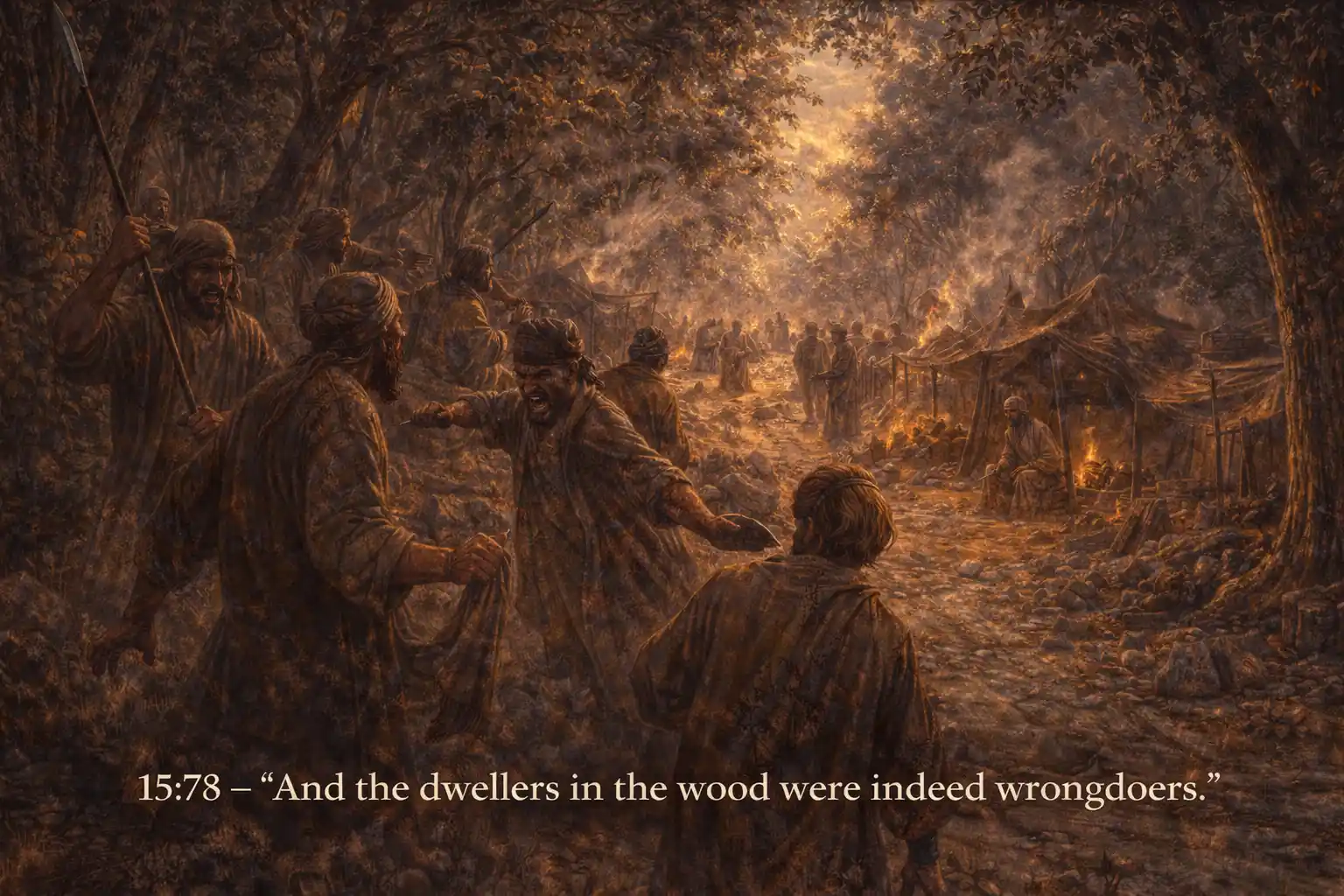
78. And the dwellers in the wood were indeed wrongdoers.

Illustration for Surah Al-Hijr 15:78

79. So We took vengeance on them. And indeed, both (towns) are (located) on a clear highway.

Illustration for Surah Al-Hijr 15:79

80. And certainly, did the companions of AlHijr (Thamud) deny the messengers.

Illustration for Surah Al-Hijr 15:80

81. And we gave them Our signs, but they turned away from them.

82. And they used to carve dwellings from the mountains, feeling secure.

83. So the awful cry seized them at the morning hour.

Illustration for Surah Al-Hijr 15:83

84. So did not avail them that which they used to earn.

Explanation (Verses 78–84)

  • 78–79 – Pattern repeated: The Qur’an compresses the story of “the dwellers in the wood” into a moral verdict: wrongdoing leads to accountability. Mentioning that these places are on a “clear highway” reinforces that these are not hidden myths; they were known locations people could pass by and reflect upon.
  • 80–81 – Rejection despite evidence: “Companions of Al-Hijr” are described as denying messengers even after receiving “signs.” The point is that rejection is often not caused by lack of proof, but by refusal to submit to truth when it disrupts power, habits, or desires.
  • 82 – False security through engineering: Carving homes into mountains symbolizes strength, wealth, and long-term planning. The Qur’an highlights the psychological trap: people mistake material security (strong infrastructure, strategic location) for protection against moral and divine accountability.
  • 83 – Sudden collapse: The “awful cry” at morning mirrors earlier destructions: when a society crosses the line after warnings, the end can be abrupt—showing that what looks stable can be fragile when its foundation is wrongdoing.
  • 84 – Wealth cannot buy immunity: “That which they used to earn” (assets, status, achievements) does not save them. The Qur’anic principle is that material accumulation without righteousness is not a shield; only reform and submission to God matter.
Key point: Strong buildings, wealth, and reputation can create an illusion of permanence—but the Qur’an repeatedly shows that moral failure is what destroys nations, not lack of resources.
Verses 85–93
Creation in truth, certainty of the Hour, and universal accountability

85. And We have not created the heavens and the earth and all that is between them except with truth. And indeed, the Hour is surely coming, so forgive (O Muhammad), with a gracious forgiveness.

86. Indeed, your Lord, He is the All Knowing Creator.

87. And indeed, We have given you seven of the oft-repeated (verses) and the great Quran.

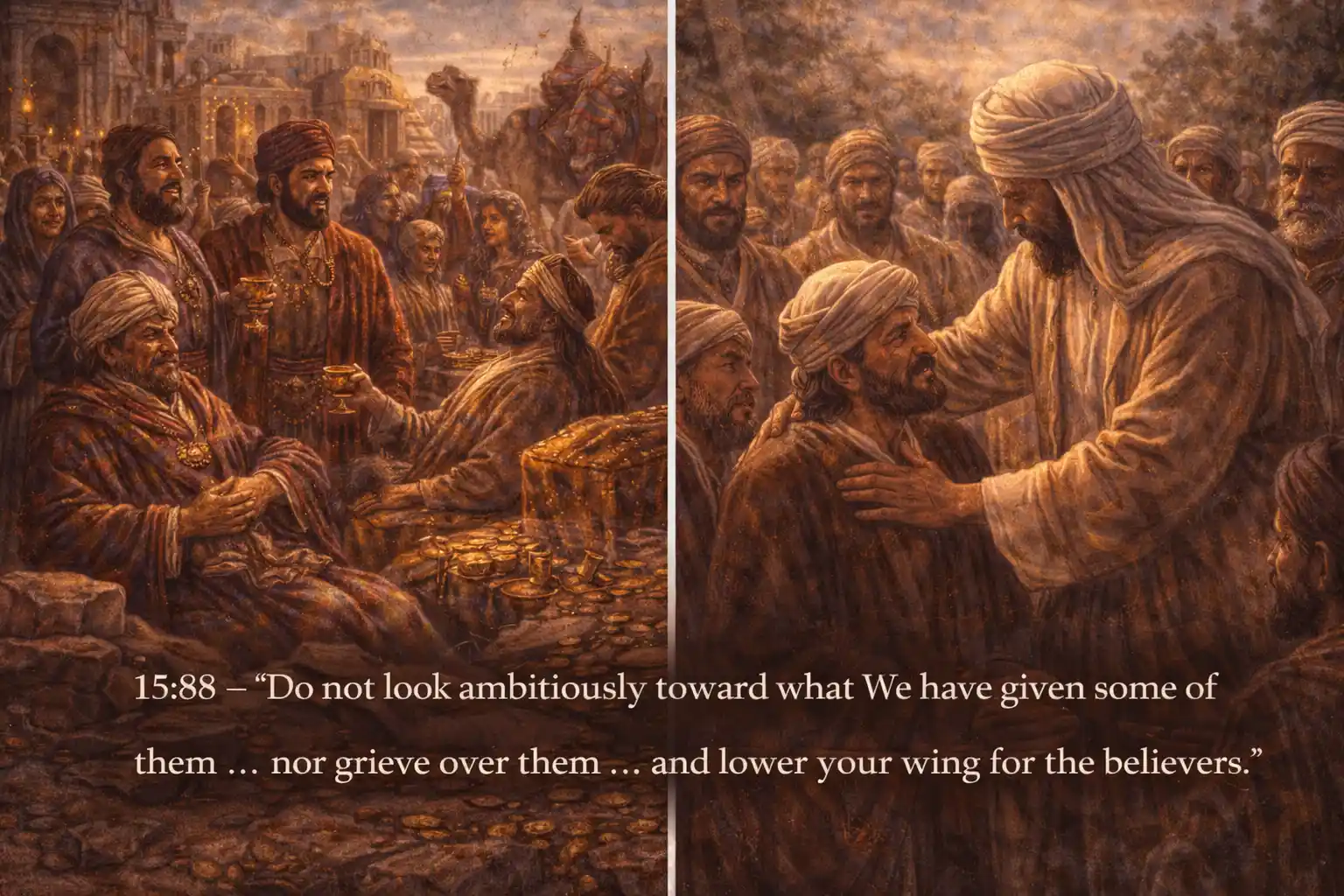
88. Look not with your eyes ambitiously towards that which We have bestowed on different kinds of people of them (the disbelievers), nor grieve over them, and lower your wings (in kindness) for the believers.

Illustration for Surah Al-Hijr 15:88

89. And say: “Indeed, I am most certainly a clear warner.”

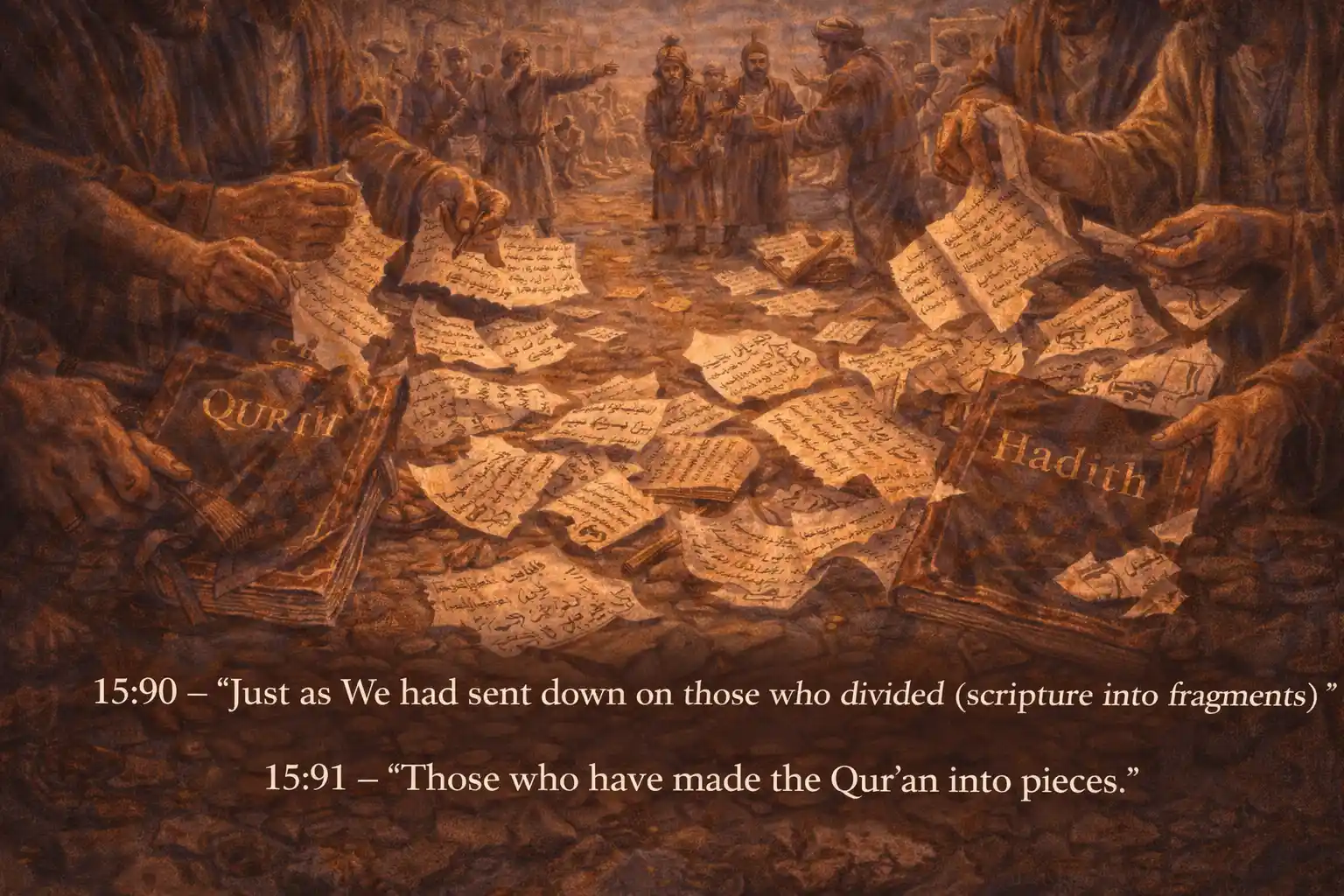
90. Just as We had sent down on those who divided (scripture into fragments).

91. Those who have made the Quran into pieces.

Illustration for Surah Al-Hijr 15:91

92. So, by your Lord, We shall certainly question them all.

93. About what they used to do.

Surah Al-Ḥijr (15:85–93) — Simple, Detailed Explanation

  • 15:85 — Creation has truth/purpose; the Hour is coming; forgive graciously

“We have not created the heavens and the earth and all that is between them except with truth. And indeed, the Hour is surely coming, so forgive with a gracious forgiveness.”

  • 1) “Except with truth” — Meaning (simple):
    • The universe is not an accident.
    • It was created with purpose, order, and justice behind it.
    • “Truth” here means: creation is meaningful, and it points to accountability.
  • 2) “The Hour is surely coming”
    • What is “the Hour”? The Day of Judgment—when life is concluded and people are held accountable.
    • Why mention this right after “truth”? Because if life has purpose, then it must end with results and judgment, not chaos.
  • 3) “So forgive with a gracious forgiveness”
    • Who is being told this? The Prophet (and by extension, anyone calling to truth).
    • What does “gracious forgiveness” mean (very practical)?
      • Forgive without pettiness.
      • Don’t take revenge just to satisfy anger.
      • Stay dignified: patience + restraint + continuing to do right.
    • Core point: Your job is not to force people; your job is to deliver truth with dignity, because the final accounting is coming.

  • 15:86 — Allah is the All-Knowing Creator

“Indeed, your Lord, He is the All-Knowing Creator.”

  • Meaning (simple): Allah created everything with full knowledge:
    • He knows what He created,
    • how it works,
    • what people hide,
    • what they intend,
    • and what outcomes are deserved.
  • Why it matters here: It connects directly to judgment: the One judging is not guessing—He knows everything perfectly.

  • 15:87 — “Seven of the oft-repeated” and the Great Qur’an

“We have given you seven of the oft-repeated and the great Qur’an.”

  • What are “the seven oft-repeated”?
    • The wording literally means: seven verses that are repeated often.
    • The most common understanding is that this refers to Surah Al-Fātiḥah (7 verses), because it is repeated constantly in prayer.
    • The Qur’an itself does not spell out the name here, so the safest Qur’an-based takeaway is:
    • Allah gave the Prophet a special core set of frequently repeated verses, and also gave him the entire Great Qur’an.
  • Why mention this here?
    • It’s a reminder: you already have the greatest gift—guidance and revelation.
    • Don’t be shaken by the rejection of people who prefer worldly things.

  • 15:88 — Don’t envy worldly gifts; don’t grieve; be gentle to believers

“Do not look ambitiously toward what We have given some of them… nor grieve over them… and lower your wing for the believers.”

  • 1) “Do not look ambitiously toward what We have given some of them” — Meaning (simple):
    • Don’t stare at the worldly advantage of those who reject truth: money, status, luxury, power.
    • Why? It can trick you into thinking: “They’re winning.”
    • The Qur’an is saying: that is not the real measure of success.
  • 2) “Nor grieve over them” — Meaning (simple):
    • Don’t destroy yourself with sadness if they refuse guidance.
    • You can care, but you are not responsible for forcing faith into someone’s heart.
  • 3) “Lower your wing for the believers”
    This is a metaphor.
    • Be humble with believers.
    • Be kind, approachable, protective.
    • Treat them gently, not harshly.

  • 15:89 — Declare your role clearly: you are a clear warner

“And say: ‘Indeed, I am a clear warner.’”

  • Meaning (simple): Your role is clarity:
    • warn of consequences,
    • present truth plainly,
    • remove excuses like “we didn’t know.”
  • “Clear” means:
    • not confusing,
    • not secret,
    • not manipulative.

  • 15:90 — Like what happened to those who divided scripture

“Just as We had sent down on those who divided (scripture into fragments).”

  • Who are “those who divided”?
    • People who received revelation but treated it dishonestly:
    • splitting it, breaking it into parts, turning it into factions and fragments.
  • Meaning (simple): This is a warning: previous communities played games with revelation, and consequences came.

  • 15:91 — Those who made the Qur’an into pieces

“Those who have made the Qur’an into pieces.”

  • What does “into pieces” mean (very practical)? It can include:
    • Accepting parts that suit you, rejecting parts that challenge you.
    • Treating the Qur’an as “segments” to argue about instead of a whole guidance.
    • Labeling it inconsistently to dismiss it (e.g., “magic” one moment, “poetry” another) to avoid submission.
  • Key point: The sin here is not ignorance—it’s dishonest handling of truth.

  • 15:92–93 — Allah will question them all about what they used to do

“By your Lord, We will certainly question them all—about what they used to do.”

  • “Question them all” — Meaning (simple):
    • No one escapes accountability.
    • Not just leaders—everyone.
  • “About what they used to do” — Important detail:
    • It’s not only about what they claimed.
    • It’s about what they did:
      • how they treated revelation,
      • how they responded to truth,
      • how they lived.
  • Direct warning: You can argue, mock, divide, distort—but you will still face questioning.
One simple summary of 15:85–93:
The universe was made with purpose and justice, not randomness. The Day of Judgment is coming, so the Prophet is told to be patient and forgive with dignity. Allah reminds him: you already have the greatest gift—revelation. Don’t envy the temporary worldly advantage of rejecters; don’t collapse in grief; be gentle with believers. Announce clearly: you are a warner. Those who chop revelation into parts and play games with truth will be questioned fully for what they did.
Verses 94–99
Public proclamation, sufficiency of Allah, and worship until certainty

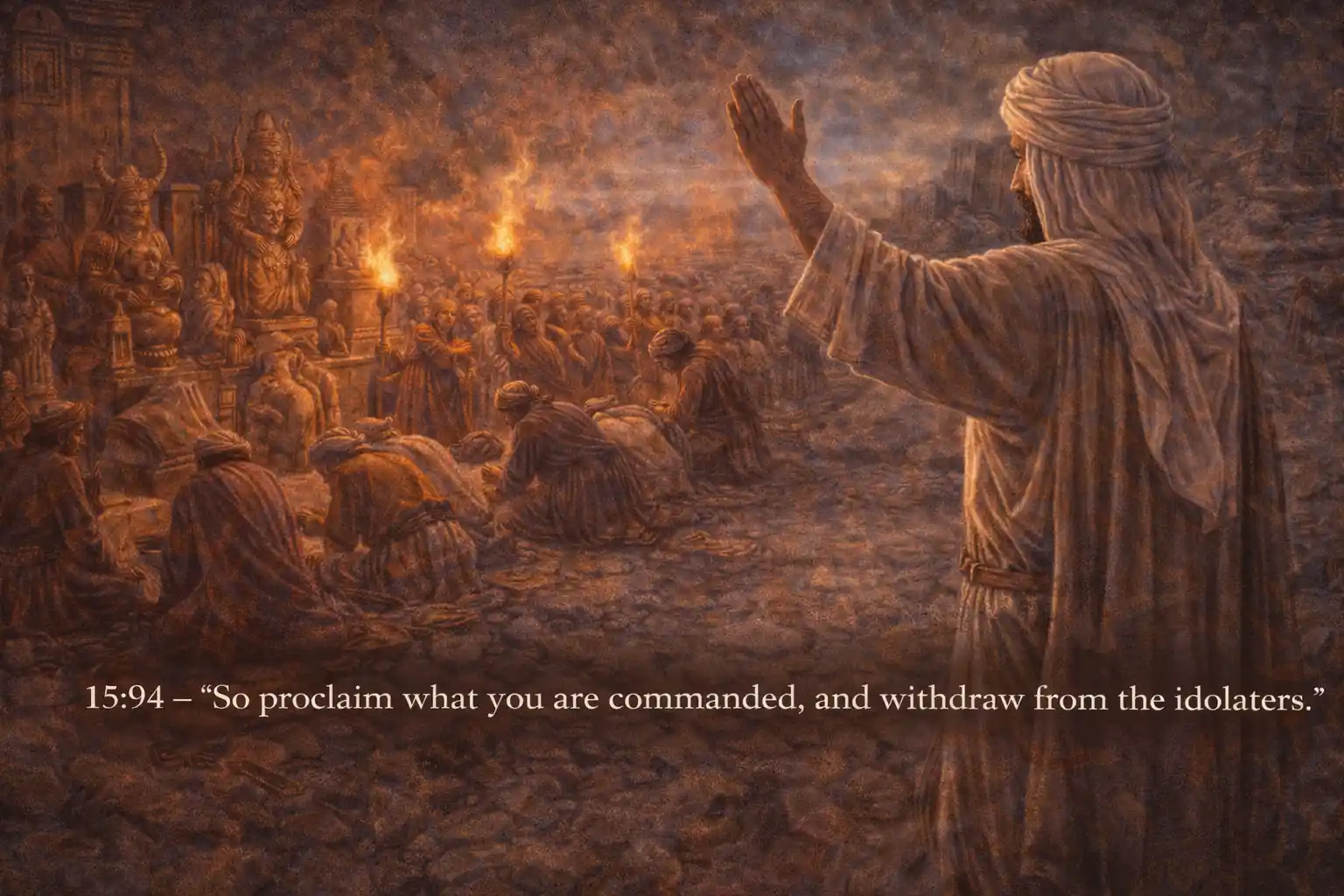
94. So proclaim that which you are commanded, and withdraw from the idolaters.

Illustration for Surah Al-Hijr 15:94

95. Indeed, We will suffice you against those who scoff.

96. Those who adopt, along with Allah, another god. Then soon they will come to know.

97. And indeed, We know that your breast is straitened of what they say.

98. So glorify the praises of your Lord and be of those who prostrate themselves (to Him).

99. And worship your Lord until there comes unto you the certainty (death).

Surah Al-Ḥijr (15:94–99) — Simple, Detailed Explanation

  • 15:94 — “So proclaim what you are commanded, and withdraw from the idolaters.”

Who is being addressed?
Allah is addressing the Prophet Muhammad (and by extension, anyone who carries Allah’s message).

  • “Proclaim what you are commanded” — what does that mean?
    • deliver the message openly,
    • don’t hide it out of fear of mockery,
    • stick to what Allah revealed—no dilution to please people.
  • “Withdraw from the idolaters” — what does “withdraw” mean (practical)?

    It does not mean “run away from all people” or “hate everyone.” It means:

    • do not join their worship practices,
    • do not compromise with their shirk,
    • do not seek their approval by adjusting truth,
    • keep a clear separation in belief and worship.

    So: speak the truth, but do not merge with false worship.


  • 15:95 — “Indeed, We will suffice you against those who scoff.”

Who are “those who scoff”?
People who mock the message and the Prophet:

  • they make jokes,
  • call names,
  • try to shame believers.

What does “We will suffice you” mean?
It means Allah is saying:

  • “You are not alone.”
  • “You do not need to defeat them by your own power.”
  • “I will handle their harm in the way I choose.”

Simple meaning: Allah guarantees protection/support such that their mockery will not stop the mission.


  • 15:96 — “Those who adopt, along with Allah, another god. Then soon they will come to know.”

Who is being described?
Those who commit shirk:

  • they give worship, reliance, or ultimate obedience to something besides Allah.

“Soon they will come to know” — what will they know?
They will eventually realize (when reality hits):

  • their false gods could not help them,
  • their denial had consequences,
  • Allah’s warnings were true.

This is a warning: they will not remain comfortable forever in denial.


  • 15:97 — “We know that your breast is straitened because of what they say.”

What does “breast is straitened” mean?
It means the Prophet feels:

  • emotional pressure,
  • heaviness in the chest,
  • sadness, stress, frustration,
  • because of the insults and rejection.

Why does Allah mention this?
To show:

  • Allah sees the pain,
  • the Prophet is not being blamed for feeling hurt,
  • the hurt is real and acknowledged.

This is comfort: your struggle is seen.


  • 15:98 — “So glorify the praises of your Lord and be of those who prostrate.”

What is Allah prescribing as the response to pressure?
Not revenge. Not despair. Not silence. Allah prescribes:

  • Glorify your Lord with praise
    Meaning:
    • keep declaring Allah’s perfection,
    • keep remembering Him,
    • keep your heart anchored in Him.
  • Be among those who prostrate
    Meaning:
    • keep praying,
    • keep grounding yourself through worship.

Practical lesson: When words of people crush you, worship is what rebuilds you from the inside.


  • 15:99 — “And worship your Lord until there comes to you the certainty (death).”

What is “the certainty”?
It refers to death—because death is the one event nobody escapes and nobody doubts once it arrives.

What does the command mean (very practical)?

  • Worship is not a temporary phase.
  • It is not only when life is easy.
  • It continues until your life ends.

Simple meaning: Stay consistent—keep obeying Allah for your whole life, until death.

One simple summary of 15:94–99:
Allah tells the Prophet: speak the truth openly and don’t compromise with idol-worship. Don’t fear mockers—Allah will take care of their harm. Allah knows the insults hurt you, so respond by strengthening your connection to Him: praise Him and pray. Continue worship steadily until death.