- Each block contains the verse text (English) and a Qur’an-only explanation.
- Where “sheikhs/imams” are mentioned, it is not about insulting people—it's a Qur’anic warning about obeying any religious authority when they claim rules, intercession, or “haram/halal” without Allah’s proof.
- Critical principle: Allah condemns invented religious law and blind following that replaces His revelation.
1Alif, Lam, Ra. A Book We have revealed to you so that you may bring people out of darkness into light—by permission of their Lord—to the path of the Mighty, the Praiseworthy.
2Allah, to whom belongs whatever is in the heavens and whatever is on the earth. And woe to the disbelievers from a severe punishment.
3Those who prefer the life of this world over the Hereafter and hinder from the way of Allah and seek to make it crooked—those are far astray.
Explanation
- Allah defines the core objective: revelation is meant to move people from confusion and deception into clarity and guidance.
- Misguidance is not only disbelief—it's also actively blocking Allah’s path and twisting it.
- “Seeking crookedness” includes adding extra religious burdens, invented intermediaries, or man-made rules that distort Allah’s message.
4We did not send any messenger except in the language of his people, so he could make it clear to them. Then Allah lets go astray whom He wills and guides whom He wills. He is the Mighty, the Wise.
Explanation
- Allah removes the “I didn’t understand” excuse: the message is delivered in a way that can be understood.
- Guidance is connected to Allah’s wisdom, not random. People who insist on distortion and pride lose clarity.
5We sent Moses with Our signs: “Bring your people out of darkness into light and remind them of the days of Allah.” In that are signs for every steadfast, grateful person.
6Moses said: “Remember Allah’s favor upon you when He saved you from Pharaoh’s people...”
7Your Lord proclaimed: “If you are grateful, I will surely increase you; but if you deny, My punishment is severe.”
8Moses said: “If you disbelieve—you and whoever is on earth—Allah is Free of need, Praiseworthy.”
Explanation
- Allah ties guidance to memory: forgetfulness of Allah’s help leads to arrogance and rebellion.
- Gratitude is not lip service; it is loyalty to Allah’s guidance and refusing false authority.
- Allah does not need anyone’s “religious institutions.” People need Allah.
9Has the news not reached you of those before you—people of Noah, ‘Ad, Thamud, and those after them? Their messengers came with clear proofs, but they said: “We disbelieve... we are in doubt about what you call us to.”
10Their messengers said: “Is there doubt about Allah, Creator of the heavens and earth? He calls you so He may forgive you...” They said: “You are only mortals like us... bring us clear authority.”
11The messengers said: “We are only mortals like you, but Allah favors whom He wills. We cannot bring you authority except by Allah’s permission... in Allah let believers trust.”
12“Why should we not trust Allah when He has guided us our ways? We will be patient against your harm...”
13The disbelievers said: “We will drive you out or you must return to our religion.” So their Lord revealed: “We will destroy the wrongdoers.”
14“And We will surely cause you to dwell in the land after them. That is for whoever fears My position (standing before Me) and fears My threat.”
Explanation (Verses 9–14)
14:9 — Past nations rejected clear proof, then claimed “doubt”
What Allah is saying (simple):
Haven’t you heard what happened to the nations before you—Noah’s people, ‘Ad, Thamud, and many others?
Their messengers came with clear proofs, but the people still refused.
What the rejecters said:
“We disbelieve…”
“We are in doubt about what you call us to.”
What this shows:
Their “doubt” is not honest confusion. It is often a cover for rejecting truth because they don’t want to submit, change, or lose power.
Main lesson:
This is a repeating pattern in history: truth arrives clearly, but some people still reject and call it “doubt.”
14:10 — Messengers confront the main question: “How can you doubt Allah?”
Messengers respond (simple):
They say: “Is there really doubt about Allah—who created the heavens and the earth?”
Meaning:
If Allah is the Creator and the world is not random, then doubting Him like this makes no sense.
The messenger is calling them to a path where Allah will forgive them if they return.
What the people reply:
“You’re just human like us.”
“Bring clear authority.”
What they’re really doing:
They attack the messenger’s humanity, as if a human cannot be chosen by Allah.
They make demands—not to learn—but to avoid obeying.
Main lesson:
The call is not about the messenger being special by himself. The call is: Allah is the Creator and is offering forgiveness—so don’t reject for pride reasons.
14:11 — Messengers admit they are human, but revelation and miracles are Allah’s decision
Messengers say (simple):
“Yes, we are human like you.”
“But Allah favors whom He wills” (meaning: Allah chooses certain humans as messengers).
“We cannot bring authority/signs except by Allah’s permission.”
“Believers should trust Allah.”
Key correction here:
Being human does not disqualify someone from being a messenger.
Miracles and proofs are not “on demand.” Allah sends what He wills, when He wills.
Main lesson:
The messenger’s humanity is not an excuse to reject. The message is from Allah, and trust should be placed in Allah, not in personality.
14:12 — “Why wouldn’t we trust Allah? He guided us. We will be patient.”
Messengers say (simple):
“Why should we not trust Allah when He guided us to our way?”
“We will be patient against your harm.”
Meaning:
Once you know Allah guided you to truth, trusting Him becomes logical.
They expect hardship—mockery, threats, persecution—but they choose patience, not revenge.
Main lesson:
Truth-carriers are tested. The right response is trust in Allah + patience, not fear-driven compromise.
14:13 — The rejecters threaten: “Leave or come back to our religion”
What the disbelievers do (simple):
They move from arguments to force:
“We will drive you out”
“Or you must return to our religion”
This is what happens when a false position can’t win by evidence:
It tries to win by pressure, expulsion, or violence.
Allah’s response (revelation to the messengers):
“We will destroy the wrongdoers.”
Important point:
Allah doesn’t ignore oppression forever.
When people reach a point of stubborn injustice and persecution, Allah’s justice arrives.
Main lesson:
When truth is met with oppression, Allah promises that ظلم (wrongdoing) will not last forever.
14:14 — Allah promises the believers the land after the oppressors
Allah promises (simple):
“We will make you dwell in the land after them.”
Meaning:
The oppressors will fall.
The believers will inherit stability after struggle.
Who is this promise for?
“Whoever fears My standing” (fears standing before Allah for judgment)
“And fears My threat” (takes Allah’s warning seriously)
So it’s not just “winning” — it’s a reward for people who:
live with accountability to Allah,
refuse to sell truth for safety.
Main lesson:
The final outcome belongs to people of taqwa (fear of Allah and self-control). Oppression can dominate for a time, but it does not win in the end.
15They sought victory, and every stubborn tyrant was brought to ruin.
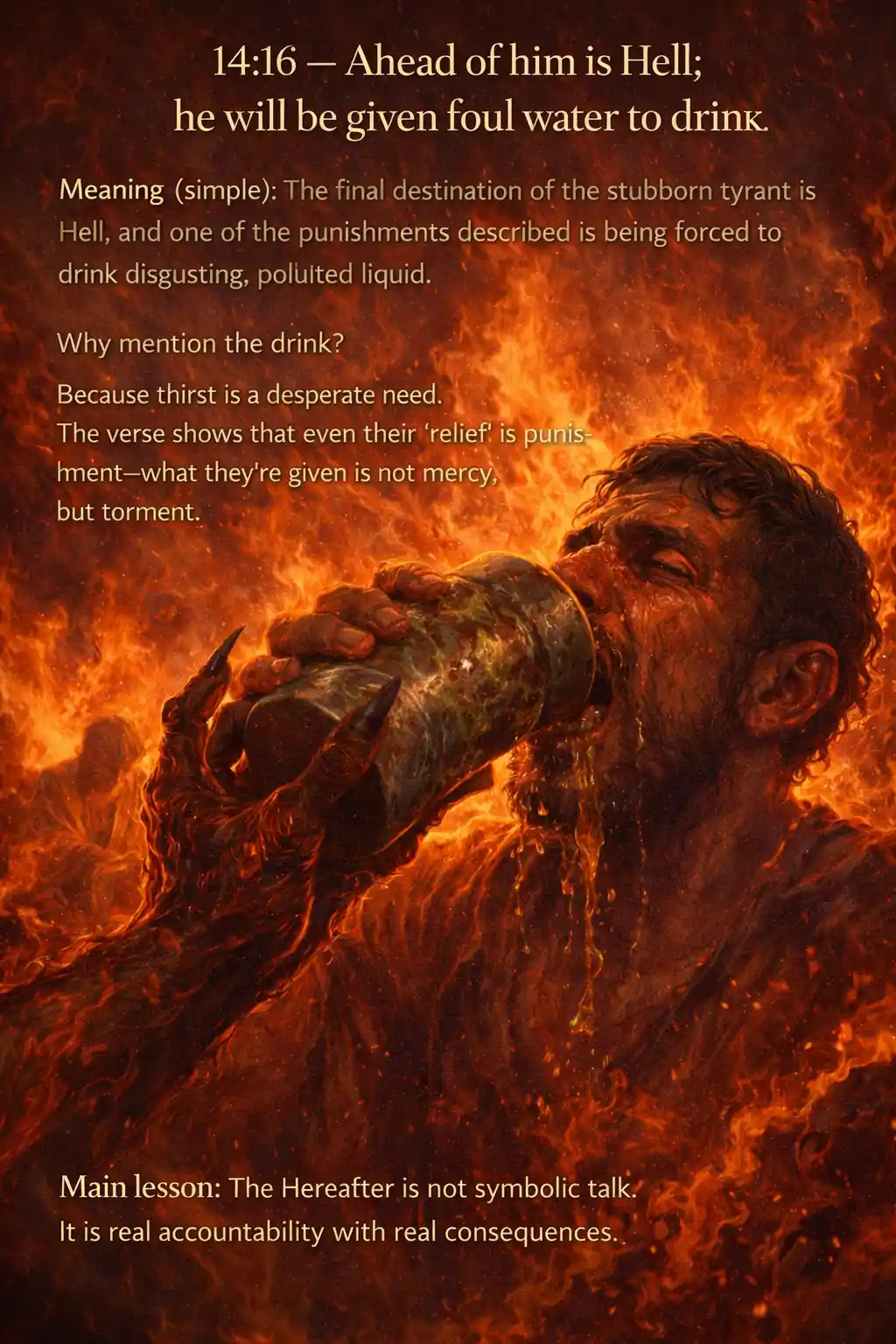
16Ahead of him is Hell, and he will be given to drink foul water.
17He will sip it and can hardly swallow it; death comes from every side, yet he will not die; beyond that is a harsh punishment.

Explanation (Verses 15–17)
14:15 — They sought victory; every stubborn tyrant was ruined
Meaning (simple):
The messengers and the believers asked Allah for help and a decisive outcome. Allah answered by giving victory to truth,
and every arrogant oppressor who refused guidance was eventually destroyed.
Key words explained:
“They sought victory”: they asked Allah to judge between truth and falsehood and to support His messengers.
“Stubborn tyrant”: someone who is:
• arrogant and refuses to submit to truth,
• oppressive to people,
• persistent in wrongdoing even after clear warnings.
Main lesson:
Oppression can look powerful for a while, but it has an expiration date. When Allah’s judgment comes, stubborn tyranny collapses.
14:16 — Ahead of him is Hell; he will be given foul water to drink
Meaning (simple):
The final destination of the stubborn tyrant is Hell, and one of the punishments described is being forced to drink
disgusting, polluted liquid.
Why mention the drink?
Because thirst is a desperate need. The verse shows that even their “relief” is punishment—what they’re given is not mercy, but torment.
Main lesson:
The Hereafter is not symbolic talk. It is real accountability with real consequences.
14:17 — He tries to sip it but can hardly swallow; death comes from every side, yet he won’t die; then more punishment
Meaning (simple):
He will try to drink that foul liquid:
• He sips it slowly (because it’s unbearable),
• He struggles to swallow (because it burns, chokes, and disgusts),
• He experiences suffering so severe it feels like death is coming from every direction…
…but he will not die.
Why “he will not die”?
Because in Hell, the punishment is not ended by death. The person remains alive to face the consequences.
“Beyond that is a harsh punishment”
Meaning: Even after this specific torment (the drink), there are more layers of punishment—continuous and severe.
Main lesson:
This is a warning: don’t be deceived by temporary power in this life. Arrogant oppression leads to a situation where suffering is intense,
but escape (even by death) is not granted.
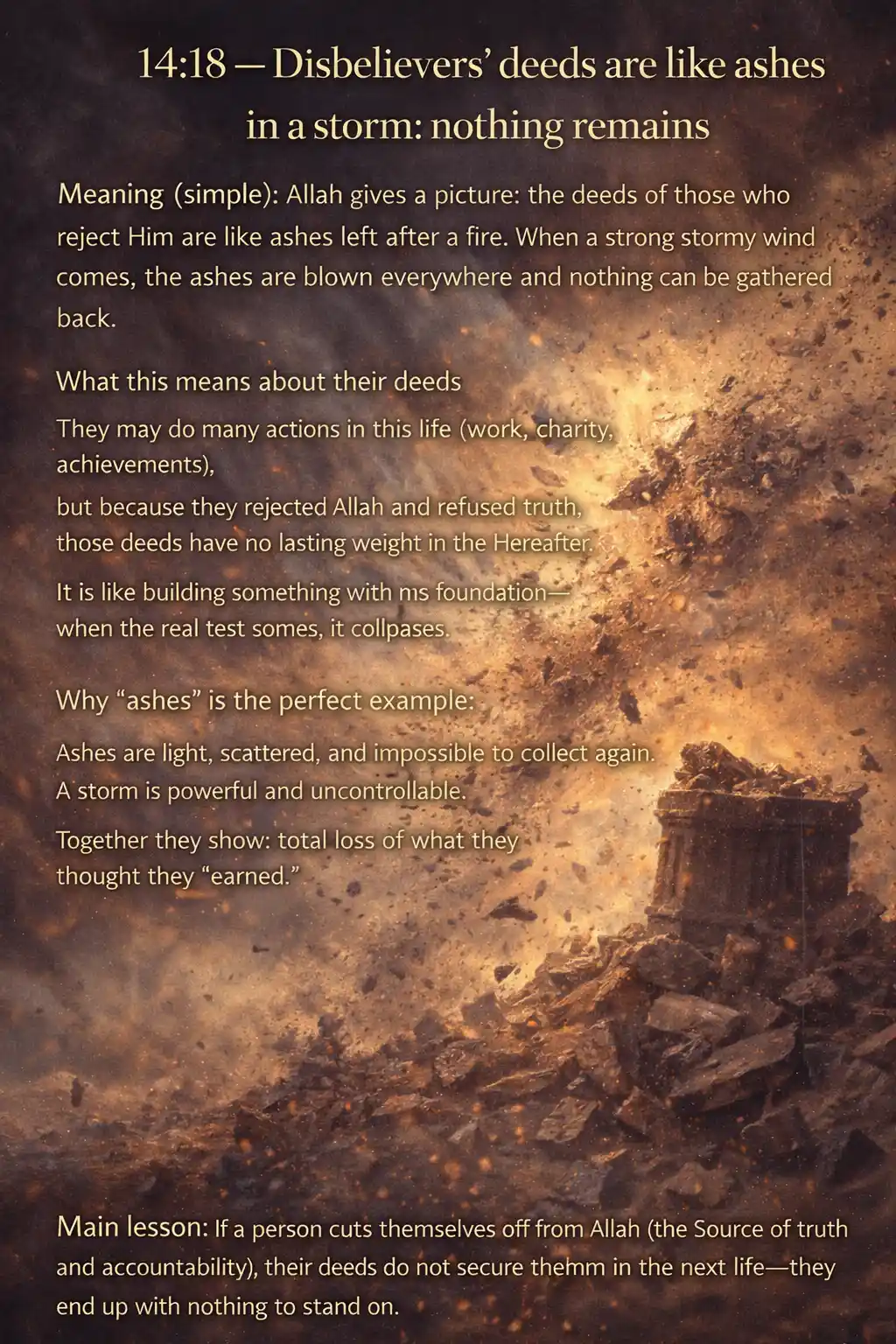
18The example of those who disbelieve: their deeds are like ashes blown by wind on a stormy day; they gain nothing from what they earned.
19Do you not see Allah created the heavens and earth in truth? If He wills, He can remove you and bring a new creation.
20That is not difficult for Allah.
Explanation (Verses 18–20)
14:18 — Disbelievers’ deeds are like ashes in a storm: nothing remains
Meaning (simple):
Allah gives a picture: the deeds of those who reject Him are like ashes left after a fire. When a strong stormy wind comes,
the ashes are blown everywhere and nothing can be gathered back.
What this means about their deeds:
• They may do many actions in this life (work, charity, achievements),
• but because they rejected Allah and refused truth, those deeds have no lasting weight in the Hereafter.
• It is like building something with no foundation—when the real test comes, it collapses.
Why “ashes” is the perfect example:
• Ashes are light, scattered, and impossible to collect again.
• A storm is powerful and uncontrollable.
• Together they show: total loss of what they thought they “earned.”
Main lesson:
If a person cuts themselves off from Allah (the Source of truth and accountability), their deeds do not secure them in the next life—
they end up with nothing to stand on.
14:19 — Allah created everything with truth; He can replace you with a new creation
Meaning (simple):
Look at the heavens and the earth: Allah made them in truth—meaning:
• with purpose,
• with order,
• with justice,
• not as a random accident.
Then Allah warns:
If He wants, He can remove you and bring a new creation.
What this teaches:
• Human beings are not “untouchable.”
• No nation, empire, or individual is permanent.
• If people insist on corruption and denial, Allah is fully able to replace them with others who will obey Him.
Main lesson:
Allah does not need anyone. We need Him. Existence itself is proof of His power, and replacement is easy for Him.
14:20 — That is not difficult for Allah
Meaning (simple):
Replacing people, creating again, bringing a new generation—this is easy for Allah.
Why?
Because Allah already created:
• the entire universe,
• life from nothing,
• order, laws of nature, and endless variety.
Main lesson:
Never think Allah’s warnings are empty. What seems impossible to humans is effortless for Allah.
21All will appear before Allah. The weak will say to the arrogant: “We followed you—can you help us against Allah’s punishment?” They reply: “If Allah guided us, we would guide you... no refuge.”
22Satan will say when the matter is decided: “Allah promised you truth; I promised you and betrayed you. I had no authority over you except that I invited you and you responded. So do not blame me—blame yourselves...”


Explanation (Verses 21–22)
14:21 — Everyone will stand before Allah; followers and leaders will argue, but nobody can save anyone
Meaning (simple):
On the Day of Judgment, everyone will come out and stand openly before Allah—no hiding, no excuses, no status.
Then a scene happens:
1) The weak speak to the arrogant leaders
The “weak” here means:
• people who followed others blindly,
• people who copied leaders, crowds, family, or society,
• people who lacked courage to think and obey Allah.
They say to the arrogant:
“We followed you—can you protect us from Allah’s punishment?”
They are basically saying:
“We did what you told us.”
“We trusted you.”
“Now help us.”
2) The leaders admit they cannot help
The leaders answer in despair:
“If Allah had guided us, we would have guided you.”
“There is no escape / no refuge.”
What this really means:
• They are admitting they are helpless.
• They admit they did not have real guidance.
• They admit: no one can shield anyone from Allah’s justice.
Main lesson:
Following people does not remove responsibility. On that Day:
• leaders can’t carry followers,
• followers can’t use leaders as an excuse,
• every soul faces Allah for its own choices.
14:22 — Satan’s speech: “I only invited you; you chose to follow. Blame yourselves.”
Meaning (simple):
After judgment is finalized—when people already know their outcome—Satan gives a speech to those who followed him.
1) Satan admits Allah was truthful
He says:
“Allah promised you truth.”
Meaning:
Allah warned you about accountability, Paradise, Hell, and consequences—and it was real.
2) Satan admits he lied
He says:
“I promised you and betrayed you.”
Meaning:
Satan’s “promises” were illusions:
• “No real punishment.”
• “You can repent later.”
• “Everyone does it.”
• “This sin is small.”
• “This life is all that matters.”
3) Satan exposes the key fact: he had no force over you
He says:
“I had no authority over you except that I invited you and you responded.”
Meaning:
• Satan cannot force you like a robot.
• He whispers, beautifies evil, encourages excuses—but you decide.
4) Satan says: don’t blame me, blame yourselves
He says:
“Do not blame me—blame yourselves.”
Meaning:
• You had a mind.
• You had warnings.
• You had chances to turn back.
• You chose desire, pride, and excuses.
Main lesson:
Shaytan’s power is mainly invitation and deception, not physical control. The verse destroys the common excuse:
“The devil made me do it.”
No—he suggested, and the person agreed.
23Those who believe and do righteous deeds will enter gardens... their greeting: “Peace.”
24Allah presents a parable: a good word is like a good tree—firm root, branches in the sky.
25It yields fruit at all times by its Lord’s permission.
26A bad word is like a bad tree—uprooted, with no stability.
27Allah keeps firm those who believe with the firm word in this life and the Hereafter...

Explanation (Verses 23–27)
14:23 — Believers who do good will enter gardens; their greeting is “Peace”
Meaning (simple):
Those who truly believe and live righteously will be admitted into Gardens (Paradise) with rivers.
When they enter, they are welcomed with “Peace”.
What “Peace” means here:
• Safety: no fear, no harm, no danger.
• Comfort: no stress, no panic, no sadness.
• Honor: a respectful greeting from Allah’s side and from the people of Paradise.
• Permanent calm: not temporary relief like in dunya—real lasting peace.
Main lesson:
Faith + good action leads to a final place of safety, honour, and calm.
14:24 — Allah gives an example: a good word is like a good tree (firm roots, high branches)
Meaning (simple):
Allah teaches with a parable: a good word is like a good tree:
• its roots are firm (it stands strong),
• its branches are high (it grows and spreads).
What is the “good word”?
At the core, it is:
• truthful belief in Allah and pure worship (tawḥīd),
• and everything that comes from it: truth, sincerity, remembrance of Allah, good speech, guidance.
Why compare it to a tree?
Because real faith is not only a feeling—like a tree, it has:
• roots (belief in the heart),
• a trunk (consistent character),
• branches (good actions and good effects).
Main lesson:
True faith is stable and it rises; it does not collapse under pressure.
14:25 — It gives fruit all the time by Allah’s permission
Meaning (simple):
That good tree keeps producing fruit repeatedly.
What “fruit” represents:
• good deeds,
• good character,
• wisdom,
• benefit to others,
• peace of heart,
• and reward in the Hereafter.
“By its Lord’s permission”
This is important: even the strongest believer only produces good consistently because Allah enables it—
guidance and steadiness are gifts from Allah.
Main lesson:
When faith is real, it keeps giving benefit—again and again—because Allah blesses it.
14:26 — A bad word is like a bad tree: uprooted, unstable
Meaning (simple):
A bad word is like a rotten tree:
• it has no deep roots,
• it gets pulled out easily,
• it cannot stand firm.
What is the “bad word”?
It includes:
• shirk (associating partners),
• denial of truth,
• hypocrisy,
• lies, arrogance, corrupt speech—anything built against Allah’s guidance.
Why this comparison?
Because falsehood may look strong for a moment, but it has:
• no solid foundation,
• no real stability,
• no lasting outcome.
Main lesson:
Falsehood is unstable. It doesn’t endure, even if it becomes popular temporarily.
14:27 — Allah keeps believers firm with the “firm word” in this life and the Hereafter
Meaning (simple):
Allah gives believers steadiness through the firm word—so they remain stable:
• in this life (during tests),
• and in the Hereafter (during the greatest moment of fear and questioning).
What is the “firm word”?
At its core:
• the truth of worshipping Allah alone,
• and the certainty that comes with it.
How Allah keeps a believer firm (examples):
• When tempted: they remember Allah and resist.
• When scared: they trust Allah and don’t collapse.
• When pressured: they don’t trade truth for approval.
• When facing death and the Hereafter: Allah gives them steadiness instead of confusion and regret.
Main lesson:
Stability is a gift from Allah. If you want to stay firm, hold tightly to the truth and keep turning back to Him.
28Have you not seen those who exchanged Allah’s favor for disbelief and led their people to the house of ruin—
29Hell, which they will enter; what an evil settlement.
30They set up rivals to Allah to mislead from His path. Say: “Enjoy for a while—your destination is the Fire.”
Explanation (Verses 28–30)
14:28 — People who traded Allah’s favor for disbelief, and dragged others to ruin
Meaning (simple):
Allah points to a type of people who were given Allah’s favour—truth, guidance, opportunities, safety,
knowledge, leadership, or blessings—but instead of being grateful, they replaced it with disbelief.
“Exchanged Allah’s favor for disbelief” means:
• Allah gave them guidance, but they chose denial.
• Allah gave them signs and understanding, but they chose arrogance.
• Allah gave them blessings and time, but they used it to fight truth.
“Led their people to the house of ruin” means:
These are not only disbelievers—they are leaders and influencers who:
• misguide families, tribes, nations, or followers,
• normalize falsehood,
• pressure others away from Allah,
• make disbelief and sin seem “normal” or “smart.”
So they don’t just ruin themselves—they take others with them.
Main lesson:
The worst misuse of Allah’s blessings is to use them to reject Him—and even worse is to become a cause of others’ ruin.
14:29 — That “house of ruin” is Hell: the worst place to settle
Meaning (simple):
Allah explains what that “ruin” is: Hell—a real destination they will enter.
“What an evil settlement” means:
• It is not a temporary discomfort; it is a terrible final place.
• It is the opposite of safety, peace, and honour.
• It is the end result of stubborn rejection and misguidance.
Main lesson:
This verse makes it clear: misleading people and rejecting truth is not a small issue—it has a final, severe outcome.
14:30 — They set up rivals to Allah to mislead people; Allah says: enjoy briefly, then the Fire
Meaning (simple):
Allah says they set up rivals to Allah—meaning they promote things that take Allah’s place in people’s hearts and obedience.
What “rivals” (partners) can look like in real life:
Not only statues—also:
• obeying leaders or scholars against Allah’s guidance,
• following culture/tradition when it contradicts truth,
• worship of wealth/status/desires as the “real priority,”
• making “what people think” more important than Allah.
Why do they do it?
“To mislead from His path”:
• They want people to follow their system, power, ego, or benefits.
• If people follow Allah’s guidance, false leadership loses control.
“Enjoy for a while”
Allah tells the Prophet to say:
• Go ahead—enjoy your temporary life.
• Your time is limited.
• This enjoyment is not proof you are right; it’s a short test.
“Your destination is the Fire”
Meaning:
• If you persist in this path—misguiding others and setting rivals to Allah—the end is Hell.
Main lesson:
Temporary success in dunya is not proof of safety. The real question is: did you use Allah’s blessings to guide people to truth—or to mislead them?
31Tell My believing servants to establish prayer and spend from what We provided them—secretly and openly—before a Day comes with no bargaining and no friendship.
Explanation (Verse 31)
14:31 — Establish prayer and spend (charity), before a Day when nothing can be “traded” and no friendship can save you
Meaning (simple):
Allah tells the Prophet to deliver a direct instruction to believers:
• Establish prayer (ṣalāh)
• Spend from what Allah provided (charity/support)
Do it secretly and openly, before the Day of Judgment arrives—because on that Day, the usual worldly “ways out” will not work.
1) “Tell My believing servants…”
This wording is gentle and honouring:
• Allah calls them “My servants” — showing closeness, care, and ownership.
• It also implies: if you truly belong to Allah, your life must show it.
2) “Establish prayer”
Not just “pray sometimes,” but establish it—meaning:
• keep it consistent,
• treat it as a pillar of life,
• protect its time,
• perform it properly (with seriousness, humility, and intention).
Why prayer is first:
• Prayer connects the believer to Allah daily.
• It disciplines the heart.
• It keeps faith alive and protects from slipping into sin.
3) “Spend from what We provided them”
Meaning (simple):
Allah reminds you: your money and resources are provision from Him.
So spending for good is not “losing”—it’s using Allah’s gift in Allah’s way.
What “spend” includes:
• obligatory charity (like zakah where applicable),
• voluntary charity (ṣadaqah),
• helping family, the needy, the vulnerable,
• supporting good causes and truth.
4) “Secretly and openly”
This shows balance:
Secret spending:
• purer intention (less showing off),
• protects the dignity of the person receiving,
• builds sincerity between you and Allah.
Open spending:
• can encourage others to give,
• can normalize generosity in society,
• can support public needs openly.
Main idea:
Give in both ways—what matters is sincerity and real benefit.
5) “Before a Day comes with no bargaining and no friendship”
This is the warning:
The Day of Judgment is not like dunya.
“No bargaining” means:
• no paying your way out,
• no deals, no bribes, no negotiations,
• no “I’ll do extra later if you let me pass today.”
“No friendship” means:
• no personal connections can override Allah’s justice,
• no “but he’s my friend / my leader / my family” as protection,
• relationships won’t save you unless they were based on truth and righteousness.
So what will matter then?
• your faith,
• your prayer,
• your sincerity,
• your deeds (including charity),
• and Allah’s mercy.
Main lesson (very simple):
Do the important things now—prayer and charity—because a Day is coming when you cannot buy your way out,
and no friend can save you.
32Allah created the heavens and earth, sent down water, produced fruits, subjected ships and rivers.
33He subjected the sun and moon, and the night and day.
34He gave you from all you asked; if you count Allah’s blessings you cannot enumerate them. Truly, man is greatly unjust and ungrateful.


Explanation (Verses 32–34)
14:32 — Allah created everything and provides for you through it
Meaning (simple):
Allah reminds people of clear, everyday proofs of His power and mercy:
1) He created the heavens and the earth
The universe is not random.
Its order and design point to a Creator with knowledge and control.
2) He sends down water from the sky
Rain is a gift that life depends on.
Without it, crops die, animals die, and people suffer.
3) He brings out fruits and provision by that water
Rain becomes food: fruits, crops, plants.
This shows Allah provides in a planned way: water → growth → nourishment.
4) He “subjected” ships and rivers
“Subjected” means: Allah made them usable for you.
Ships: Allah made the sea’s laws and properties such that humans can build ships, float, travel, trade, and carry goods.
Rivers: Allah made rivers flow in stable paths, supplying drinking water, irrigation, transport, and life for towns.
Main lesson:
The world is full of signs that Allah is the Creator and Provider. What looks “normal” is actually mercy and control.
14:33 — Allah made the sun, moon, night, and day serve a purpose
Meaning (simple):
Allah reminds you of the biggest systems that run your life:
Sun and moon
The sun gives light, warmth, seasons, growth, and energy.
The moon helps mark time, months, and patterns (especially important historically and for calendars).
Night and day
Day: work, movement, earning, visibility.
Night: rest, quiet, recovery.
These cycles are stable and reliable, not chaotic.
Main lesson:
Allah placed you in a perfectly functioning system that supports life. That stability is not self-created—it is Allah’s management.
14:34 — Allah gave you more than you can count; yet humans can be unjust and ungrateful
Meaning (simple):
Allah says: He gave you from all that you asked for—and even beyond what you asked.
This includes:
• things you asked for directly (food, safety, help),
• and things you benefit from without even asking (health, air, time, senses, family, opportunities).
“If you count Allah’s blessings you cannot enumerate them”
Meaning:
• Allah’s favours are too many to fully count.
• Even one blessing (like eyesight) has countless layers inside it.
“Truly, man is greatly unjust and ungrateful”
This is a warning about a common human weakness:
Unjust can mean:
• using Allah’s gifts for disobedience,
• denying the Giver,
• harming others despite receiving so much.
Ungrateful can mean:
• taking blessings as “normal” and forgetting Allah,
• complaining constantly while ignoring what you already have,
• attributing blessings only to oneself (“I earned it alone”).
Main lesson:
Allah’s blessings surround you, but the danger is forgetting the One who gave them. Real gratitude is recognizing Allah, obeying Him, and using His gifts correctly.
35Ibrahim said: “My Lord, make this city secure and keep me and my sons away from worshipping idols.”
36“They have misled many people. Whoever follows me is of me; whoever disobeys—You are Forgiving, Merciful.”
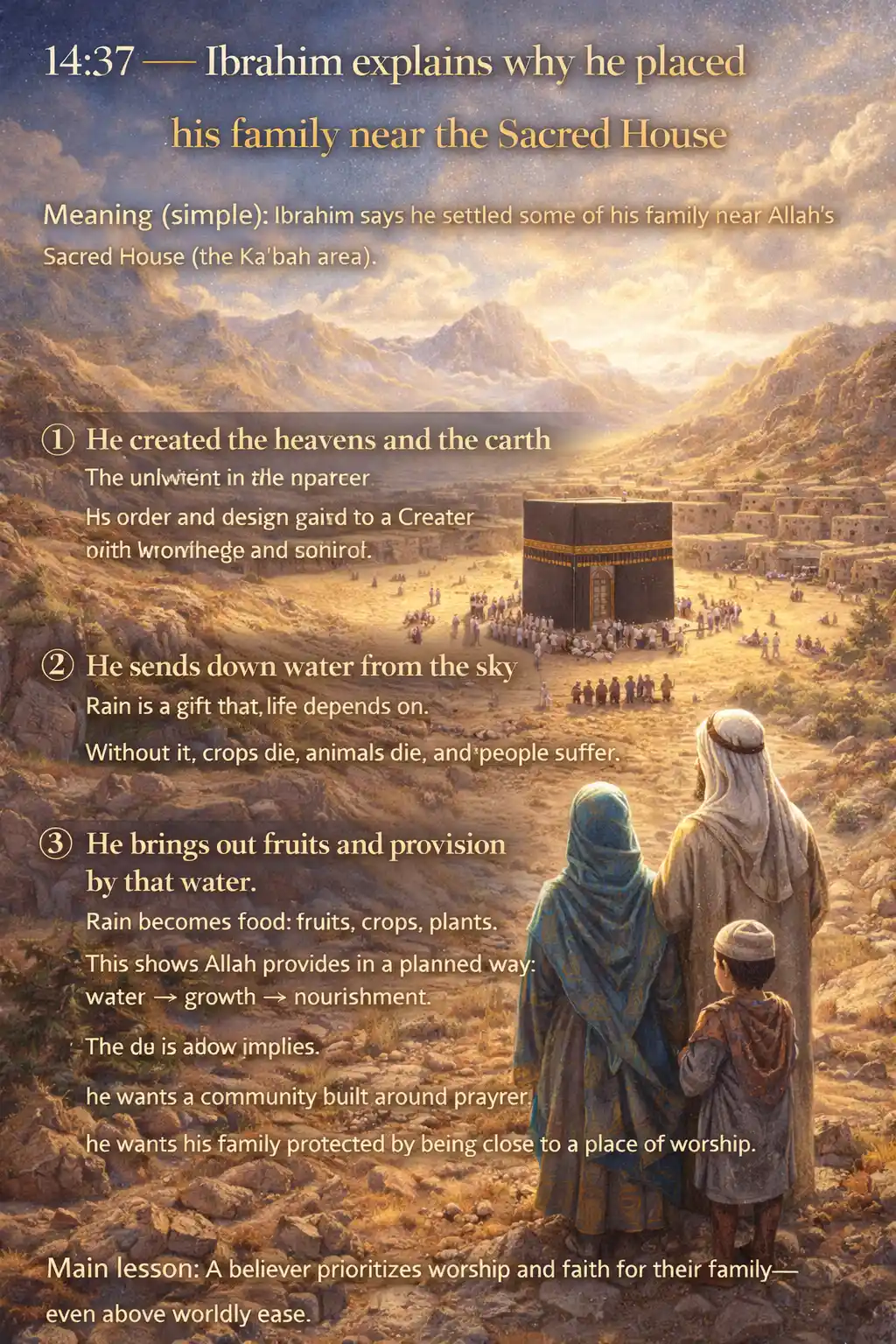
37“I settled some of my offspring near Your Sacred House... so that they establish prayer...”
38“Our Lord, You know what we conceal and what we reveal...”
Explanation (Verses 35–38)
14:35 — Ibrahim asks for safety and protection from idolatry
Meaning (simple):
Ibrahim (Abraham) makes two big du‘a (requests):
“Make this city secure”
He asks Allah to make the place safe—free from fear, violence, and chaos.
Safety matters because worship, family life, and building a community are hard without security.
“Keep me and my sons away from worshipping idols”
Ibrahim is not only worried about danger outside—he’s worried about a danger inside the heart:
shirk (idolatry/associating partners).
Even though he is a prophet, he shows humility: guidance and protection are from Allah.
Main lesson:
The greatest safety is not only physical safety—it is spiritual safety from shirk.
14:36 — Idols mislead many; Ibrahim leaves judgment to Allah’s mercy
Meaning (simple):
Ibrahim says idols have misled many people—because people:
• copy society blindly,
• follow desires,
• follow traditions without proof.
Then he says:
“Whoever follows me is of me”
Meaning: whoever follows the path of pure worship and obedience is truly part of Ibrahim’s way.
“Whoever disobeys—You are Forgiving, Merciful”
Meaning: Ibrahim does not act like he controls people’s hearts or destiny.
He still leaves the door open to Allah’s mercy—because people can repent.
Main lesson:
Guidance is a choice, but Allah’s mercy remains open for the one who turns back sincerely.
14:37 — Ibrahim explains why he placed his family near the Sacred House
Meaning (simple):
Ibrahim says he settled some of his family near Allah’s Sacred House (the Ka‘bah area).
Key details:
It was a difficult place (historically barren and hard), but he did it for a higher purpose.
“So that they establish prayer”
Meaning: the main goal is worship and obedience, not comfort and luxury.
This du‘a also implies:
• he wants a community built around prayer,
• he wants his family protected by being close to a place of worship,
• he wants their lives to have a clear spiritual center.
Main lesson:
A believer prioritizes worship and faith for their family—even above worldly ease.
14:38 — Allah knows everything hidden and visible
Meaning (simple):
Ibrahim ends by saying:
Allah knows what we hide and what we show.
Nothing is secret from Allah—feelings, intentions, fears, motives, and prayers.
So Ibrahim is trusting that:
• Allah understands the full reality behind his du‘a,
• Allah knows what his family will face,
• Allah knows what he truly wants in his heart.
Main lesson:
Your du‘a does not need perfect wording. Allah already knows the full truth inside you—hidden and open.
39“Praise be to Allah who granted me Ishmael and Isaac in old age...”
40“My Lord, make me an establisher of prayer—and from my offspring...”
41“Our Lord, forgive me, my parents, and the believers on the Day the reckoning is established.”
Explanation (Verses 39–41)
14:39 — Ibrahim thanks Allah for children in old age
Meaning (simple):
Ibrahim says: “All praise is for Allah who gave me Ishmael and Isaac in old age.”
What this shows:
• Gratitude: Ibrahim is openly thankful, not taking blessings for granted.
• Allah’s power: Having children in old age is normally unlikely, so it highlights that Allah gives beyond “normal limits.”
• Answered du‘a: Ibrahim had long desired righteous offspring, and Allah granted it at the right time.
Main lesson:
When Allah gives a blessing—especially after long waiting—it should increase gratitude and humility, not pride.
14:40 — Ibrahim asks to be consistent in prayer, and wants it for his children too
Meaning (simple):
Ibrahim makes a practical du‘a:
“My Lord, make me an establisher of prayer…”
Meaning: not just someone who prays sometimes, but someone who maintains prayer consistently—protecting its time and treating it as a pillar of life.
“…and from my offspring…”
Meaning: he wants his children and future generations to also be people of ṣalāh.
Why this is important:
• Prayer is the strongest daily connection to Allah.
• Ibrahim’s goal is not only “successful children” in dunya—he wants faithful children who remember Allah.
Main lesson:
A righteous parent doesn’t only ask for worldly success—he asks for worship and guidance to continue in the family line.
14:41 — Ibrahim asks forgiveness for himself, his parents, and all believers on Judgment Day
Meaning (simple):
Ibrahim asks Allah:
• to forgive him,
• to forgive his parents,
• and to forgive the believers,
on the Day when the حساب (reckoning/accounting) is established.
What this teaches:
• Everyone needs forgiveness: Even a prophet asks for it, showing humility.
• Care for others: He is not only thinking about himself—he includes parents and the whole community of believers.
• Focus on the Day of Judgment: That Day is when deeds are weighed and decisions are final, so forgiveness matters most then.
Main lesson:
Success is not only having blessings in life—success is being forgiven when you stand before Allah.
42Do not think Allah is unaware of what wrongdoers do; He only delays them to a Day when eyes will stare.
43Rushing forward, heads raised, gaze not returning, hearts emptied.
44Warn people of the Day punishment comes; wrongdoers will ask for delay...
45You lived in the dwellings of those who wronged themselves, and it became clear how We dealt with them...
46They plotted, but their plot is with Allah—even if their plot could move mountains.
Explanation (Verses 42–46)
14:42 — Allah is not unaware; He is delaying them to a terrifying Day
Meaning (simple):
Allah tells the Prophet (and everyone): do not think Allah is “not seeing” what wrongdoers do.
• Allah knows knows every ظلم (oppression), lie, theft, cheating, and harm.
• The reason they are not punished immediately is because Allah is giving delay (time).
Why delay?
• It is a test: will they repent or become worse?
• It is also justice: their record becomes complete.
• But the delay is not safety. It is only postponement until the Day of Judgment.
“to a Day when eyes will stare”
Meaning: people will be shocked, terrified, unable to look away—like someone frozen in fear.
Main lesson:
Allah’s silence is not approval. Delay is not escape.
14:43 — Their panic on that Day: rushing, heads up, eyes fixed, hearts empty
Meaning (simple):
Allah describes the state of people when Judgment arrives:
• “Rushing forward”: moving fast in panic, like running with no plan.
• “Heads raised”: not relaxed; stiff with fear and shock.
• “Their gaze not returning”: they are staring forward, frozen—like they cannot blink or look away.
• “Hearts emptied”: their hearts feel hollow—no comfort, no calm, no hope—just terror.
This is the opposite of dunya confidence:
• In the world they felt in control.
• On that Day they are completely exposed and powerless.
Main lesson:
Arrogance disappears when reality hits; fear replaces it.
14:44 — Warn them: when punishment comes, they will beg for more time
Meaning (simple):
Allah tells the Prophet: warn people about the Day punishment comes.
On that Day, the wrongdoers will beg:
• “Give us more time, just a little delay.”
Why?
• Because they will finally see the truth clearly.
• They will want a second chance to obey and fix what they ruined.
But the point is:
• That Day is not a “second chance” day.
• It is the day of final results.
Main lesson:
Repentance is for now—not when consequences are already in front of your eyes.
14:45 — You saw what happened to earlier wrongdoers; the warning was already clear
Meaning (simple):
Allah says: you lived in the lands/homes of people before you who wronged themselves.
Meaning:
• You saw ruins, collapsed nations, destroyed civilizations, stories passed down.
• You heard what ظلم did to them.
“And it became clear how We dealt with them”
Allah already showed examples in history: when corruption becomes stubborn and people refuse truth, they fall.
So the argument “we didn’t know” is not valid.
The evidence was around you.
Main lesson:
History is a warning sign. If people repeat the same ظلم, they should expect a similar end.
14:46 — They plotted, but Allah already encompasses their plot—even if it seems huge
Meaning (simple):
Allah says they planned and plotted (against the Prophet, against truth, against believers).
But:
• Their plot is already within Allah’s control and knowledge.
• They cannot outsmart Allah.
“even if their plot could move mountains”
This phrase shows how massive and powerful their planning may seem:
• propaganda,
• power,
• alliances,
• persecution,
• strategies that look “unstoppable.”
Yet Allah’s control is greater than all of it.
Main lesson:
No matter how strong falsehood looks, it is still under Allah’s authority—and it cannot defeat the final truth.
47Do not think Allah will fail His promise to His messengers. Allah is Mighty, capable of retribution.
48The Day the earth is changed to another earth, and the heavens; and they appear before Allah, the One, the Irresistible.
49You will see the criminals bound together in chains.
50Their garments of tar; fire covering their faces.
51So Allah may repay every soul for what it earned; Allah is swift in reckoning.
52This is a proclamation for mankind: to be warned by it, to know He is One God, and for people of understanding to take heed.
Explanation (Verses 47–52)
14:47 — Allah will not fail His promise to His messengers
Meaning (simple):
Allah says: don’t ever think Allah will break His promise to His messengers.
What promises are included here:
• that truth will eventually be made clear,
• that ظلم (oppression) will not last forever,
• that the messengers will be supported,
• and that final justice will come, even if it is delayed.
Why people might “think” it’s failing:
• because they see wrongdoers living comfortably,
• believers being tested,
• truth being mocked for a time.
Allah answers with two names:
• Mighty: no one can overpower Him.
• Capable of retribution: when Allah decides to punish, no one can stop it.
Main lesson:
Delay is not defeat. Allah’s justice and promise always arrive at the appointed time.
14:48 — The Day the earth and heavens are changed, and everyone stands before Allah
Meaning (simple):
This verse describes the Day of Judgment as a complete transformation:
• The earth will be changed into another earth (a new reality, not the familiar world system).
• The heavens will also be changed.
• Everyone will be brought forward and will stand exposed before Allah.
Allah is described as:
• The One: no partners, no equals.
• The Irresistible: nothing can resist His command or escape Him.
Main lesson:
Judgment Day is not “just another day.” It is a total change of reality, where everyone stands before the only true Authority.
14:49 — The criminals will be chained together
Meaning (simple):
Those who committed serious جرم (crimes) against Allah’s guidance—especially disbelief, ظلم, corruption—will be seen:
• bound in chains,
• linked together (like prisoners being dragged and controlled).
This shows:
• humiliation after arrogance,
• loss of freedom after they abused freedom in dunya.
Main lesson:
Those who used their freedom to do evil will face a reality where freedom is removed.
14:50 — Their clothing and faces: tar-like garments and fire covering them
Meaning (simple):
Allah gives a terrifying image of punishment:
Garments of tar (or a burning, sticky substance):
• it clings,
• it is filthy,
• it fuels burning and misery.
Fire covering their faces:
• the face is the place of dignity and identity,
• so this shows extreme humiliation and pain.
Main lesson:
The Hereafter punishment is real, severe, and humiliating for those who insisted on rebellion.
14:51 — Allah repays every soul for what it earned; Allah is swift in reckoning
Meaning (simple):
Allah explains the reason for this scene:
• Every person will be repaid for what they earned (what they chose and did).
• Nothing is missed: public deeds and hidden intentions.
“Swift in reckoning” means:
• Allah’s judgment does not get delayed by complexity.
• Allah can account for all people perfectly, without confusion or error.
Main lesson:
No injustice will remain unpaid, and no good deed will be lost. Everyone will receive exact justice.
14:52 — The Qur’an is a public warning: know Allah is One, and take heed
Meaning (simple):
Allah ends the surah with the purpose of the message:
A proclamation for mankind:
• This Qur’an is not only for one tribe or time.
• It is for all people.
To be warned by it:
• So people wake up before it’s too late.
To know He is One God:
• The central truth: worship Allah alone, without partners.
For people of understanding to take heed:
• People who think deeply and are honest will learn, change, and prepare.
Main lesson:
These verses are not meant to entertain or scare for no reason. They are meant to warn, correct belief, and push people toward truth and accountability.