- Ending treaties with open idolaters who repeatedly broke agreements.
- Separating sincere believers from hypocrites and political allies of disbelief.
- Putting loyalty to Allah and His Messenger above family, tribe or comfort.
Every ayah should be read with the Qur'anic rules of justice: no killing of innocents, no treachery, treaties honoured, and mercy to those who seek protection.
1. Freedom from obligation (is proclaimed) from Allah and His Messenger toward those of the idolaters with whom you made a treaty.
2. So travel freely in the land for four months, and know that you cannot escape Allah, and that Allah will disgrace the disbelievers.
3. And it is a proclamation from Allah and His Messenger to the people on the day of the greater pilgrimage that Allah is free from obligation to the idolaters, and so is His Messenger. So if you repent, then it is better for you; and if you turn away, then know that you cannot escape Allah. And give tidings to those who disbelieve of a painful punishment.
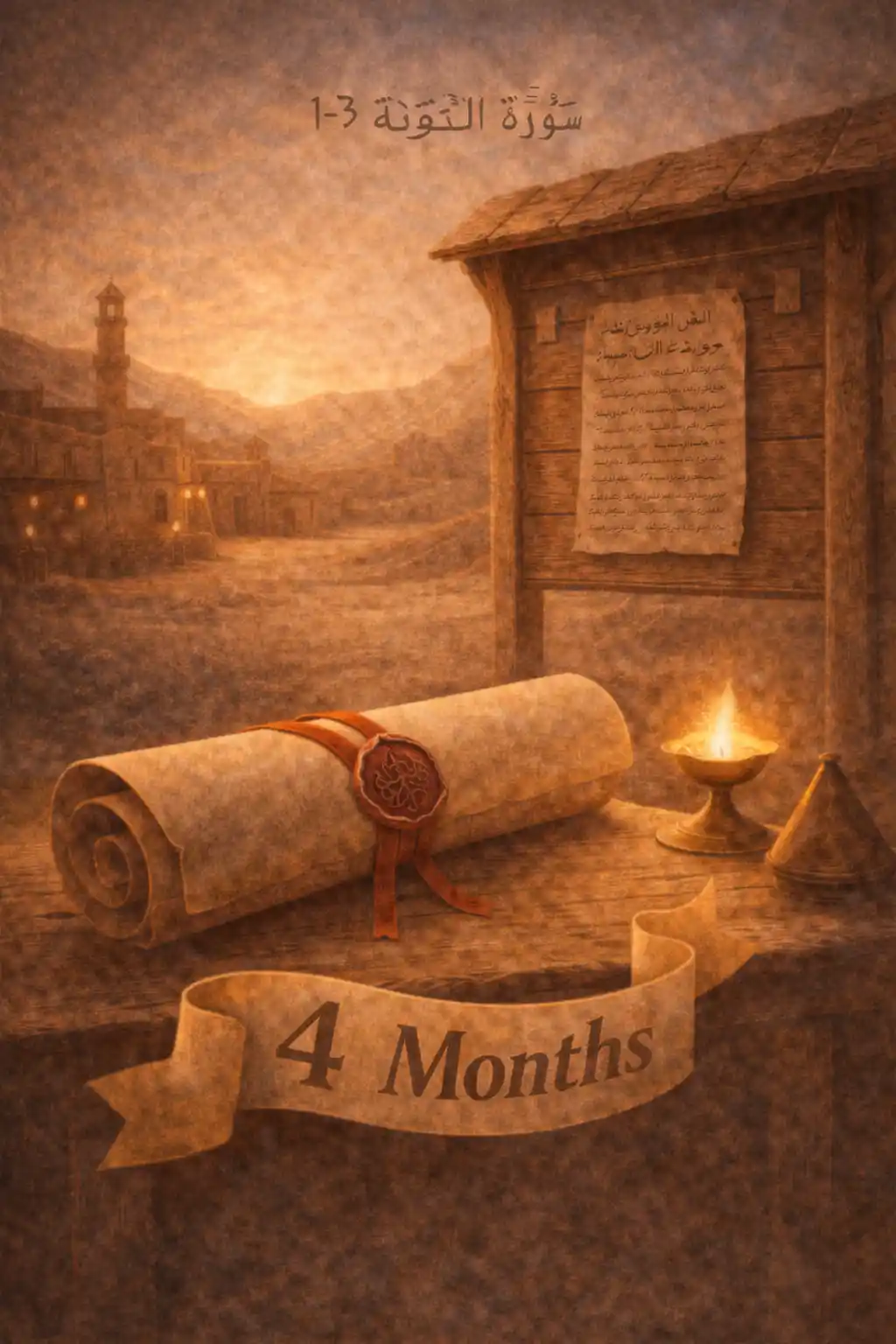
4. Except for those with whom you (Muslims) made a treaty among the idolaters, and they have not failed you in anything and have not supported anyone against you. So fulfill to them their treaty until their term. Indeed, Allah loves those who are righteous.
Explanation: Cancelling agreements is allowed, but not treachery
- 9:1–3 – Allah publicly cancels treaty obligations with certain idolaters who repeatedly broke faith and fought the believers. They are given a clear four-month notice to move around safely and decide whether they will repent or persist.
- The message is not a secret ambush: it is announced at Hajj, in front of everyone, showing that Islam is not a hidden conspiracy but open and principled.
- 9:4 – At the same time, Allah commands that any idolaters who did keep their treaty faithfully must still be honoured until the end of the agreed term. Justice is not cancelled because others misbehaved.
5. Then, when the sacred months have passed, slay the idolaters wherever you find them, and take them captive, and besiege them, and sit in wait for them at every place of ambush. Then if they repent and establish prayer and give the poor-due, then leave their way free. Indeed, Allah is Forgiving, Merciful.
6. And if any one of the idolaters seeks your protection, then protect him so that he may hear the Word of Allah; then deliver him to his place of safety. That is because they are a people who do not know.

Explanation: War orders in a specific context, not a license for chaos
- These ayat refer to a particular group of idolaters who: repeatedly broke treaties, attacked first, and abused the sacred months.
- After the four-month grace period, the believers are ordered to confront them decisively. This is a state of open war, not everyday normal life in every country and every era.
- The command is balanced by an immediate condition: if they stop fighting, repent, and accept lawful order (salah and zakat), their path must be cleared. No revenge, no extra humiliation.
- Verse 6 proves this is not “kill all idolaters anywhere forever”: even in this war context, if any of them asks for protection, Muslims must protect him, let him hear the Qur'an, and then escort him back to safety.
7. How can there be for the idolaters a treaty with Allah and with His Messenger, except for those with whom you made a treaty near Al-Masjid al-Haram? So as long as they stand true to you, stand you true to them. Indeed, Allah loves those who are righteous.
8. How (can there be any treaty with them) while, if they gain dominance over you, they do not respect concerning you any kinship nor agreement? They seek to please you with their mouths while their hearts refuse, and most of them are disobedient.
9. They have sold the signs of Allah for a small price and have hindered people from His way. Indeed, evil is what they were doing.
10. They do not respect regarding a believer any kinship nor agreement. And it is they who are the transgressors.
Explanation: Two groups – honourable minority and treacherous majority
- 9:7 – Again, Allah makes an exception: those idolaters who were given a treaty near the Sacred Mosque and remained loyal still deserve loyalty. “As long as they stand true to you, stand you true to them.”
-
9:8–10 describe another group who:
- Would show no respect for ties of kinship or written agreements if they had power.
- Say nice words, but inside they reject and oppose the believers.
- Use religion for a “small price” – some worldly benefit – and block others from Allah’s path.
- These are called “transgressors”, so the tough measures in this surah are directed to this type of enemy, not to peaceful neighbours or ordinary non-Muslims.
Surah At-Tawbah (9) – Qur'an-Only Explanation
- Context: After years of aggression, some groups still plotted, broke oaths and attacked the believers.
- Key principle: No blind loyalty to tribe or contracts when they are used to protect open hostility to Allah’s guidance.
- Balance: Firmness against treachery, but safety and protection for anyone who sincerely seeks to understand Allah’s words.
1. Freedom from obligation (is proclaimed) from Allah and His Messenger toward those of the idolaters with whom you made a treaty.
2. So travel (freely) in the land four months, and know that you cannot escape Allah, and that Allah will disgrace the disbelievers.
3. And (it is) a proclamation from Allah and His Messenger to the people on the day of the greater pilgrimage that Allah is free from obligation to the idolaters, and (so is) His Messenger. So if you repent, then it is better for you, and if you turn away, then know that you cannot escape Allah. And give tidings to those who disbelieve of a painful punishment.
4. Except those with whom you (Muslims) made a treaty among the idolaters, then they have not failed you in anything, nor have aided against you anyone. So fulfil to them their treaty until their term. Indeed, Allah loves those who are righteous.
Explanation (1–4)
These verses announce that Allah and His Messenger are no longer bound by treaties with idolaters who repeatedly violated agreements. But it is not a blanket cancellation of all treaties.
- Verse 1–3: Public declaration at Hajj: no more protection for hostile idolaters. They are given four months of amnesty to travel, think, and decide — to repent or to continue.
- They are warned clearly: they cannot escape Allah’s judgement, even if they feel safe in numbers or land.
- Verse 4: A crucial exception: any group that kept the treaty honestly and never helped enemies against the believers must have the treaty honoured until its full term. Allah loves this justice (taqwa).
5. Then, when the sacred months have passed, then slay the idolaters wherever you find them, and take them (captive), and besiege them, and sit in wait for them at every place of ambush. Then if they repent and establish prayer and give the poor-due, then leave their way free. Indeed, Allah is Forgiving, Merciful.
6. And if any one of the idolaters seeks your protection, then protect him so that he may hear the Word of Allah, then deliver him to his place of safety. That is because they are a people who do not know.
7. How can there be for the idolaters a treaty with Allah and with His Messenger, except those with whom you made a treaty near Al-Masjid Al-Haram. So as long as they stand true to you, so stand you true to them. Indeed, Allah loves those who are righteous.
8. How (can there be any treaty with them) while if they gain dominance over you, they do not respect concerning you any kinship, nor agreement. They seek to please you with their mouths, while their hearts refuse. And most of them are disobedient.
9. They have sold the signs of Allah for a small price and have hindered people from His way. Indeed, evil is what they were doing.
10. They do not respect in regard to a believer any kinship, nor agreement. And it is they who are the transgressors.
Explanation (5–10)
Verse 5 is often quoted alone to attack Islam, but here we see its conditions and limits in context.
- Verse 5: After the four-month grace period, those same hostile idolaters who keep fighting and plotting can be fought wherever they appear as enemies (war situation). But if they repent, establish prayer, and pay zakat, they must be left alone. Allah opens the door of forgiveness.
- Verse 6: Even an idolater who is still in shirk but asks for protection to listen to Allah’s words must be protected and safely escorted back. This destroys the idea that Muslims must kill all non-Muslims. The command here is: protect, explain, and then safely return him.
- Verse 7: Again, exception is repeated: any group that keeps its treaty near the Sacred Mosque and does not cheat must be given full loyalty. Allah loves those who are fair and honourable.
-
Verses 8–10: The ones targeted are those who:
- Would show no mercy if they gained power over the believers.
- Only use sweet words, but secretly hate and oppose the truth.
- Sell Allah’s signs for small worldly gain and block people from His path.
- Respect neither family ties nor agreements when dealing with believers.
11. But if they repent and establish prayer and give the poor-due, then they are your brothers in religion. And We detail the verses for a people who have knowledge.
12. And if they break their pledges after their treaty (with you) and assail your religion, then fight the leaders of disbelief. Indeed, there are no oaths (sacred) to them, so that they might cease.
13. Would you not fight a people who have violated their oaths, and intended to expel the Messenger, and they began (the attack upon) you the first time. Do you fear them. But Allah has more right that you should fear Him, if you are believers.
14. Fight them, Allah will punish them by your hands, and He will disgrace them, and will give you victory over them, and He will heal the breasts of a people who are believers.
15. And He will remove the anger of their (believers’) hearts. And Allah turns in forgiveness to whom He wills. And Allah is All Knowing, All Wise.
16. Do you think that you shall be left alone while Allah has not yet made evident those who strive among you. And they have not taken, besides Allah and His Messenger and the believers, intimates. And Allah is Informed of what you do.
Explanation (11–16)
These verses show that the door of brotherhood is always open for sincere repentance, but that chronic oath-breakers and aggressors cannot hide behind treaties.
- Verse 11: The moment previous enemies repent, establish prayer, and pay zakat, they are no longer treated as enemies but as brothers in the same faith. Hostility is not permanent; it ends with sincere submission to Allah.
- Verse 12: When groups break their pledges and openly attack the religion, they are described as “leaders of disbelief”. They use treaties only as tools, not as real commitments. Fighting them is to make them stop.
-
Verse 13: These people:
- Violated oaths repeatedly,
- Planned to expel the Messenger,
- Started the aggression first.
-
Verses 14–15: Allah uses your struggle to:
- Punish oppressive aggressors,
- Give victory to the believers,
- Heal the hearts of those who were oppressed and harmed.
- Verse 16: Believers will not be left untested. Allah exposes who truly strives for His cause and who takes secret allies over Allah, His Messenger, and the believers.
17. It is not for the idolaters to maintain the mosques of Allah, bearing witness against themselves of disbelief. As for such, their deeds have become worthless and in the Fire they will abide.
18. The mosques of Allah shall be maintained only by those who believe in Allah and the Last Day and establish prayer and give the poor-due and do not fear except Allah. For is it expected that those will be of the (rightly) guided.
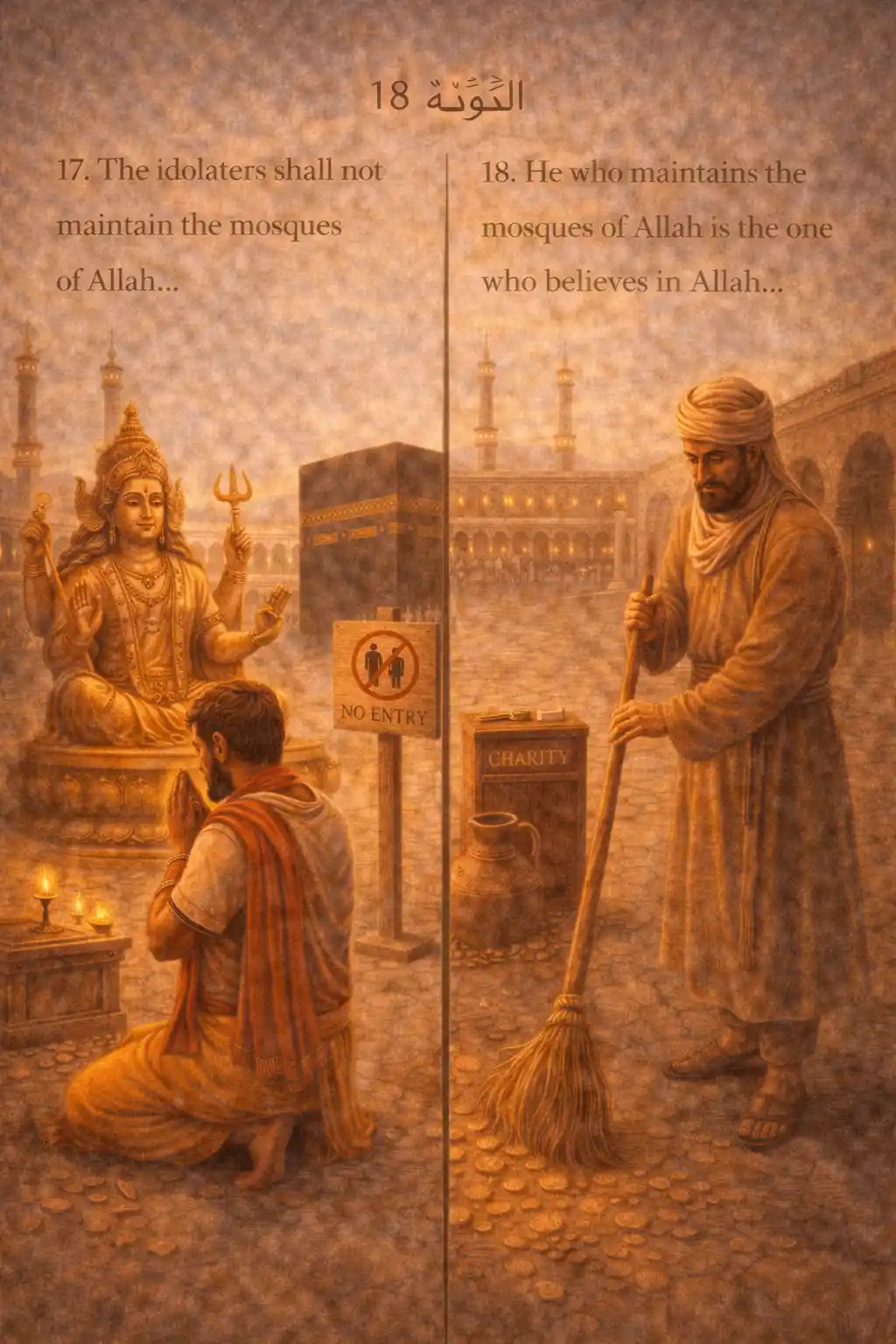
19. Have you made the providing of water to the pilgrims and the maintenance of Al-Masjid Al-Haram as (equal to the deeds of) him who believes in Allah and the Last Day, and strives in the way of Allah. They are not equal in the sight of Allah. And Allah does not guide the wrongdoing people.

20. Those who have believed, and emigrated, and striven in the cause of Allah with their wealth and their lives are of much greater ranks with Allah. And it is those who are the successful.
21. Their Lord gives them good tidings of mercy from Him, and good pleasure, and gardens for them wherein is everlasting delight.
22. Abiding therein forever. Indeed, with Allah there is immense reward.
Explanation (17–22)
These verses correct a misunderstanding: some people thought that physical service to the sanctuary alone (like giving water to pilgrims) gives them the highest rank, even if they are in shirk or not committed to Allah’s path.
- Verse 17: Idolaters cannot claim honour of “maintaining” Allah’s mosques while openly witnessing against themselves with disbelief. Their outward works have no weight with Allah without faith.
-
Verse 18: The ones truly maintaining the mosques are those who:
- Believe in Allah and the Last Day,
- Establish the prayer,
- Give zakat,
- Fear none but Allah.
- Verse 19: Providing water for pilgrims and looking after the physical building of the Sacred Mosque is good, but it is not equal to faith + striving in Allah’s way. You cannot put outward service above sincere iman and sacrifice. (“Don’t think that just doing respectable religious services makes you equal to someone who has real faith and sincerely struggles for Allah’s cause. They are not the same in Allah’s sight.”)
-
Verses 20–22: Those who:
- Believe,
- Emigrate for Allah,
- Strive with wealth and life,
23. O you who believe, do not take your fathers and your brothers as allies if they love disbelief over belief. And whoever takes them for friends among you, then it is those who are the wrong doers.
24. Say: “If your fathers, and your sons, and your brothers, and your wives, and your kindred, and the wealth you have acquired, and merchandise for which you fear a decline, and dwellings you desire are more beloved to you than Allah and His Messenger and striving in His way, then wait until Allah brings His command to pass. And Allah does not guide the wrongdoing people.”
25. Truly, Allah has given you victory on many (battle) fields and on the day of Huneyn, when you exulted in your multitude, but it did not avail you at all, and the earth, with its vastness, was straitened for you, then you turned back fleeing.
26. Then Allah sent down His tranquility upon His Messenger and upon the believers, and sent down hosts (angels) whom you did not see, and punished those who disbelieved. And such is the recompense of the disbelievers.
27. Then Allah will accept repentance after that for whom He wills. And Allah is Oft Forgiving, Merciful.
28. O you who believe, the idolaters only are unclean. So let them not come near Al-Masjid Al-Haram after this their year. And if you fear poverty, Allah shall enrich you of His bounty if He wills. Indeed, Allah is Knower, All Wise.

29. Fight those who do not believe in Allah, nor in the Last Day, nor make unlawful that which Allah has made unlawful and His Messenger, and those who do not acknowledge the religion of truth, among those who were given the Scripture, until they pay the tribute out of their hand and are utterly subdued.
Explanation (23–29)
This passage focuses on where loyalty and love must stand when there is a clash between family, wealth, comfort and the path of Allah. It also recalls historical battles and clarifies how the sacred precinct is to be purified from open idol worship.
-
Verses 23–24: Believers are warned not to take even close relatives as
protecting allies if those relatives actually prefer disbelief over faith.
Love and loyalty are natural, but they cannot be placed above obedience to Allah.
The verse lists:
- Parents, children, siblings, spouses, relatives,
- Wealth, business, homes,
-
Verses 25–26: A reminder from the Battle of Hunayn:
the Muslims felt strong because of their large numbers, but they were shaken and forced
to retreat. Victory came only when:
- Allah sent down tranquility on the Prophet and the believers,
- Angels were sent in support,
- The disbelievers were punished.
- Verse 27: Even after such confrontation, the door of repentance remains open. Allah accepts repentance from whom He wills.
- Verse 28: Idolaters are described as “unclean” in belief and practice, so they are no longer allowed near the Sacred Mosque after that year. If believers fear losing trade and income from pilgrims, Allah promises that He Himself can enrich them.
-
Verse 29: Addressed to the context of hostile groups among the
People of the Book who:
- Do not truly believe in Allah and the Last Day as they should,
- Do not uphold what Allah made unlawful,
- Do not accept the religion of truth, and oppose it.
30. And the Jews say: “Ezra is the son of Allah,” and the Christians say: “The Messiah is the son of Allah.” That is their saying with their mouths. They imitate the saying of those who disbelieved before. May Allah destroy them, how are they deluded (from the truth).
31. They have taken their rabbis and their monks as lords besides Allah, and the Messiah son of Mary. And they were not commanded except to worship one God. There is no god except Him. Be He glorified from all that they ascribe as partners (with Him).
32. They want to put out the light of Allah with their mouths, but Allah refuses except that His light should be perfected, however much the disbelievers may dislike.
33. He it is Who has sent His Messenger with the guidance and the religion of truth, that He may cause it to prevail over all religions, however much the idolaters may dislike.
34. O you who believe, indeed many of the (Jewish) rabbis and the (Christian) monks devour the wealth of mankind in falsehood, and hinder (people) from the way of Allah. And those who hoard up gold and silver and spend it not in the way of Allah, so give them tidings of a painful punishment.

35. On the day when it will be heated in the fire of Hell, then with it will be branded their foreheads, and their flanks, and their backs. (It will be said): “This is that which you hoarded for yourselves. So taste what you used to hoard.”

36. Indeed, the number of the months with Allah is twelve months by Allah's ordinance (from) the day He created the heavens and the earth, of them four are sacred. That is the right religion. So do not wrong yourselves in them. And fight against the idolaters collectively as they fight against you collectively. And know that Allah is with those who are righteous.
37. The postponement (of a sacred month) is only an addition in disbelief whereby those who disbelieve are misled. They make it lawful (one) year and make it unlawful (another) year, that they may adjust the number (of months) that is made unlawful by Allah. So they make lawful that which Allah has made unlawful. Made pleasing to them is the evil of their deeds. And Allah does not guide the people who disbelieve.
Explanation (30–37)
These verses expose corrupted beliefs and practices that appeared among earlier religious communities, and warn Muslims not to fall into similar distortions: worshipping leaders, abusing religion for money, hoarding wealth, and altering Allah’s sacred calendar.
- Verse 30: Attributing “sonship” to Allah (whether to Ezra or the Messiah) is rejected as a statement made only “with their mouths”. It imitates older forms of disbelief that deified humans. Allah condemns this delusion.
-
Verse 31: Taking rabbis and monks as lords besides Allah
means:
- Obeying them blindly in making lawful and unlawful,
- Putting their authority above Allah’s clear revelation.
- Verses 32–33: Some try to extinguish Allah’s light (revelation, guidance) by words, propaganda, and opposition. But Allah insists on perfecting His light. He sent the Messenger with guidance and the religion of truth so that it will prevail over all false systems, whether people like it or not.
-
Verses 34–35: A warning to:
- Religious leaders who devour people’s wealth unjustly and block them from Allah’s path,
- Anyone who hoards gold and silver and refuses to spend for Allah’s sake.
- Verse 36: The divine calendar: there are twelve months, of which four are sacred, fixed from the creation of the heavens and the earth. In those sacred months, people must be especially careful not to wrong themselves. If the idolaters attack collectively, believers are told to stand together and respond collectively.
-
Verse 37: “Postponement” (nasi’) was a pre-Islamic trick:
- They would shift the sacred months around to suit their interests,
- So they could fight when Allah made it unlawful, then pretend it was allowed.
38. O you who believe, what is (the matter) with you, when it is said to you, march forth in the way of Allah, you adhere heavily to the earth. Do you take pleasure in the life of the world rather than the Hereafter. So what is the enjoyment of the life of this world as compared with the Hereafter except a little.
39. If you do not march forth, He will punish you with a painful punishment, and He will replace you by people other than you, and you will not harm Him at all. And Allah is Able to do all things.
40. If you do not help him (Muhammad), then Allah did indeed help him when those who disbelieved drove him out (of Makkah). The second of two, when they two were in the cave, when he (Muhammad) said to his companion: “Do not grieve, indeed Allah is with us.” Then Allah sent down His tranquility upon him and strengthened him with hosts which you saw not, and made the word of those who disbelieved the lowermost, while Allah's Word it was that became the uppermost. And Allah is All Mighty, All Wise.
41. March forth, light-armed and heavy-armed, and strive with your wealth and your lives in the way of Allah. That is better for you if you only knew.

42. Had it been a near adventure and an easy journey, they would have followed you, but the distance seemed too far for them. And they will swear by Allah (saying): “If we had been able, we would have gone out with you.” Destroying their own selves. And Allah knows, indeed they are liars.
43. May Allah forgive you (O Muhammad), why did you grant them permission, until became manifest to you those who told the truth, and you had known the liars.
44. Those who believe in Allah and the Last Day would not ask your permission to be exempted from fighting with their wealth and their lives. And Allah is Aware of those who are righteous.
45. Only those would ask permission of you, who do not believe in Allah and the Last Day, and whose hearts are in doubt. So they, in their doubt, are hesitating.
Explanation (38–45)
This passage exposes the attitude of those who cling to comfort when called to strive, and distinguishes between sincere believers and those whose faith is weak or hypocritical.
-
Verse 38: When Allah calls you to something that costs comfort—time, money, ego, convenience—don’t “cling to the earth” (dunyā-first). If you keep refusing, you lose your role and Allah’s work continues through others.:
-
Striving starts with obligations (the biggest “march”)
- Prayer on time even when work, sleep, or entertainment makes it inconvenient.
- Halal income: refusing haram money, bribes, scams, interest-based shortcuts.
- Zakat and spending: giving when you fear “I won’t have enough.”
- Truthfulness and integrity when lying would be easier.
- This is the modern version of not “adhering heavily to the earth.”
-
Striving with your self (jihad al-nafs): the daily battle
- Quitting pornography, drugs, alcohol, gambling, toxic habits.
- Controlling anger, arrogance, envy, and showing patience.
- Building discipline: sleep, routine, productivity—so you can serve.
- If you want one sentence: fight the “lazy comfort voice” inside you.
-
Striving with wealth (2025 reality: costs money)
- Supporting parents, spouse, and children properly (including housing and stability).
- Supporting orphans/needy, education, community projects.
- Paying debts and being fair in contracts.
- Avoiding the hoarding mindset: “I can’t give because I fear poverty.”
- This directly links to Surah 9’s themes around wealth and priorities.
-
Striving with knowledge and clarity (especially today)
- Learning Qur’an, learning your obligations, learning what’s halal/haram.
- Teaching others with wisdom and proof, not insults.
- Protecting your family from confusion, misinformation, and manipulation.
- In 2025, ignorance spreads faster, so knowledge becomes a form of striving.
-
Striving in community service
-
Striving starts with obligations (the biggest “march”)
-
Verse 39: If they refuse to respond, Allah can:
- Punish them with a painful punishment,
- Replace them with another people,
- Remain completely unharmed by their refusal.
- Verse 40: Reminder of the Hijrah and the cave incident: when the Prophet ﷺ and his companion were alone, driven out, apparently weak. The Prophet said: “Do not grieve; indeed Allah is with us.” Allah sent tranquility, unseen forces (angels) and made the plot of disbelievers fail. This shows that Allah’s support is enough even when numbers are small.
-
Verse 41: Believers are commanded to go forth:
- “Light-armed and heavy-armed” – in all conditions,
- With both wealth and lives,
- Because this struggle is ultimately better for them, even if they do not yet realise it.
- Verse 42: Hypocrites would have joined if the journey was easy and nearby. But when it required real sacrifice, they stayed back and made excuses, swearing “If we could, we would have come.” Allah exposes them as lying to themselves and destroying their own souls.
- Verse 43: Allah gently addresses the Prophet himself: why did you give them permission (to stay behind) before it became clear who was truthful and who was lying? This teaches that even the Prophet, out of mercy, may grant permission – but Allah wants the reality of people’s hearts to become visible.
-
Verses 44–45: Clear distinction:
- True believers do not look for excuses to avoid striving.
- Those who constantly ask to be excused are the ones whose faith in Allah and the Last Day is weak,
- Their hearts are in doubt, so they hesitate and stand in the middle.
46. And if they had intended to go forth, they would have certainly made for it some preparation, but Allah disliked their being sent, so He made them lag behind, and it was said (to them): “Sit you among those who sit (at home).”
47. Had they gone out among you, they would not have added to you except trouble, and they would have hurried about in your midst, seeking to cause sedition among you. And among you are avid listeners to them. And Allah is Aware of the wrong doers.
48. Indeed, they had desired sedition before, and had upset matters for you, until the truth came and the decree of Allah became manifest though they hated it.
49. And among them is he who says: “Grant me permission and put me not into trial.” Surely, they have fallen into trial. And indeed, Hell is surrounding the disbelievers.
50. If good befalls you (O Muhammad), it grieves them. And if a calamity strikes you, they say: “We took our precaution beforehand,” and they turn away while they are rejoicing.
51. Say: “Never shall we be struck except what Allah has decreed for us. He is our protector. And in Allah let believers put their trust.”
52. Say: “Do you await for us (anything) except one of the two best things (martyrdom or victory), while we await for you that Allah will afflict you with a punishment from Himself or at our hands. So wait, indeed we along with you are waiting.”
Explanation (46–52)
Here Allah exposes the inner states of the hypocrites: lack of real intention, spreading division, and reacting wrongly to victory and defeat. He also teaches believers how to think about destiny and outcomes.
- Verse 46: If they genuinely intended to join the struggle, they would have prepared. Their lack of preparation shows the truth of their hearts. Allah, in His wisdom, disliked that they should be with the believers, so He caused them to stay behind. Sometimes Allah’s mercy is to keep harmful people away from the community.
-
Verse 47: If they had gone, they would only have:
- Added trouble,
- Worked inside the ranks to spread doubts and division,
- Used weak-hearted listeners among the believers to carry their whispers.
- Verse 48: This is not new behaviour. They previously tried to cause sedition and undermine the Prophet’s mission, but Allah’s truth ultimately appeared and His decree was fulfilled, even if they hated it.
- Verse 49: Some hypocrites said: “Give me permission and do not put me into trial (fitnah),” pretending they feared falling into temptation. In reality, by turning away from Allah’s command, they have already fallen into the greatest trial, and Hell surrounds persistent disbelievers.
-
Verse 50: Their hearts are reversed:
- If good happens to the Prophet and believers, they are upset,
- If hardship hits, they are happy and say, “We were cautious, we stayed safe.”
-
Verse 51: The believers’ attitude is completely different:
- Nothing happens except what Allah has written,
- Allah is their protector (mawla),
- They put their full trust (tawakkul) in Him, not in schemes or numbers.
-
Verse 52: The Prophet is told to challenge their thinking:
- For the believers, only two good outcomes exist: victory or martyrdom.
- For the enemies, they should fear Allah’s punishment, either directly from Him or through the believers.
53. Say: “Spend willingly or unwillingly, never will it be accepted from you. Indeed, you are disobedient people.”
54. And nothing prevents, from being accepted from them their contributions, except that they disbelieved in Allah and in His Messenger, and they come not to the prayer except they are lazy, and they do not spend except they are unwilling.
55. So let not amaze you (O Muhammad), their wealth, nor their children. Allah only intends to punish them through them in the life of the world, and that their souls shall pass away while they are disbelievers.
56. And they swear by Allah that they are from among you, while they are not of you, but they are a people who are afraid.
57. If they could find a refuge, or caves, or a place to enter (and hide), they would turn to it while they run heedlessly.
58. And among them are some who accuse you (O Muhammad) in the matter of the (distribution of) charities. So if they are given thereof, they are pleased, but if they are not given thereof, behold, they are enraged.
59. And if they had been content with what Allah and His Messenger had given them, and had said: “Sufficient is Allah for us. Allah will give us of His bounty, and (also) His Messenger. Indeed to Allah we are suppliants.”
60. Zakat expenditures are only for the poor, and the needy, and those employed to administer thereof (the funds), and for attracting the hearts together (for Islam), and for those in bondage, and for those in debt, and for Allah's cause, and for the wayfarer, an obligation from Allah. And Allah is All Knower, All Wise.

Explanation (53–60)
These verses explain why the “charity” of hypocrites is not accepted, and they clarify exactly who is entitled to Zakat, so people do not invent their own categories.
-
Verses 53–54: Hypocrites may give money, but:
- They disbelieve in Allah and His Messenger in reality,
- They come to prayer lazily, without heart,
- They only spend unwillingly, forced by social pressure.
- Verse 55: Their wealth and children may impress people, but Allah explains that these can be a form of punishment: they keep them busy and attached until they die in disbelief. So material success is not always a sign of Allah’s pleasure.
-
Verses 56–57:
- They swear they are “from you” to look like true Muslims, but they are not.
- Inside, they are full of fear, always wanting a way to escape.
- If they found any place to hide (refuge, caves, any hole), they would run to it.
-
Verses 58–59: Some hypocrites complain about the Prophet’s
distribution of charity:
- If they get their share, they are “pleased”,
- If not, they become angry and accuse him of injustice.
-
Verse 60: Allah Himself defines eight categories of Zakat
recipients:
- The poor (who have almost nothing),
- The needy (who have some, but still are in hardship),
- Administrators who manage the funds,
- Those whose hearts are to be brought closer (to remove hostility or support truth),
- Those in bondage (to free captives/slaves),
- Those in debt (not due to sin, but genuine burden),
- In the cause of Allah (legitimate efforts for His Deen),
- The wayfarer (stranded traveller).
61. And among them are those who hurt the Prophet and say: “He is (lending his) ear (to every news).” Say: “He listens to what is best for you, he believes in Allah, and has faith in the believers, and is a mercy to those who believe among you.” And those who hurt Allah's Messenger, for them is a painful punishment.
62. They swear by Allah to you (Muslims) to please you. And Allah and His Messenger have more right that they should be pleased, if they are believers.
63. Do they not know that whoever opposes Allah and His Messenger, then certainly for him is the fire of Hell to abide therein. That is the great disgrace.
64. The hypocrites fear lest a surah should be revealed about them, informing them of what is in their hearts. Say: “Ridicule (as you wish). Indeed, Allah will expose that which you fear.”
65. And if you ask them, they will surely say: “We were only talking idly and playing.” Say: “Is it at Allah and His verses and His Messenger that you were ridiculing.”
66. “Make no excuse. You have disbelieved after your (confession of) belief.” If We forgive a party of you, We shall punish another party, because they have been criminals.
67. The hypocrite men and the hypocrite women are from one another. They enjoin what is wrong, and forbid from right, and withhold their hands (from spending). They have forgotten Allah, so He has forgotten them. Indeed, the hypocrites, it is they who are the disobedient.
68. Allah has promised the hypocrite men and the hypocrite women and the disbelievers fire of Hell, they shall abide therein. It is sufficient for them. And Allah has cursed them, and for them is an enduring punishment.
69. (You disbelievers are) like those before you, they were mightier than you in strength, and more abundant in wealth and children. So they enjoyed their portion (awhile), so you enjoy your portion (awhile) as those before you did enjoy their portion (awhile). And you indulged in play and pastime, like that in which they indulged in play and pastime. Such are they whose deeds have perished in the world and the Hereafter. And such are they who are the losers.
70. Has there not reached them the news of those before them. The people of Noah, and (the tribes of) Aad, and Thamud, and the people of Abraham, and the dwellers of Midian, and the towns overturned. Their messengers came to them with clear proofs. So Allah surely wronged them not, but they used to wrong themselves.
Explanation (61–70)
This passage exposes how hypocrites speak about the Prophet, how they mock the deen, and reminds them of the fate of earlier nations who behaved in similar ways.
-
Verse 61: Some hurt the Prophet by calling him an “ear” –
implying he believes everything he hears. Allah corrects them:
- He listens to what is best for the people,
- He believes in Allah and trusts the believers,
- He is a mercy for those who truly believe.
-
Verses 62–63:
- They swear by Allah just to please people,
- But the priority for a believer is to please Allah and His Messenger, not public opinion,
- Opposing Allah and His Messenger leads to Hell and a great disgrace.
-
Verses 64–66: The hypocrites:
- Fear revelation exposing what is in their hearts,
- Mock Allah, His verses, and His Messenger, then claim, “We were only joking.”
-
Verses 67–68: Description of hypocrite men and women:
- They support wrong and stop people from right,
- They are stingy and withhold spending,
- They “forgot” Allah, so Allah “forgot” them – meaning they are left without His mercy,
- Their promised end is Hell, cursed and enduring punishment.
-
Verses 69–70: A warning by comparison:
- Past nations were stronger and richer, with more children,
- They enjoyed their worldly portion and played, just as these people now enjoy and play,
- In the end, their deeds were lost in this world and the next; they became losers.
71. And the believing men and the believing women are protecting friends of one another. They enjoin what is right and forbid from wrong, and they establish prayer and give the poor-due, and they obey Allah and His Messenger. Those, Allah will have mercy upon them. Indeed, Allah is All Mighty, All Wise.
72. Allah has promised the believing men and the believing women gardens underneath which rivers flow, they will abide therein, and pleasant dwellings in gardens of Eden. And the greater (bliss) is the pleasure of Allah. It is that which is the great success.
73. O Prophet, strive against the disbelievers and the hypocrites, and be harsh upon them. And their abode is Hell, and wretched is the destination.
74. They swear by Allah that they did not say (anything wrong). And indeed, they did say the word of disbelief, and did disbelieve after their (accepting of) Islam. And they planned (to murder Prophet) that which they were not (able) to attain. And they did not seek revenge except that Allah and His Messenger had enriched them of His bounty. Then if they repent, it will be better for them. And if they turn away, Allah will afflict them with a painful punishment in the world and the Hereafter. And there will not be for them on earth any protector, nor helper.
75. And among them are those who made a covenant with Allah (saying): “If He should give us of His bounty, we will surely give charity, and we will surely be among the righteous.”
76. But when He gave them from His bounty, they hoarded it and turned away, and they become evasive.
77. So He punished them by (putting) hypocrisy into their hearts until the Day they shall meet Him, because they broke that (covenant) with Allah which they had promised Him and because they used to lie.
78. Do they not know that Allah knows their secret and their private conversation, and that Allah is the Knower of the unseen.
79. Those who criticize the contributors among the believers concerning (their) charities, and (also criticize) those who could not find (to give as charity) except their effort. So they ridicule them. Allah will ridicule them. And for them is a painful punishment.
80. Ask forgiveness for them (O Muhammad), or do not ask forgiveness for them. If you should ask forgiveness for them seventy times, Allah will never forgive them. That is because they disbelieved in Allah and His Messenger. And Allah does not guide disobedient people.
Explanation (71–80)
These verses contrast the true believers, who support truth and obey Allah, with the hypocrites, who lie, break promises, and mock those who give charity.
-
Verse 71: Believing men and women are described as
protecting friends of each other. Their signs:
- They enjoin right and forbid wrong,
- They establish prayer and give Zakat,
- They obey Allah and His Messenger.
-
Verse 72: The reward for such believers:
- Gardens with rivers, eternal residence, and pleasant homes,
- But above all, the pleasure of Allah, which is the greatest success.
- Verse 73: The Prophet is commanded to strive against disbelievers and hypocrites and be firm with them. Their end is Hell, showing that hypocrisy is not a small sin; it destroys a person if they do not repent.
-
Verse 74: Some hypocrites:
- Deny their wrong words with oaths,
- But Allah declares they indeed spoke disbelief after previously accepting Islam,
- They even plotted to harm the Prophet but failed,
- Ironically, they were only angry because Allah and His Messenger had enriched them from His bounty yet they still opposed the truth.
-
Verses 75–77: A powerful warning about breaking vows:
- Some swore: “If Allah gives us wealth, we will give charity and be righteous.”
- When Allah did give, they held back, turned away, and became evasive.
- As a result, Allah placed hypocrisy in their hearts until the Day they meet Him – because of broken promises and lying.
- Verse 78: Allah reminds them: He knows both open and hidden talk. Their secret planning and private conversations are not hidden from Him.
-
Verse 79: They mock:
- The generous believers who give large amounts, and
- The poor believers who can give only a small effort or little charity.
- Verse 80: Their rejection is so severe that even if the Prophet asked forgiveness seventy times, it would not be accepted – because they disbelieved in Allah and His Messenger. This verse makes clear: no intercession can benefit those who insist on hypocrisy and disbelief while rejecting the truth.
81. Those who remained behind (from Tabuk), rejoiced in their staying after (the departure of) the Messenger of Allah, and they disliked to strive with their wealth and their lives in the cause of Allah, and they said: “Do not go forth in the heat.” Say: “The fire of Hell is more intense in heat,” if only they could understand.
82. So let them laugh a little, and they will weep much, as the recompense for what they used to earn.
83. So if Allah brings you back (from the campaign) to a party of them (the hypocrites), and they ask your permission to go out (to fight), say: “You will never go out with me, ever, and you will never fight along with me (against) an enemy. Indeed, you were content with sitting the first time, so you sit with those who stay behind.”
84. And do not (O Muhammad) pray over any of them who has died, ever, nor stand at his grave. Indeed, they disbelieved in Allah and His Messenger, and they died while they were disobedient.
85. And let not amaze you their wealth and their children. Allah only intends to punish them thereby in the world, and that their souls should pass away while they are disbelievers.
86. And when a surah was revealed (enjoining) that believe in Allah and strive along with His Messenger, the wealthy among them asked your permission (to be exempted) and said: “Leave us (behind), to be with those who sit (at home).”
87. They were content that they be with those who stay behind (at home). And their hearts were sealed, so they do not understand.
88. But the Messenger and those who believe with him strive with their wealth and their lives. And those, for them are the good things. And it is those who will be the successful.
89. Allah has prepared for them gardens underneath which rivers flow, wherein they will abide. That is the great success.
90. And those with excuses among the wandering Arabs came, that permission might be given to them (to exempt them from the battle). And those who lied to Allah and His Messenger sat (at home). There will strike those who disbelieved among them a painful punishment.
Explanation (81–90)
These verses speak about the expedition of Tabuk and separate three groups: the hypocrites who stayed behind without excuse, those who had genuine excuses, and the true believers who went out with the Prophet.
-
Verse 81: The hypocrites who stayed back:
- Were happy to remain behind when the Prophet went out,
- Disliked striving with their wealth and lives,
- Used the excuse of the heat to avoid going out.
- Verse 82: They laugh a little now in worldly comfort, but the result will be much weeping in the Hereafter due to what they earned.
-
Verse 83: If they later come asking permission to join future battles, the Prophet is told to refuse them:
- They chose to sit the first time without excuse,
- So they must continue sitting with those who stay behind.
-
Verse 84: The Prophet is forbidden to:
- Pray over any of these specific hypocrites when they die, or
- Stand at their graves in respect.
- Verse 85: Again, Allah warns: do not be impressed by their wealth or children. These are being used as a means to punish them in this world and then they die as disbelievers.
-
Verses 86–87: When a revelation came telling them to:
- Believe sincerely and strive with the Messenger,
- The wealthy hypocrites asked to stay behind, preferring comfort.
-
Verses 88–89: In contrast:
- The Messenger and true believers strive with their wealth and lives.
- They receive all good things and real success: gardens under which rivers flow, living there forever.
-
Verse 90: Among the wandering desert Arabs:
- Some came with real excuses, asking permission sincerely,
- Others lied to Allah and His Messenger and simply stayed behind without excuse.
91. Not upon the weak, nor upon the sick, nor upon those who do not find anything to spend, is any blame (that they stayed at home), when they are sincere to Allah and His Messenger. No ground (for blame is) upon those who do right. And Allah is Oft Forgiving, Merciful.
92. Nor (is the blame) upon those who, when they came to you (asking) that you should mount them, you said: “I can not find anything to mount you upon (for riding).” They turned back and their eyes overflowed with tears out of grief that they did not find the means to spend.
93. The ground (for blame) is only upon those who ask permission of you (for exemption to stay at home) while they are rich. They are content to be with those who stay behind. And Allah has sealed their hearts so they do not know.
94. They will make excuses to you when you return to them. Say: “Make no excuse, never shall we believe you. Allah has already informed us your news. And Allah will observe your deeds, and His Messenger. Then you will be brought back to the Knower of the unseen and the seen. Then He will inform you of what you used to do.”
95. They will swear by Allah to you when you return to them that you may turn away from them. So turn away from them. Indeed, they are unclean, and their abode is Hell, a recompense for what they used to earn.
96. They (the hypocrites) swear to you that you may be pleased with them, but if you are pleased with them, certainly Allah is not pleased with the people who are disobedient.
97. The wandering Arabs are stronger in disbelief and hypocrisy, and more likely not to know the limits which Allah has revealed to His Messenger. And Allah is All Knower, All Wise.
98. And among the wandering Arabs are some who take that which they spend (for the cause of Allah) as a loss, and they await for you (evil) turns of fortune. Upon them will be the misfortune of evil. And Allah is All Hearer, All Knower.
99. And among the wandering Arabs are some who believe in Allah and the Last Day, and take that which they spend as means of nearness to Allah, and (a cause of receiving) the Messenger's invocations. Indeed, it is a means of nearness for them. Allah will admit them to His mercy. Indeed, Allah is Oft Forgiving, Most Merciful.
100. And the first to lead the way, of the Muhajirin and the Ansar, and those who followed them in goodness, Allah is pleased with them and they are pleased with Him. And He has prepared for them gardens underneath which rivers flow, wherein they will abide forever. That is the great triumph.
Explanation (91–100)
These verses clearly distinguish between three types of people: those with genuine excuses, those who lie and stay behind without excuse, and those who lead in faith and sacrifice.
-
Verses 91–92: No blame on:
- The weak, the sick, and the poor who truly have nothing to spend, as long as they are sincere to Allah and His Messenger.
- Those who came wanting to join but the Prophet had no mounts for them; they went back crying because they could not participate. Their sadness itself shows their sincerity.
-
Verse 93: Blame belongs to the rich who:
- Ask to be excused from striving, even though they have the means,
- Are satisfied to sit with those who stay behind,
- Have sealed hearts because of their attitude.
-
Verses 94–96: When the Prophet returns:
- They will make many excuses and swear oaths, hoping to be accepted.
- Allah has already exposed their inner reality.
- Even if believers feel soft toward them, Allah is not pleased with disobedient people.
-
Verses 97–99: About the wandering desert Arabs:
- Many are harder in disbelief and hypocrisy, and more ignorant of Allah’s limits.
- Some see spending in Allah’s cause as a loss and wait for misfortune to hit the believers – for them is an evil turn.
- But others among them truly believe and treat their spending as a way to get closer to Allah and receive the Prophet’s supplication. For these, Allah promises His mercy.
-
Verse 100: The highest rank is for:
- The first Muhajirin (emigrants),
- The Ansar (helpers),
- And whoever follows them in goodness.
101. And among those around you of the wandering Arabs are hypocrites, and among the people of AlMadinah. They persist in hypocrisy. You (O Muhammad) do not know them. We know them. We shall punish them twice, then they will be returned to a great punishment.
102. And others who have acknowledged their sins. They had mixed a righteous deed with another that was evil. It may be that Allah will turn unto them in forgiveness. Indeed, Allah is Oft Forgiving, Most Merciful.
103. Take from their wealth a charity, (in order) to purify them and sanctify them with it, and pray for them. Indeed, your prayers are (a source of) security for them. And Allah is All Hearer, All Knower.
104. Do they not know that Allah is He who accepts repentance from His slaves, and receives charities. And that Allah is He who accepts repentance, the Merciful.
105. And say: “Do (as you will), for Allah will see your deeds, and His Messenger, and the believers. And you will be returned to the Knower of the unseen and the seen. Then He will inform you of what you used to do.”
106. And others who await Allah's decree, whether He will punish them or will forgive them. And Allah is All Knowing, All Wise.
107. And those who took (for themselves) a mosque for (causing) harm and disbelief, and (to create) division among the believers, and as a station for those who warred against Allah and His Messenger before. And they will indeed swear: “We did not intend except good.” And Allah bears witness that they are certainly liars.
108. Do not stand (for prayer) therein, ever. The mosque whose foundation was laid on righteousness from the first day, is more worthy that you stand therein (to pray). In it are men who love to purify themselves. And Allah loves those who purify themselves.
109. Is it then he who laid the foundation of his building on righteousness from Allah and His pleasure better, or he who laid the foundation of his building on the edge of a precipice about to collapse, so it collapsed with him into the fire of Hell. And Allah does not guide the people who are the wrongdoers.
110. Their building which they built will not cease to be a doubt in their hearts until their hearts are torn to pieces. And Allah is All Knowing, All Wise.
Explanation (101–110)
These verses expose hidden hypocrisy, encourage repentance, and give a strong warning through the story of a mosque built with corrupt intentions.
-
Verse 101: There are hypocrites:
- Around Madinah among the wandering Arabs,
- And within Madinah itself.
-
Verses 102–104: Another group:
- Admits their sins honestly and recognizes that their deeds are mixed – some good, some bad.
- For them, Allah opens the door of hope: “It may be that Allah will turn to them in forgiveness.”
- Charity is taken from their wealth to purify and cleanse them, and the Prophet’s supplication for them brings tranquility and reassurance.
- Allah is the One who accepts repentance and charity, and He is Merciful.
-
Verse 105: A universal principle:
- “Do as you will” – but remember that Allah, His Messenger, and the believers will see your deeds.
- Ultimately, everyone returns to Allah, Who will inform them of what they used to do.
- Verse 106: There is also a group whose situation is unclear; their case is left for Allah to decide whether to punish or forgive them. This shows that some individuals’ inner reality is known only to Allah.
-
Verses 107–108: The story of the harmful mosque (Masjid Dirar):
- Some people built a mosque with bad intentions: to harm, disbelieve, divide believers, and support enemies of Allah and His Messenger.
- They claimed they only wanted good, but Allah testifies they are liars.
- The Prophet is commanded never to pray in it.
- Instead, he should pray in a mosque founded on righteousness from the first day, where people love purity and Allah loves them for it.
-
Verses 109–110: A powerful metaphor:
- A building founded on righteousness and Allah’s pleasure is stable and accepted.
- A building founded on the edge of a collapsing cliff falls with its builder into Hellfire – this is like actions built on hypocrisy and corruption.
- Their harmful building will remain a source of doubt and unease in their hearts until their hearts are torn apart – a sign of inner spiritual destruction.
111. Indeed, Allah has purchased from the believers their lives and their wealth (in exchange) for that theirs shall be the Paradise. They fight in the way of Allah, so they kill and are killed. A true promise (binding) upon Him in the Torah and the Gospel and the Quran. And who fulfills His covenant more than Allah. So rejoice in your bargain which you have contracted. And it is that which is the great success.
112. Those who turn repentant (to Allah), those who worship (Him), those who praise (Him), those who fast, those who bow down, those who fall prostrate (in prayer), those who enjoin the right and who forbid the wrong and those who observe the limits (ordained) of Allah. And give good tidings to believers.
113. It is not for the Prophet, and those who believe, that they ask for the forgiveness for the idolaters even though they may be near of kin, after it has become clear to them that they are companions of Hellfire.
114. The prayer of Abraham for the forgiveness of his father was only because of a promise he had made to him, but when it had become clear to him that he (his father) was an enemy to Allah, he (Abraham) disowned him. Indeed, Abraham was soft of heart, forbearing.
115. And Allah would not let a people astray after when He has guided them until He has made clear to them what they should avoid. Indeed, Allah is the All Knower of everything.
116. Indeed, to Allah belongs the sovereignty of the heavens and the earth. He gives life and He causes death. And you have, besides Allah, no protecting friend, nor helper.
117. Allah has forgiven the Prophet, and the Muhajirin, and the Ansar who followed him in the hour of hardship. After the hearts of a party of them had almost deviated (from the right path), then He forgave them. Indeed, He was to them Kind, Most Merciful.
118. And upon the three (did He turn in mercy) who were left behind, until when the earth, in spite of its vastness, was straitened for them, and their own souls were straitened for them, and they perceived that there is no refuge from Allah but towards Him. Then He turned to them, that they might repent. Indeed, Allah is He who accepts repentance, Most Merciful.
119. O you who believe, fear Allah, and be with those who are true.
120. It was not (proper) for the people of AlMadinah and those around them of the wandering Arabs that they remain behind the Messenger of Allah, and prefer themselves over his self. That is because they are not afflicted by thirst, nor fatigue, nor hunger in the cause of Allah, nor they take any step to enrage the disbelievers, nor do they inflict upon an enemy any infliction, but it is written for them as a righteous deed. Indeed, Allah does not waste the reward of those who do good.
Explanation (111–120)
These verses describe the highest level of commitment to Allah, list the qualities of true believers, clarify the limits of seeking forgiveness for persistent idolaters, and show how Allah’s mercy reaches those who sincerely repent.
-
Verse 111: Allah describes a sacred bargain:
- Believers “sell” their lives and wealth to Allah.
- The “price” they receive is Paradise.
- They strive in His cause, and this contract is confirmed in the Torah, Gospel, and Quran.
- No one is more faithful to His promise than Allah, so believers should rejoice in this deal.
-
Verse 112: A complete profile of the true believer:
- Repentant, devoted in worship, full of praise.
- Fasting, bowing, and prostrating in prayer.
- Enjoining right and forbidding wrong.
- Respecting and guarding the limits set by Allah.
-
Verses 113–114: Limits of seeking forgiveness:
- It is not appropriate to keep asking forgiveness for idolaters who are clearly enemies of the truth and die in that state, even if they are close relatives.
- Abraham’s example shows this: he initially prayed for his father because he had made a promise, but once it became clear that his father was an enemy of Allah, he disassociated himself from him.
- Abraham was tender-hearted and patient, so his break with his father was not out of cruelty but obedience to Allah.
-
Verse 115: Allah does not misguide a people after guidance:
- He only holds them responsible after He has made clear what they must avoid and what is right and wrong.
- This shows Allah’s justice and knowledge – people are not left confused without clarification.
-
Verse 116: A reminder of Allah’s absolute sovereignty:
- He owns the heavens and the earth, gives life and death.
- There is no true protector or helper besides Him.
-
Verses 117–118: Allah’s mercy to the sincere:
- He forgave the Prophet, the emigrants (Muhajirin), and the helpers (Ansar) who stood firm in the most difficult time, even when some nearly slipped.
- He also turned in mercy to three believers who stayed behind without valid excuse; they felt extreme inner distress and realized there is no escape from Allah except to Him in repentance.
- Allah accepted their repentance, showing that genuine regret and return to Allah are always open.
-
Verses 119–120: Practical guidance:
- Believers are commanded to have taqwa (God-awareness) and to stay with those who are truthful – in speech, action, and commitment.
- It is not proper for people near the Messenger to sit back while he struggles; every thirst, fatigue, hunger, step, and wound in Allah’s cause is written as a good deed.
- Allah never wastes the reward of those who do good sincerely.
121. Nor do they spend any expenditures, small or large, nor do they cross a valley, but it is written for them, that Allah may reward them the best of what they used to do.
122. And it was not (necessary) for the believers to go forth (for battle) all together. So why did not a party go forth from every division of them, so that those (left behind) may gain sound knowledge in religion, and that they may warn their people when they return to them, that they might avoid (wrong).
123. O you who believe, fight those who are near to you of the disbelievers, and let them find harshness in you. And know that Allah is with those who are righteous.
124. And whenever a surah is revealed, there are among them those who say: “Which of you has this increased in faith.” As for those who believe, it has increased them in faith and they rejoice.
125. And as for those in whose hearts is disease, it only increases wickedness to their wickedness, and they die while they are disbelievers.
126. Do they not see that they are tried every year once or twice. Still they turn not in repentance, nor do they remember.
127. And whenever a surah is revealed, they look at one another (saying): “Does anyone see you.” Then they turn away. Allah has turned their hearts because they are a people who do not understand.
128. There has certainly come to you a Messenger from amongst yourselves. Grievous to him is that you should suffer (any difficulty), concerned over you, for the believers full of kindness, merciful.
129. Then if they turn away, (O Muhammad) say: “Sufficient for me is Allah. There is no deity except Him. In Him have I put my trust, and He is the Lord of the Tremendous Throne.”
Explanation (121–129)
These closing verses complete the picture: every effort is recorded, some believers are tasked with seeking knowledge, and the reaction to revelation exposes hearts. The surah ends with a beautiful description of the Messenger’s compassion and a declaration of trust in Allah.
-
Verse 121: No effort is wasted:
- Every amount spent, whether small or large,
- Every journey, even crossing a valley,
- Is written and preserved so that Allah may reward them in the best way.
-
Verse 122: Balance between striving and learning:
- Not all believers need to go out together for every campaign.
- A group from each community should stay, learn the religion deeply, and then teach and warn their people when they return.
- This verse establishes the importance of seeking sound knowledge (tafaqquh) and teaching it.
-
Verse 123: Command to stand firm:
- Believers are to confront nearest hostile enemies, with firmness and visible strength,
- While remembering that Allah is with those who are mindful and upright (the righteous).
-
Verses 124–127: Reactions to revelation:
- When a surah is revealed, believers feel their faith increase and they are happy.
- Those with diseased hearts respond differently: each revelation only increases their inner corruption and stubbornness.
- They are tested once or twice every year with trials, but still they neither repent nor take heed.
- When new revelation comes, they look at each other and slip away, hoping not to be exposed; Allah turns their hearts because they choose not to understand.
-
Verse 128: The character of the Messenger:
- He is from among the people themselves, not a distant stranger.
- Their hardship weighs heavily on him; he is deeply concerned for their guidance and well-being.
- For the believers, he is gentle, kind, and merciful.
-
Verse 129: Final declaration of reliance:
- If people still turn away after all this clarity, the Prophet is commanded to affirm his trust in Allah alone.
- “Sufficient for me is Allah” expresses complete contentment with Allah as Protector.
- He is the only deity, the One in whom trust is placed, and the Lord of the Mighty Throne that encompasses all creation.