- The full English verse text comes first in each block.
- Directly under it is a clear explanation.
- Where a verse touches intercession, imams/sheikhs, shirk, innovations or blindly following scholars, the explanation points that out explicitly.
- All religious authority is taken from the Qur'an itself (e.g., 6:114, 17:36, 45:6). Reports attributed to the Prophet outside the Qur'an are not used as a source of deen.
✅ Verses 1–9 (Āl ʿImrān): Very Simple Child Explanation
✅ 1: “Alif. Lam. Mim.”
Simple meaning: These are special Arabic letters. We don’t know exactly what Allah meant by them.
Allah put them at the start of some surahs to remind us:
- ✅ The Qur’an is made of letters people know
- ✅ But nobody can make something like the Qur’an
It’s like a teacher writes 3 letters on the board and says: “You know these letters… but you still can’t write a book as perfect as this.”
✅ 2: “Allah—there is no god except Him, the Ever-Living, the Sustainer.”
Simple meaning: Allah is telling us who He is:
- ✅ Only Allah deserves worship (no one else)
- ✅ Ever-Living = Allah never dies
- ✅ Sustainer = Allah takes care of everything
Allah sustains:
- the sky
- the earth
- animals
- people
- food and water
- your heartbeat—everything
You go to sleep, but Allah never “switches off.” He keeps the world running.
✅ 3: Allah sent the Qur’an in truth, and it confirms earlier books

Simple meaning: Allah sent down:
- ✅ The Qur’an to Prophet Muhammad
- ✅ It is true
- ✅ It confirms that Allah sent guidance before too
So Allah is saying:
“My message didn’t start now. I’ve been guiding people for a long time.”
✅ 4: Torah and Gospel were guidance, and the Qur’an is the Criterion

Simple meaning: Allah says:
- ✅ Torah was given to Musa (Moses)
- ✅ Gospel was given to Isa (Isa)
- ✅ These were guidance for people
And Allah sent the Criterion:
- ✅ right vs ❌ wrong
- ✅ truth vs ❌ lies
Then Allah warns:
- ❌ If someone rejects Allah’s verses on purpose, there is serious punishment
- ✅ Allah is All-Mighty (nobody can defeat Him)
- ✅ Allah is the Owner of retribution (He can give justice)
If a school gives you the rulebook and you clearly understand it, but you keep breaking rules proudly, you will face consequences.
✅Verse 5: Nothing is hidden from Allah

Simple meaning: Allah knows everything:
- what you do in public
- what you do in private
- what you think in your heart
- what happens in the sky and on earth
Even if you hide something under your bed, Allah still knows.
✅Verse 6: Allah shapes you in the womb

Simple meaning: Allah created you before you were born:
- your face
- your eyes
- your height
- your body
- everything about you
And Allah repeats:
- ✅ There is no god except Him
- ✅ He is All-Mighty
- ✅ He is All-Wise (everything He does has wisdom, even if we don’t understand it yet)
A toy doesn’t build itself. A baby doesn’t design itself. Allah designs and creates perfectly.
✅Verse 7: The Qur’an has clear verses and verses that need care

Simple meaning: Allah says the Book has two kinds of verses:
✅ 1) Clear verses
- Easy to understand
- They are the foundation (the base) of the Qur’an
Examples: worship Allah alone, be just, pray, don’t ظلم, etc.
✅ 2) Allegorical verses
- Not as straightforward
- Can be misunderstood if someone is trying to cause confusion
Allah warns about certain people:
- ❌ Their hearts have deviation (they want wrong)
- ❌ They chase the unclear parts to start arguments and confusion
- ❌ They force meanings Allah didn’t intend
But Allah praises the good attitude:
- ✅ People firm in knowledge say: “We believe in it. All of it is from our Lord.”
- ✅ They don’t twist the Qur’an
- ✅ They stay humble
It’s like a rulebook with some rules that are super clear, and some advanced rules that need care.
Bad kids pick the confusing lines to make excuses. Good kids follow the clear rules and stay respectful.
✅Verse 8: A duʿā: “Don’t let our hearts deviate”

Simple meaning: The believers ask Allah:
- “Ya Allah, don’t let our hearts turn away after You guided us.”
- “Give us Your mercy.”
This teaches:
- ✅ Guidance is a gift
- ✅ We must ask Allah to help us stay firm
Like saying: “Allah, keep me strong so I don’t go back to bad habits.”
✅Verse 9: Another duʿā: “You will gather everyone on a Day with no doubt”

Simple meaning: They say:
- “Allah, You will gather everyone on Judgment Day.”
- “There is no doubt about it.”
- “Allah never breaks His promise.”
Meaning:
- ✅ Judgment Day is real
- ✅ Everyone will be brought back
- ✅ Allah’s justice is guaranteed
Like a final school results day that will definitely happen—nobody can cancel it.
✅ The Big Simple Message of Verses 1–9
- ✅ Allah is the only One to worship
- ✅ Allah keeps everything alive and running
- ✅ Allah sent guidance before, and the Qur’an is the final clear guide
- ✅ Allah knows everything—nothing is hidden
- ✅ Some verses are clear, and some require humility
- ✅ Real believers ask Allah: “Keep our hearts straight”
- ✅ Judgment Day is coming for sure
Qur’an-Only Explanation (3:10–20)
- Verses 10–12 — Money and family can’t “buy” safety from Allah
✅ Verse 10 — Wealth and children can’t save a person from Allah’s judgment
1) What problem Allah is talking about
Some people reject Allah (disbelieve) and feel confident because they have:
- wealth (money, business, status)
- children (family, tribe, support, “connections”)
They think these things make them safe and untouchable — even from consequences.
2) Allah’s main point
Allah says clearly:
- ✅ Money and children cannot protect you from Allah
On the Day of Judgment:
- your money cannot “pay your way out”
- your family cannot “defend you” or cancel your accountability
- nobody can block Allah’s justice
So the verse destroys the false idea that: “worldly power = safety from God.”
If a judge has proof you did wrong, having lots of money or a big family doesn’t erase the truth.
3) What “benefit them against Allah” means
It means:
- they won’t stop punishment
- they won’t bring back a person from judgment
- they won’t buy forgiveness
- they won’t change Allah’s decision if the person insisted on disbelief and wrongdoing
4) “Fuel for the Fire” (what it’s warning)
This is a strong warning:
If someone chooses disbelief and rebellion until the end — after truth came to them — then they face Hell.
“Fuel” means:
- they become part of what the Fire burns
- it shows how serious the outcome is
It’s not saying wealth and children are evil by themselves.
It’s saying: they won’t save a person who rejects Allah.
5) The lesson for us
- ✅ Don’t rely on worldly things as your “shield” from Allah.
- ✅ What matters most is faith, repentance, and obedience.
- ✅ Wealth and children are tests and gifts — but not a protection from accountability.
It’s like breaking a serious school rule and saying, “Don’t punish me, I have lots of toys!”
Toys don’t erase the rule you broke.

✅ Verse 11 — Earlier nations rejected signs, so punishment came
- Allah reminds people about earlier nations (like Pharaoh’s people):
- They saw signs, yet still rejected, so they were punished for their sins.
- Lesson: proud rejection of clear truth is dangerous.
✅ Verse 12 — Warning: Defeat in this life, and Judgment in the next

What Allah is doing in this verse
Allah tells the Prophet to say directly to the people who disbelieve and fight the truth:
- ✅ “You will be defeated.”
- ✅ “You will be gathered to Hell.”
- ✅ “And Hell is a terrible place to end up.”
This verse is both:
- a warning in this life, and
- a warning about the next life.
1) “Say to those who disbelieve…”
This isn’t talking about someone who is confused or still learning.
It’s about people who:
- know the message,
- reject it stubbornly, and often
- oppose it (mock it, fight it, try to stop it).
2) “You will be defeated”
Meaning:
- Don’t think you will always win just because you have power, money, or numbers.
- Allah can make the truth win and break arrogant opposition.
“You can act strong now, but you are not above Me.”
A bully can look powerful at school, but when the principal steps in, the bully gets stopped.
3) “And gathered to Hell”
This is about the Day of Judgment.
“Gathered” means:
- Everyone will be brought back after death,
- Everyone will stand before Allah,
- Nobody can hide, escape, or “skip” accountability.
Then those who rejected truth knowingly and died on that path face punishment.
4) “What an evil resting place it is”
“Resting place” here means:
- the final destination
- where a person ends up
Allah calls it “evil/terrible” to show:
- it is not a small warning
- it is something to fear and avoid
The main lesson
- ✅ Don’t be arrogant against Allah.
- ✅ Don’t think worldly strength guarantees success forever.
- ✅ Judgment Day is real, and Allah’s justice will happen.
- ✅ The safe path is to turn back, believe, and obey.
- Verse 13 — Allah shows signs through real events
-
Group 1: believers, fighting “in the path of Allah”
(meaning: fighting for truth, defending the believers, not for pride or money) - Group 2: disbelievers, fighting against that message
- “This is not normal.”
- “Allah is showing a lesson.”
- ✅ You already have proof to learn from — look at what happened when those two groups met.
- they felt overwhelmed and fearful
- they thought: “They are too many.”
- ✅ Victory isn’t only numbers, weapons, or money.
- ✅ Allah can give strength, calm, strategy, and courage to whoever He wants.
- people who don’t just look at the surface
- people who think deeply and learn lessons from history
- ✅ Don’t be fooled by power and numbers.
- ✅ Allah controls outcomes.
- ✅ Truth supported by Allah can overcome stronger opposition.
- ✅ Arrogance and rejection can lead to defeat.
- Verses 14–15 — People love dunya things… but Jannah is better
- Allah says people are naturally drawn to:
- spouses/relationships, children, wealth (gold/silver), animals, farms/land.
- These are enjoyments of this world.
- Important balance:
- These things are not automatically “evil”.
- But if they become more important than Allah, they can distract the heart and control a person.
- Allah asks: do you want something better than all of that?
- For people with taqwa (God-consciousness: wanting to obey Allah and avoid wrong):
- ✅ Gardens with rivers (Jannah)
- ✅ Staying there forever
- ✅ Pure companions (no jealousy, no harm, no ugly behavior)
- ✅ And the greatest gift: Allah is pleased with them
- Verses 16–17 — What good believers say and what they do
- Believers say:
- “Our Lord, we believe.”
- “Forgive our sins.”
- “Protect us from the Fire.”
- They do not act proud — they ask Allah for mercy.
✅ Verse 13 — The lesson from two groups that met
1) What “two groups that met” means
Allah is talking about a real event where two armies met:
So this verse points to a real battle as an example.
2) “There has already been a sign for you…”
A sign means something that should make a person think:
Allah is saying:
3) “They saw the believers as twice their own number”
This part is very important.
Allah says the disbelieving side saw the believers as much more than they really were — like double.
Meaning:
So Allah caused a change in what they perceived (what they saw and felt), and that affected their confidence.
Sometimes when you’re scared, a small problem looks huge. Allah can make the arrogant side feel that fear.
4) “Yet Allah supports with His help whom He wills”
This is the main message:
So even if one side looks weaker, Allah can still make them win if He supports them.
5) “Surely in that is a lesson for people of insight”
“People of insight” means:
The lesson is:
One-line summary
Allah is saying: Look at the battle between truth and falsehood — Allah made the arrogant side see believers as more than they were, and Allah gave help to whom He wanted. That’s a lesson for thinking people.
Sometimes a small team wins because they have discipline and help, not because they’re bigger.
✅ Verse 14 — Worldly attractions are natural, but can become a distraction
A kid loves candy. Candy isn’t “evil.”
But if the kid only wants candy and ignores health and rules, it becomes a problem.
✅ Verse 15 — Allah offers something better: Jannah and Allah’s pleasure

It’s like choosing between a toy that breaks tomorrow vs a perfect gift that never breaks and makes your parents proud forever.
✅ Verse 16 — Believers ask Allah for forgiveness and protection
✅ Verse 17 — The qualities of the best believers
Qur’an-Only Explanation (3:21–32)
- Verses 21–22 — Rejecting Allah’s signs and attacking truth has a terrible end
✅ Verse 21 — A warning for those who reject signs and fight justice
- Allah warns about people who:
- ❌ reject the signs of Allah,
- ❌ wrongfully attack Allah’s prophets,
- ❌ and harm those who call to justice.
- Allah tells them there will be a painful punishment.
- Lesson: rejecting truth is bad — but hating truth so much that you fight it is even worse.
It’s like someone not only refusing to follow the rules, but also trying to silence the student who reminds everyone to do what’s right.
✅ Verse 22 — Their deeds are wasted, and they’ll have no helpers
- Allah says these people lose the benefit of their deeds:
- ✅ in this world (no real blessing or lasting good),
- ✅ and in the Hereafter (no reward).
- And they will have no helpers to rescue them from justice.
It’s like building something for years, but because you built it on dishonesty and arrogance, it collapses and doesn’t count.
- Verses 23–25 — Some people refuse Allah’s Book and comfort themselves with false hopes
✅ Verse 23 — People invited to Allah’s Book, but some refuse

1) Who is Allah talking about?
Allah is talking about some people who were given scripture before (people who had a revealed book / religious knowledge).
The verse says “a portion of the Scripture” to show:
- they had some knowledge
- but not necessarily that they followed it properly
2) “They are invited to the Book of Allah to judge between them”
This means:
There is a dispute or disagreement, and they are told: ✅ “Come — let Allah’s Book decide what is right.”
So the invitation is:
- to use God’s guidance as the judge
- not personal desires, pride, or politics
Two kids argue. The teacher says: “Let’s check the rules of the school.”
That’s the fair way.
3) “Then a group of them turns away”
Even though they claim they respect God’s book, when they are asked to accept its judgment: ❌ some of them back away.
So they don’t reject because “there’s no evidence.”
They reject because they don’t like what the truth would mean for them.
4) “Refusing”
This word is strong.
It means:
- not an honest mistake
- not confusion
- but a deliberate refusal
They refuse because:
- the ruling might go against their interests
- it might expose them
- it might require them to change
Someone says “I want fairness,” but when fairness doesn’t benefit them, they suddenly say: “No, not that rule.”
5) The main lesson of the verse
Allah is warning about hypocrisy:
✅ It’s easy to say: “We follow God’s book.”
But the real test is:
So the verse teaches:
- True sincerity is submitting to Allah’s guidance
- Turning away from it is a sign of stubbornness and pride
✅ Verse 24 — Comforting lies deceived them

What Allah is talking about
Allah is continuing from verse 23 about some people who were given scripture, but when Allah’s Book is brought to judge between them, they turn away.
Verse 24 explains why they felt so confident turning away: because they told themselves a comforting lie.
1) “They say: The Fire will not touch us except for a few numbered days”
This means they believed something like:
- “Even if we are punished, it will be only a short time.”
- “We are God’s special people.”
- “We’ll be fine in the end no matter what we do.”
So they treated Hell like a temporary slap on the wrist, not a serious warning.
A kid keeps breaking rules because he says:
“Even if I get punished, it’s only 2 minutes. I don’t care.”
That attitude makes him bold in doing wrong.
2) “The lies they used to invent have deceived them in their religion”
This is the key part.
Allah is saying:
- They made up claims that Allah never promised them.
- Those claims tricked them and made them feel safe.
- Because they felt safe, they stopped taking guidance seriously.
So the danger is not only sin — it’s false religious comfort.
What kind of “lies” is Allah talking about?
- “Allah will never judge us seriously.”
- “We are guaranteed salvation no matter what.”
- “We can ignore the truth and still be safe.”
These lies make people:
- reject correction
- ignore Allah’s warnings
- twist religion to fit desire
3) The main lesson of the verse
- ✅ Never assume you are safe from Allah’s justice just because you belong to a group, family, or label.
- ✅ Never invent religious “guarantees” that Allah did not reveal.
- ✅ A fake promise can ruin a person’s religion because it kills fear of accountability.
They were deceived because they convinced themselves punishment would be small — so they felt free to reject truth and keep doing wrong.
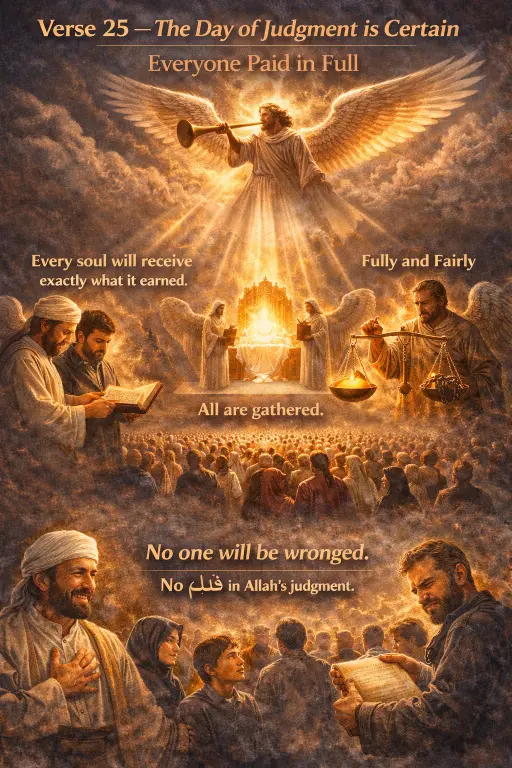
✅ Verse 25 — The Day of Judgment is certain, and everyone is paid in full
- Allah reminds: there is a Day with no doubt where everyone will be gathered.
- Every soul will receive exactly what it earned — fully and fairly.
- And no one will be wronged (no ظلم in Allah’s judgment).
Like the fairest results day ever: every answer is checked perfectly, nothing is missed, and nobody is treated unfairly.
- Verses 26–27 — Allah owns all power and controls all changes
✅ Verse 26 — Allah gives power and takes power; He honors and humbles
- Allah teaches the Prophet to say:
- ✅ Allah is the Owner of all dominion (all rule and authority).
- ✅ Allah gives power to whom He wills and removes it from whom He wills.
- ✅ Allah honors whom He wills and humbles whom He wills.
- ✅ All good is in Allah’s hand, and He has power over everything.
- Lesson: status, leadership, and success are not permanent — Allah is the true King above all kings.
It’s like a trophy: today one person holds it, tomorrow someone else can — but Allah is the One who controls who gets it and why.

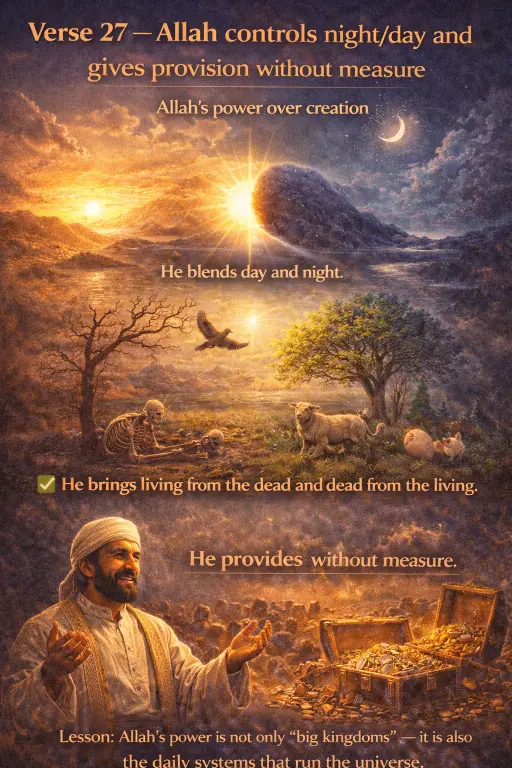
✅ Verse 27 — Allah controls night/day and gives provision without measure
- Allah describes His control over creation:
- ✅ He blends night into day and day into night.
- ✅ He brings living from the dead and dead from the living (life cycles Allah controls).
- ✅ He provides for whom He wills without measure.
- Lesson: Allah’s power is not only “big kingdoms” — it is also the daily systems that run the universe.
Like the One who controls the world’s “switches” and “systems” — daylight, nighttime, seasons, and provision — perfectly.
- Verses 28–30 — Loyalty, caution, and Allah’s complete knowledge
✅ Verse 28 — Don’t replace believers with disbelievers as your allies
- Allah warns believers not to take disbelievers as allies instead of believers.
- Whoever does that has no connection with Allah —
- ✅ except when protecting yourselves as a precaution (when safety requires caution).
- Allah warns you of Himself, and to Allah is the final return.
- Lesson: your deepest loyalty should be to faith and truth — not to people who want to pull you away from it.
Choose friends who help you be good. If someone pressures you to do wrong, don’t let them become your “main team.”
But if you must be cautious for safety, Allah understands precautions.

✅ Verse 29 — Allah knows what is hidden and what is public
- Allah knows what you hide in your heart and what you show openly.
- Allah knows everything in the heavens and earth.
- And Allah has power over all things.
- Lesson: you cannot “fake” sincerity with Allah — He sees the inside, not just the outside.

✅ Verse 30 — On Judgment Day, every deed will be present
- On that Day, each soul will find all its good deeds and bad deeds present.
- A person will wish their bad deeds were far away.
- Allah warns you of Himself, and Allah is kind to His servants.
- Lesson: Allah’s warning is not cruelty — it’s mercy, so people wake up before it’s too late.
It’s like seeing your full report on a big results day — you’d want the bad choices erased.
Allah warns now so you can fix things while you still can.
- Verses 31–32 — Real love of Allah means obedience, not claims
✅ Verse 31 — “If you love Allah, follow the Messenger”
What the verse says in plain words
Allah tells the Prophet to say:
So Allah makes a clear test:
- ✅ Love of Allah is not just words.
Anyone can claim:
- “I love Allah.”
But Allah says the proof is:
- follow the Messenger.
What does “follow me” actually mean (from the Qur’an itself)?
The Qur’an explains it:
1) Follow what the Messenger brings from Allah
The Messenger’s job is to deliver Allah’s message, not invent religion.
- The Messenger’s duty is only to deliver clearly (Qur’anic meaning repeated).
- The Prophet is commanded to follow what is revealed to him.
So “follow me” means:
- ✅ Follow the Qur’an that was revealed through him.
- ✅ Follow the guidance Allah placed in the revelation.
Important: Following the Messenger ≠ “Hadith is the religion”
The Qur’an never tells us:
Instead, the Qur’an repeatedly teaches:
- ✅ Allah’s words are the authority.
- ✅ The Messenger calls to that authority.
- ✅ The Messenger is obeyed because he delivers Allah’s commands.
So following the Prophet is:
- following the Qur’an he was given
- obeying Allah’s commands he conveyed
- accepting the message he preached: worship Allah alone, obey Allah, be just, pray, avoid ظلم, repent, etc.
Why does Allah connect this to forgiveness?
Because the verse is teaching a pathway:
- Claim: “I love Allah.”
- Proof: “Then follow the Messenger (the Qur’an he brought).”
- Result: Allah will love you and forgive your sins.
So the verse is saying:
- ✅ Real love of Allah produces obedience, not just feelings.
Child-simple example
A student who says “I respect you” but ignores the lessons is lying.
Same idea:
- Saying “I love Allah” while rejecting Allah’s guidance is not real love.
The main lesson
- ✅ Love of Allah is proven by obedience to Allah’s message.
- ✅ The Messenger is followed by following what Allah revealed through him (the Qur’an).
- ✅ The reward is Allah’s love and forgiveness, because Allah is Forgiving and Merciful.
If you say you respect your teacher, you show it by listening and following instructions — not by ignoring them.
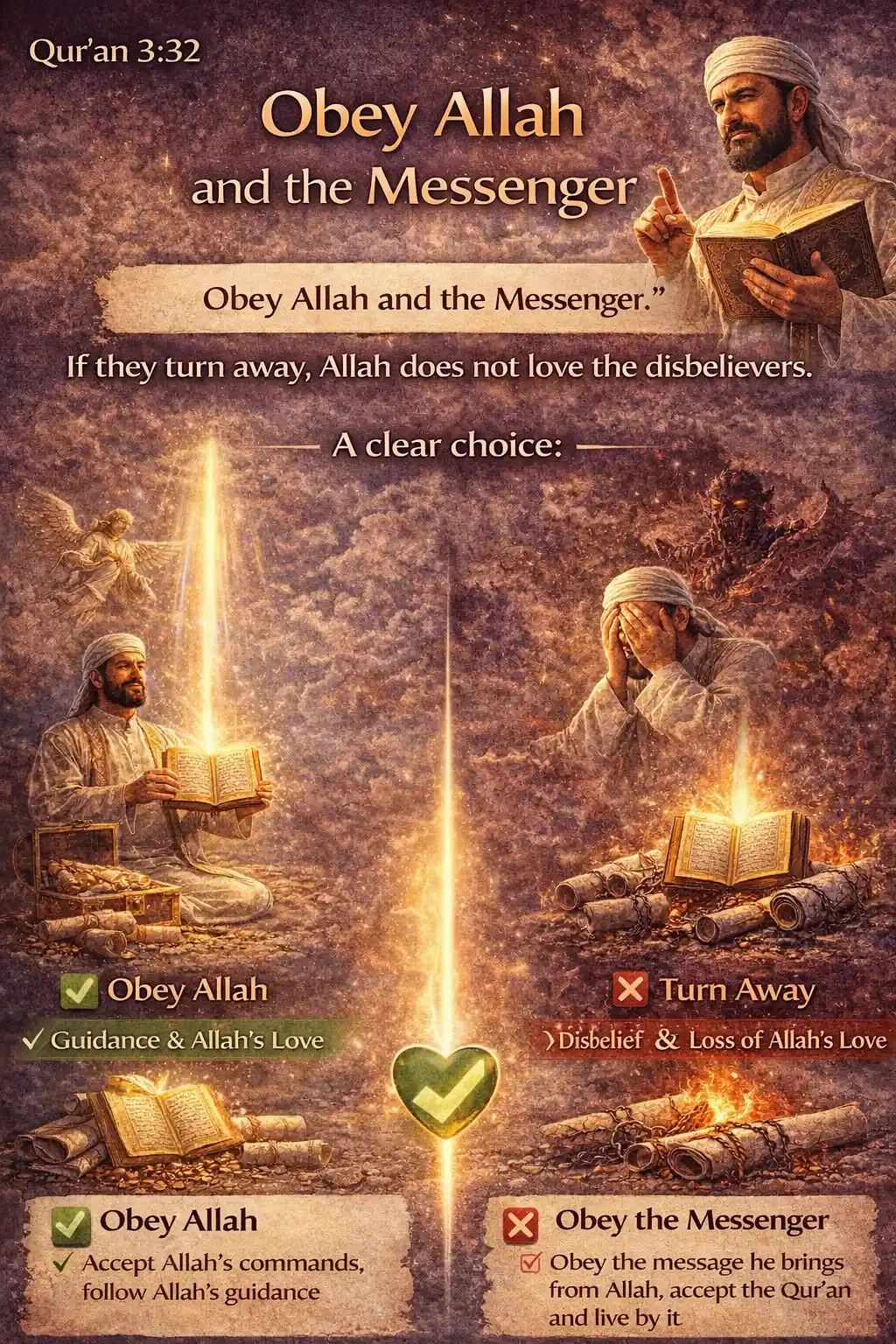
✅ Verse 32 — Obey Allah and the Messenger; turning away has consequences
- Allah commands: “Obey Allah and the Messenger.”
- If people turn away, Allah does not love the disbelievers.
- Lesson: guidance is clear — refusing it is a choice with consequences.
Big Story (3:33–51)
- ✅ He chooses certain people to carry truth
- ✅ Duʿā (prayer) matters a lot
- ✅ Allah can give gifts in “impossible” situations
- ✅ Maryam was protected and honoured
- ✅ ‘Isa (Isa) was created by Allah’s command and given miracles by Allah’s permission
- ✅ The main message stays the same: Worship Allah alone
- Verses 33–34 — Allah chose special people and families
- Verse 33
- Allah says He chose:
- ✅ Adam
- ✅ Nuh (Noah)
- ✅ The family of Ibrahim (Abraham)
- ✅ The family of Imran
- Meaning (simple): Allah picked them to be leaders of guidance for people in their time.
Like a teacher choosing class leaders because they are trustworthy and help others do right.
- Verse 34
- Allah says they are:
- ✅ descendants (family line)
- ✅ “some from others” (connected)
- Meaning (simple): They were from the same chain of faith—each generation kept the message alive:
- ✅ worship Allah
- ✅ do justice
- ✅ stay truthful
- And Allah is:
- ✅ All-Hearing (hears every duʿā)
- ✅ All-Knowing (knows hearts and secrets)

- Verses 35–37 — Maryam’s mother makes a promise, and Allah raises Maryam
✅ Verse 35 — The wife of ‘Imran dedicates her child to Allah
1) Who is speaking?
It says: “the wife of ‘Imran” (a righteous woman).
She is pregnant, and she is making a sincere duʿā to Allah.
2) “My Lord… I have dedicated what is in my womb entirely for Your service”
This means she is saying:
“Dedicated for Your service” means:
- to be raised in obedience to Allah
- to be devoted to worship and goodness
- to serve the religion by doing what Allah loves
In simple terms:
- ✅ She is promising Allah: “I want this child to be a servant of faith, not just a worldly person.”
Important point
She is not saying she owns the child. She is showing:
- love of Allah
- desire for her child to be guided
- willingness to sacrifice personal plans for Allah’s pleasure
3) “So accept it from me”
This is humility.
She’s saying:
- “I’m trying my best, but only You can accept it.”
- “Make this intention real.”
- “Make this child truly devoted.”
So she knows:
- ✅ Good intentions need Allah’s acceptance to have value.
4) “Surely You are the All-Hearing, All-Knowing”
She ends by praising Allah with two names:
All-Hearing
Allah hears:
- her duʿā
- her words
- even what she whispers
All-Knowing
Allah knows:
- her intention is sincere
- what is in her heart
- what this child will become
So she is basically saying:
Child-simple example
“Allah, this baby I’m carrying — I want them to grow up loving You and doing good. Please accept my promise. You hear me and You know my heart.”
The big lesson of the verse
- ✅ Parents should want guidance for their children, not just success.
- ✅ Sincere intentions matter, but acceptance is from Allah.
- ✅ Duʿā is powerful — Allah hears and knows everything.
✅ Verse 36 — Maryam is born, and her mother makes duʿā
1) What just happened?
The wife of ‘Imran had made a promise to Allah:
Then she gives birth.
2) “My Lord, I have given birth to a female”
She is speaking honestly to Allah.
In that time and culture, people often expected that a boy would be easier for public religious service (travel, public duties, etc.). So she is saying this with surprise and concern — not complaining against Allah, but explaining her situation.
3) “And Allah knew best what she had delivered”
Allah adds a powerful correction:
- ✅ Allah already knew the child would be a girl.
- ✅ Allah’s plan is wiser than the mother’s expectation.
- ✅ The child’s value is not decided by people’s assumptions.
“You don’t see the full picture — I do.”
4) “And the male is not like the female”
This sentence is about roles and circumstances, not “one is better.”
Meaning:
- A boy and a girl can have different challenges and different life paths.
- What she thought would be easiest (a male for that type of service) is not the only way Allah’s plan can happen.
- And the verse itself shows that Allah’s plan for Maryam was extraordinary.
5) “I have named her Mary”
She gives the child a name: Maryam.
This shows:
- she accepts Allah’s decree
- she continues her dedication
- she is still hopeful and sincere
6) “I seek refuge for her and her offspring in You from the accursed devil”
This is a duʿā for protection.
She is asking Allah:
- protect Maryam from evil influence
- protect her future children too
- keep them safe in faith and character
“Accursed devil” means Shayṭān — the enemy who tries to push people into:
- disobedience
- pride
- deception
- sin
Child-simple summary
When the baby is born, she says: “Allah, it’s a girl.”
Allah reminds: “I knew — and My plan is better than what you expected.”
She names her Maryam and makes duʿā:
“Allah, protect her and her children from Shayṭān.”
Main lessons
- ✅ Allah’s plan can be better than our expectations.
- ✅ Being female is not a “problem” — it was just not what she expected for that role.
- ✅ Righteous parents should make duʿā for their children’s protection and guidance.
- ✅ True faith includes accepting Allah’s decision and still doing good.
✅ Verse 37 — Allah accepted Maryam
- Allah accepted Maryam, raised her well, and placed her with Zakariya.
- Zakariya found provision (food/sustenance) with her and asked: “Where is this from?”
- Maryam said: “It is from Allah. Allah provides for whom He wills without measure.”
- Lesson:
- ✅ Allah can provide in surprising ways
- ✅ The best response is humility: “It’s from Allah.”
Like getting help you didn’t expect, and saying: “Allah helped me,” not “I’m the best.”

- Verses 38–41 — Zakariya makes duʿā for a child, and Allah gives him a sign
✅ Verse 38 — Zakariya makes duʿā for good offspring
1) What is happening in the story?
Zakariya (Zechariah) is with Maryam (Mary). He sees Allah giving her provision in amazing ways.
That makes him think:
- ✅ “Allah can do what seems impossible.”
So he turns to Allah and makes a duʿā.

2) “Thereupon Zakariya called upon his Lord…”
“Thereupon” means right after that.
He didn’t just admire what he saw — he used it as a reminder to ask Allah.
3) “My Lord, grant me from Yourself a good offspring”
He is asking for a child. But notice: he doesn’t just ask for any child.
He asks for “good offspring” — meaning:
- a righteous child
- a child with faith
- a child who will do good and obey Allah
And “from Yourself” means:
- ✅ “Only You can give this.”
- ✅ “This is a gift that comes from Your power, not my ability.”
So it’s a humble request.
4) “Surely You are the Hearer of the call”
Zakariya ends by praising Allah:
- ✅ Allah hears every duʿā
- ✅ Allah hears even quiet words and secret prayers
- ✅ No request is “too small” or “too hard” for Allah
It’s like saying:
Child-simple example
I know You hear me when I call You.”
Main lesson
- ✅ When you see Allah’s blessings, let it increase your trust and duʿā.
- ✅ Ask Allah not just for things — ask for goodness in what you receive.
- ✅ Allah hears every call, even if nobody else hears it.
- Angels called him while he was praying:
- “Allah gives you good news of Yahya (John).”
- They describe Yahya as:
- ✅ confirming a word from Allah
- ✅ noble
- ✅ pure/chaste
- ✅ a prophet and righteous
- Lesson: ✅ Allah answers duʿā at the best time, in the best way.

- Verse 40
- Zakariya said: “How can I have a boy? I’m old and my wife can’t have children.”
- Allah’s answer: “Allah does what He wills.”
- Lesson: ✅ Allah is not limited by “impossible” situations.

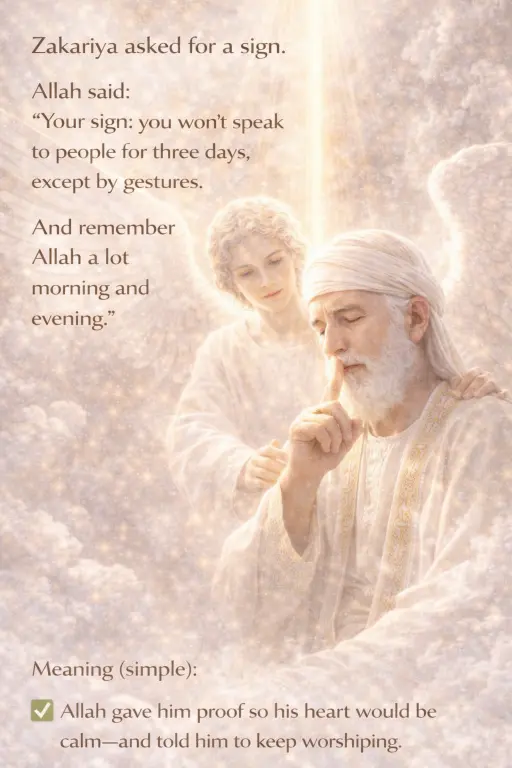
- Verse 41
- Zakariya asked for a sign.
- Allah said: “Your sign: you won’t speak to people for three days, except by gestures.
- And remember Allah a lot morning and evening.”
- Meaning (simple): Allah gave him proof so his heart would be calm—and told him to keep worshiping.
Like Allah giving a special “confirmation” so he knows, “Yes, your prayer is answered.”
- Verses 42–44 — Maryam is chosen and protected, and Allah tells unseen news
- Verse 42
- Angels said:
- “Maryam, Allah chose you, purified you, and chose you above women of your time.”
- Meaning (simple): Allah made Maryam special in faith, purity, and role.

- Verse 43
- They told her:
- ✅ obey your Lord
- ✅ prostrate
- ✅ bow with those who bow
- Meaning: Even when chosen, the main duty is still: ✅ worship Allah humbly.

- Verse 44

1) What is Allah talking about?
Allah is telling Muhammad about an event that happened long before he was born:
- A righteous family dedicated a child (Mary) to worship and service of Allah.
- When Mary was young, the religious people at that time argued about something important:
“Who will be responsible to look after Mary?”
Meaning: who will be her guardian, teacher, and caretaker.
Because Mary was special and this was an honorable responsibility, more than one person wanted that role, so they needed a fair way to decide.
2) “News of the unseen” — what does that mean?
Allah says: “That is from the news of the unseen…”
“The unseen” here means information that a human being could not know by normal means, such as:
- events from the past that you did not witness,
- things that were hidden from you,
- details that only Allah truly knows unless He reveals them.
Simple meaning: “This story is not something you could have known by yourself.”
3) “Which We reveal to you” — the main point
Allah says He revealed this information to the Prophet.
So the message is:
- This knowledge is coming from revelation (from Allah),
- not from being present,
- not from guessing,
- not from watching it happen.
4) “You were not with them…” — why Allah repeats this
Allah says twice that the Prophet was not there:
“You were not with them when they cast lots…”
“And you were not with them when they disputed.”
Allah repeats it to make the point extremely clear:
Meaning: “You didn’t witness this. So how are you speaking about it accurately? Because Allah is the One telling you.”
It’s like saying to someone:
“You weren’t in that room when it happened… yet you’re telling the exact story. That can only be because the true source informed you.”
5) “They cast lots with their pens” — what does that mean?
They used a lottery method to decide who would care for Mary.
The verse mentions “their pens” because these people were connected with scripture and writing — so the object associated with them (their pens) is mentioned.
Main idea: The point is not the exact method, but the fairness.
- They didn’t want it to be corruption or favoritism.
- So they used a random method (a “draw”) to decide.
6) “When they disputed” — what was the dispute?
They “disputed” because:
- this was an honor,
- they believed Mary deserved the best care,
- and multiple people wanted to take that role.
Lesson: Good people can still disagree — and they needed a fair decision.
7) The simple “child meaning”
Imagine a teacher says:
“We need one student to lead the class project.”
Many students want it. They start debating. So the teacher says:
“Let’s pick fairly—draw a name.”
Now imagine someone later tells the story with perfect detail, but they weren’t even in the class that day. You’d ask:
“How do you know exactly what happened?”
Allah is saying: “That’s the point. I revealed it to you.”
8) Extra Qur’an link (still simple)
A few verses earlier, the Qur’an already hints at the outcome:
- Mary was placed under the care of Zakariyya (see 3:37).
So 3:44 is explaining that this happened after a decision process — and that Allah is the One informing the Prophet about those unseen details.
- Verses 45–47 — Angels give Maryam news of ‘Isa (Isa)

1) “When the angels said, ‘O Mary…’”
Allah tells us that angels spoke to Mary.
This shows the message is important and honorable, because angels only speak by Allah’s command.
2) “Allah gives you good news…”
“Good news” means Mary is being told something happy and huge:
- Allah is going to give her a special child.
- This child will be a major sign and a mercy for people.
So Mary is not being warned or blamed here — she is being given glad tidings.
3) “Of a word from Him” — what does “a word” mean?
This part is very important.
In the Qur’an, Allah creates by His command — He says “Be”, and it happens.
So “a word from Him” means:
- This child will exist because Allah commands it, not because humans make it happen.
- It highlights Allah’s power to create in an extraordinary way.
Simple meaning: Allah is saying: “This baby is coming by My command.”
4) “His name will be the Messiah, Isa, son of Mary”
Allah tells Mary the identity of the child:
- He will be Isa.
- He will be called the Messiah (a special title meaning he is chosen for a mission by Allah).
- And notice: “son of Mary”.
Why does it say “son of Mary”?
- Usually people are called by their father’s name.
- Here, Allah emphasizes Mary’s role and signals that this birth is unique and directly under Allah’s plan.
5) “Honoured in this world and the Hereafter”
This means Isa will have high status in both lives:
In this world
- People will recognize his importance.
- He will be respected as a great servant of Allah and a major sign.
In the Hereafter
- He will also be honoured by Allah.
- His rank will remain noble — he won’t be “just a normal person” in Allah’s sight.
“He will be respected now, and respected forever.”
6) “And one of those brought near”
This means he will be among those who are close to Allah in rank.
Important note: “Close” here is about honour and status, not physical distance (because Allah is not like creation).
So it means:
- Allah loves him for his faith and obedience,
- and raises his rank among the righteous.
7) Child-simple summary
Imagine a king sends a message to a very pure person and says:
“I’m giving you amazing news.”
“You will have a special child by my command.”
“He will be respected by people.”
“And he will be honoured even more in the next life.”
That’s the core meaning of this verse.
- Verse 46
1) “He will speak to people in the cradle…”
A cradle means a baby’s bed — so this is talking about when he is still a baby.
Allah is telling Mary that her child, Isa, will do something amazing and unusual:
- He will speak clearly to people while he is still an infant.
Why is that important?
- Babies don’t normally talk.
- So this will be a sign from Allah to defend Mary and show this child is special and part of Allah’s plan.
Child example: It’s like a newborn suddenly speaking full sentences — everyone would know something extraordinary is happening.
2) “…and in maturity”
“Maturity” means when he becomes a grown adult.
So Allah is saying:
- He won’t only be able to speak as a miracle when he’s a baby,
- he will also speak as a normal adult who teaches and guides people.
So he will speak at two very different times:
- When he is extremely young (miracle),
- When he is fully grown (teaching).
3) “And he will be of the righteous”
“Righteous” means:
- someone who is truly good,
- obeys Allah,
- avoids evil,
- speaks truthfully,
- and does what is right.
So Allah is reassuring Mary:
- This child will not be corrupt,
- he will be a pure, obedient servant of Allah.
4) The full simple meaning
“Your son will be a sign from Allah: he will speak even as a baby, and later as an adult he will speak with wisdom — and he will be one of the truly righteous.”
- Verse 47
- Mary is saying she has not had a husband,
- and she has had no relationship that could cause pregnancy.
- Your situation is understood,
- and despite that, Allah’s promise is true.
- Allah is not limited by the usual patterns of nature.
- The “normal way” is only normal because Allah usually chooses it.
- But Allah can create in any way He wants.
- Allah decides something with complete authority.
- No one can stop it.
- No one can make it fail.
- Allah does not struggle to create,
- Allah does not need causes the way humans do,
- Allah’s command is enough.
- Verses 48–49 — ‘Isa is taught and given miracles (by Allah’s permission)
- Verse 48
- Isa will understand Allah’s message deeply,
- and he will be able to teach people correctly.
- knowing what is right,
- knowing how to apply truth in real life,
- speaking at the right time, in the right way,
- judging fairly,
- guiding people with mercy and clarity.
- knowledge, and
- the right way to use that knowledge.
- Isa will know what Allah revealed before,
- and he will continue the chain of guidance,
- and he will correct misunderstandings people may have developed about Allah’s law.
- Isa will receive and teach a revelation from Allah,
- and that message is called the Gospel (Injil).
- Meaning: Allah gives him knowledge and guidance.
- Verse 49
- this message is from Allah,
- and the messenger is truly sent by Allah.
- Isa forms the shape of a bird from clay,
- then it becomes a living bird.
- Isa is not doing this by his own independent power.
- Allah is the One allowing it to happen.
- The miracle is a sign of Allah’s power, not proof that the messenger is divine.
- the healing is not “magic,”
- it’s a miracle Allah grants as a sign.
- it only happens because Allah allows it,
- so it’s meant to prove Allah’s power and confirm the messenger.
- what they ate,
- what they had stored at home.
- Normally, a stranger cannot know your private, accurate details.
- So it becomes another proof that Allah is supporting this messenger with knowledge beyond normal human access.
- These miracles and accurate knowledge are not random tricks.
- They are evidence meant to guide sincere people.
- Verses 50–51 — The message: obey Allah, worship Allah alone
- Verse 50
- he supports the core message of the Torah: worship Allah, obey Allah, live righteously,
- and he is part of the same line of guidance from Allah.
- there were certain restrictions on the Children of Israel,
- and Allah allowed Jesus to lift or ease some of them.
- Because Allah can test people in different times with different rules,
- and Allah is the Lawgiver.
- “I’m not asking you to believe blindly.”
- “Allah gave signs to prove I am sent by Him.”
- fear displeasing Allah,
- remember Allah is watching,
- take His commands seriously,
- don’t reject truth out of pride.
- obey the guidance Allah is delivering through him,
- follow the commands he brings from Allah.
- obey him as if he is Allah.
- Verse 51
- Allah is my Lord (the One who created me, owns me, controls my life),
- and Allah is your Lord too (the One who created you and owns you).
- worship Allah alone,
- pray to Allah,
- obey Allah’s commands,
- rely on Allah,
- do not worship any other being or thing.
- not confusing,
- not mixed with other worship,
- not based on people’s opinions,
- but based on worshipping Allah alone.
1) What is happening in this verse?
The angels have just told Mary that she will have a child (Isa).
Mary is shocked — not because she doubts Allah’s power, but because she knows the normal way childbirth happens.
2) Mary’s question: “How can I have a child when no man has ever touched me?”
This is respectful Qur’anic wording.
It means:
“My Lord, I don’t understand — how can this happen through normal human causes?”
This shows Mary’s purity and also her honesty. She isn’t hiding anything — she’s clarifying the reality.
3) The answer: “It is so”
This means:
Meaning: “Yes, it will happen exactly as you were told.”
So the message is:
4) “Allah creates what He wills”
This is the big rule Allah is teaching:
Main point: Creation depends on Allah’s will, not on human ability.
5) “When He decrees a matter…”
“To decree” means:
Meaning: Once Allah decides, the matter is settled.
6) “He only says to it: ‘Be’, and it is”
This is a simple way of describing Allah’s power.
It does not mean Allah needs time, tools, or help. It means:
Whole meaning: Allah can create something instantly by His command.
7) Child-simple example
Imagine you ask:
“How can a house appear with no builders?”
For humans, that’s impossible. But for Allah, creating is not like humans building.
Allah’s creation is like: Allah says, “Be,” and it happens.
8) The full simple meaning of the verse
Mary says: “My Lord, how can I have a child if no man has ever been with me?”
Allah replies: “That is how it will be. Allah creates whatever He wants. When He decides something, He only says ‘Be,’ and it becomes real.”

1) What is the big idea of the verse?
Allah is saying: “I will personally teach Isa.”
So this verse is about knowledge from Allah, not ordinary education only.
“Your son will not just be a good person — he will be taught and guided by Allah for a mission.”
2) “He will teach him the Book”
“The Book” here means revelation / scripture knowledge — how to read, understand, and teach Allah’s guidance.
Simple meaning:
Think: not random opinions, but guidance tied to revelation.
3) “And wisdom”
“Wisdom” means more than “being smart.” It means:
So Allah is saying Isa will have:
4) “And the Torah”
The Torah was a scripture given earlier to Moses.
Allah teaching Isa the Torah means:
5) “And the Gospel”
The Gospel (in Islamic terms: the revelation Allah gave to Isa) is mentioned here too.
So Allah is saying:
6) Putting it all together (child-simple)
Allah is telling Mary:
“I will teach your son scripture.”
“I will give him wisdom so he uses knowledge correctly.”
“He will know the earlier book (Torah).”
“And I will give him his own revelation (Gospel).”
Core meaning: Isa will be a guided teacher and messenger, taught by Allah, connected to earlier revelation, and given his own message to deliver.
1) “A messenger to the Children of Israel”
A messenger is someone sent by Allah to deliver guidance.
“Children of Israel” means the people who came from the line of Jacob (Israel) — a community Allah had already sent prophets to before.
So Allah is saying: Isa is sent to that specific community, to call them back to worship Allah and obey His guidance.
2) “I have come to you with a sign from your Lord”
A sign means a proof that:
“I’m not speaking on my own. Allah is giving you clear signs.”
3) The clay bird — “I create… then I blow… and it becomes a bird — by Allah’s permission”
This describes a miracle:
Key guardrail: “By Allah’s permission”
This phrase is repeated to make the point crystal clear:
Simple example: Like a teacher letting a student use a special tool for a demo — the student is showing it, but the ability and permission came from the one in authority.
4) Healing — “I heal the blind and the leper — by Allah’s permission”
This means Isa was given the ability to heal people with serious conditions that humans normally could not cure easily (especially in that time).
Again, “by Allah’s permission” is repeated:
(Kept non-graphic as requested.)
5) “And I give life to the dead — by Allah’s permission”
This is another major miracle described in the verse.
The same rule applies:
6) Knowledge sign — “I inform you of what you eat and what you store in your houses”
This is not about spying for fun.
It means Isa could tell people hidden details they hadn’t told him, like:
Why would that be a “sign”?
Simple example: If someone accurately tells you what’s inside your closed bag without looking, you’d know they must have information you didn’t give them.
7) “Surely in that is a sign for you, if you are believers”
Allah is concluding the argument:
“If you truly want truth, these signs are enough to recognize that this message is from Allah.”
8) The whole verse in one simple summary
Isa is sent as a messenger to the Children of Israel and says:
“I’ve come with proofs from Allah.”
“Allah allows miracles through me: creating a living bird from clay, healing, and even bringing the dead back — only by Allah’s permission.”
“Allah also gives me knowledge of your private matters.”
“All of this is a sign, if you are sincere believers.”
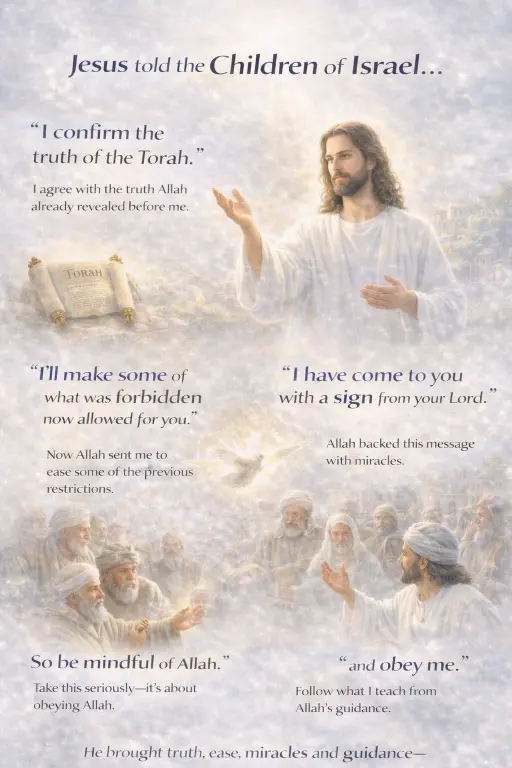
1) “Confirming what is before me of the Torah”
This means Jesus is saying:
“I am not bringing a totally new religion.”
“I agree with the truth that Allah already revealed in the Torah.”
So “confirming” means:
Child example: Like a teacher saying, “What your previous teacher taught you was right — I’m continuing that lesson.”
2) “And to make lawful for you some of what was forbidden to you”
This means Jesus is also saying:
“Some things that were not allowed for you before will now be allowed.”
Important detail: it says some, not all.
So the idea is:
Why would Allah forbid something and later allow something?
Simple example: Like a school rule that was strict for a time, then later the principal relaxes some rules when the situation changes.
3) “I have come to you with a sign from your Lord”
Jesus repeats the same point from the previous verse:
Meaning: “This is not my personal opinion — Allah backed this message with evidence.”
4) “So be mindful of Allah”
“Be mindful of Allah” means:
“Take this seriously, because this is about Allah.”
5) “And obey me”
This can confuse people, so here’s the simple meaning:
Jesus is a messenger. So obeying him means:
It does not mean:
Meaning: “If you want to obey Allah, then accept the messenger Allah sent to you.”
Child example: If the king sends a trusted messenger with instructions, obeying the messenger is obeying the king’s command — because the messenger is delivering the king’s message.
6) The whole verse in one simple summary
Jesus tells the Children of Israel:
“I confirm the truth of the Torah.”
“Allah also sent me to make some previously forbidden things allowed for you.”
“Allah gave signs that I’m truly sent.”
“So fear Allah, and follow what I’m bringing you.”
1) “Surely Allah is my Lord and your Lord”
Jesus is saying:
So the message is: We all belong to the same Creator — Allah alone.
2) “So worship Him”
Because Allah is the Lord of everyone, Jesus gives the main instruction:
It’s basically: If Allah is your Lord, then He is the only One who deserves worship.
3) “That is the straight path”
“Straight path” means the clear, correct way that leads to Allah’s approval and salvation:
The whole verse in one simple line
Allah is the Lord of Jesus and everyone else, so worship Allah alone — that is the true, straight way.


- ✅ Allah chooses righteous people to guide others
- ✅ Maryam’s mother made a sincere promise to Allah
- ✅ Allah raised Maryam with purity and special care
- ✅ Zakariya made duʿā and Allah gave him Yahya even when it seemed impossible
- ✅ Maryam was chosen and then given news of ‘Isa
- ✅ Allah created ‘Isa by His command (“Be”)
- ✅ ‘Isa’s miracles were only by Allah’s permission
- ✅ The main message stays the same: Worship Allah alone
Big Story (52–63)
- ✅ Some people rejected ‘Isa (Isa) even after signs
- ✅ ‘Isa looked for true helpers who want Allah’s cause
- ✅ The disciples believed and supported him
- ✅ People planned to stop the truth, but Allah’s plan is always stronger
- ✅ Allah protected ‘Isa and will judge everyone fairly
- ✅ ‘Isa is a creation of Allah (like Adam), not Allah
- ✅ Truth is clear: worship Allah alone
✅ Verse 52 — ‘Isa asks: “Who will help me for Allah’s cause?”
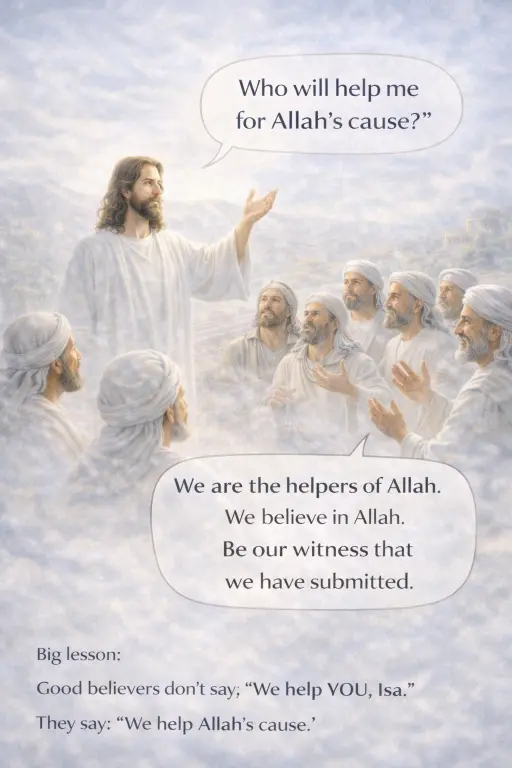
- What happened: ‘Isa noticed many people still didn’t believe, even after guidance.
- So he asked: “Who are my helpers for Allah?”
- Meaning (simple): He is saying:
- ✅ “Who will stand with me to teach Allah’s message?”
- ✅ “Who will help me spread truth and justice?”
- Then the disciples answered:
- “We are the helpers of Allah.”
- “We believe in Allah.”
- “Be our witness that we have submitted.”
- Big lesson:
- Good believers don’t say: “We help YOU, Isa.”
- They say: “We help Allah’s cause.”
- Meaning: they help truth, not ego.
Like a kid saying: “I’m not helping you cheat. I’m helping the teacher’s rules—doing what’s right.”
✅ Verse 53 — The disciples make a sincere duʿā

- They said:
- “Our Lord, we believe in what You sent down,
- and we followed the messenger,
- so write us among the witnesses.”
- Meaning (simple):
- ✅ “Allah, we believe in Your message.”
- ✅ “We follow Your messenger.”
- ✅ “Make us people who tell the truth and stand by it.”
- Lesson: A true believer asks Allah to keep their heart firm, not just “I believe” with words.
✅ Verse 54 — People planned, but Allah planned better

- What happened: Some disbelievers tried to make plans to defeat the truth.
- Allah says: “They planned, and Allah planned, and Allah is the best of planners.”
- Meaning (simple):
- ✅ Humans can make sneaky plans.
- ✅ But Allah’s plan is always wiser and stronger.
- ✅ Allah can stop evil plans in ways people never expect.
Like bullies planning to trap someone, but the teacher already knows and stops it perfectly.
✅ Verse 55 — Allah protects ‘Isa and promises victory for true followers

- Allah said to ‘Isa:
- “I will take you and raise you to Myself,
- and purify you from the disbelievers,
- and I will make those who follow you above those who disbelieve until the Day of Resurrection.”
- Meaning (simple):
- ✅ Allah will rescue and honour ‘Isa.
- ✅ Allah will separate him from the lies and attacks of disbelievers.
- ✅ Allah will give strength and honour to the people who truly follow the truth.
- Then Allah says: “Then to Me you will all return, and I will judge between you.”
- Lesson: Even if people argue and fight on earth, the final court is with Allah—perfect justice.
✅ Verse 56 — Disbelief brings severe punishment

- Allah says about those who reject:
- “I will punish them severely in this world and the Hereafter, and they will have no helpers.”
- Meaning (simple):
- ✅ Rejecting truth has consequences.
- ✅ On Judgment Day, nobody can “save” someone from Allah if they insisted on ظلم (wrong).
If someone keeps choosing wrong and ignores warnings, eventually consequences come—and no friend can remove them.
✅ Verse 57 — Faith + good deeds = full reward

- Allah says:
- “As for those who believe and do righteous deeds, He will give them their rewards in full.”
- And Allah does not love wrongdoers.
- Meaning (simple):
- ✅ Belief isn’t just words.
- ✅ Real belief shows in actions: honesty, kindness, justice, worship, helping.
- Lesson: Allah’s reward is fair and complete.
✅ Verse 58 — This is Qur’an: a wise reminder

- it reminds people of the truth they forget,
- it teaches what is right and wrong,
- it gives guidance at the right time and in the right way,
- it corrects false ideas and protects from confusion.
This is Qur’an 3:58 in the Qur’an. Allah is speaking to Muhammad.
1) “This is what We recite to you…”
Allah is saying:
“What you are hearing and conveying is not your own invention.”
“These words are being given to you and recited to you as revelation.”
Meaning: It’s a direct reminder that the source is Allah, not Muhammad.
2) “Of the verses…”
“Verses” means Allah’s āyāt — the revealed lines that make up the Qur’an, and also “signs” that point to truth.
“These are My clear statements and proofs.”
3) “And a wise reminder (the Qur’an)”
A “wise reminder” means:
So “wise” here means: it’s not just emotional or poetic — it is guidance with purpose, truth, and correct judgment.
The whole verse in one simple line
Allah is telling Muhammad: “What you are reciting to people is from Us: real verses and a wise reminder — the Qur’an — meant to guide them.”
✅ Verse 59 — ‘Isa is like Adam: created by Allah’s command

- Allah says:
- “The example of Isa with Allah is like the example of Adam.
- He created him from dust, then said: ‘Be,’ and he was.”
- Super simple meaning:
- ✅ Adam had no father and no mother.
- ✅ ‘Isa had no father.
- ✅ Both were created by Allah’s command.
- Big lesson (very important):
- ✅ A miracle birth does not make someone “Allah.”
- It shows Allah’s power to create however He wants.
If Allah can create Adam from dust with no parents, creating ‘Isa without a father is not hard for Allah.
✅ Verse 60 — This is the truth, so don’t doubt

- What you’ve just been told (about Jesus, Adam, and the message of worshipping Allah alone) is truth.
- It’s not a guess, legend, or debate topic.
- It comes from your Lord — the One who knows reality perfectly.
- Don’t be like people who hesitate after clarity,
- or who doubt because of pressure, arguments, or stubbornness.
This is Qur’an 3:60 in the Qur’an. Allah is speaking to Muhammad (and through him, to everyone hearing the message).
1) “This is the truth from your Lord”
Allah is saying:
“This is the correct account and guidance.”
2) “So do not be of those who doubt”
This means:
Meaning: It’s a command to stay firm when the truth has been made clear.
The whole verse in one simple line
Allah is saying: “This is the real truth from Me — so don’t hesitate or doubt after you’ve been given clear guidance.”
✅ Verse 61 — If people keep arguing, bring it back to Allah honestly

- Some people may still argue with you even after clear knowledge and evidence has been given.
- So the issue is not “honest confusion” anymore.
- It becomes: arguing for the sake of arguing, or refusing the truth out of pride.
- “sons” = your children / families
- “women” = your families
- “ourselves” = each side personally shows up
- Not shouting, not insulting, not fighting.
- Both sides turn to Allah with humility.
- “Curse” here means asking Allah to remove His mercy and support from the liars (and to expose them).
- It is a way of saying: “O Allah, show clearly who is lying.”
- Truth matters so much that deliberate lying about Allah is extremely dangerous.
- If people keep disputing after clear knowledge, the believer doesn’t have to play endless debate games.
- Allah gives a final, serious method that shows: who is sincere and who is bluffing.
This is Qur’an 3:61 in the Qur’an. Allah is speaking to Muhammad about how to handle a stubborn dispute after the truth has already been made clear.
Here’s the verse in very simple, detailed steps:
1) “Then whoever disputes with you about it, after what has come to you of the knowledge…”
This means:
2) “Say: Come, let us call our sons and your sons, and our women and your women, and ourselves and yourselves…”
Allah tells the Prophet to propose something very serious:
Both sides bring their closest, most precious people:
Why bring families?
Because it shows absolute seriousness. No one would bring their family to something like this if they knew they were lying.
“If you’re truly confident you’re right, let’s settle it with the most serious appeal to Allah.”
3) “Then we pray humbly…”
This means:
“We leave the judgment to Allah.”
4) “And invoke the curse of Allah upon those who lie.”
This sounds intense, but here’s the simple meaning:
So it’s not a human punishment.
It’s not “we attack each other.”
It’s: Allah judges between us.
5) The big lesson of the verse
One-line simple summary
Allah is saying: “If people keep arguing after clear truth, tell them: bring your families and come sincerely to Allah, and ask Allah to expose and condemn the liars — so the truth becomes clear.”
This shows how serious truth is—truth is not a game.
✅ Verse 62 — Core truth: Allah is One

- Allah says:
- “This is the true narration.
- There is no god except Allah.
- Allah is All-Mighty, All-Wise.”
- Meaning (simple):
- ✅ Allah alone is God.
- ✅ Allah has perfect power and perfect wisdom.
✅ Verse 63 — If they turn away, Allah knows the troublemakers

- Allah says:
- If they turn away, Allah is aware of those who cause فساد (mischief/corruption).
- Meaning (simple): If someone refuses truth and spreads confusion, Allah knows exactly who is doing it.
- ✅ ‘Isa looked for helpers who support Allah’s truth
- ✅ The disciples believed and made a sincere duʿā
- ✅ People planned evil, but Allah’s plan is always stronger
- ✅ Allah protected ‘Isa and will judge all disputes
- ✅ Disbelief leads to punishment; faith + good deeds leads to full reward
- ✅ ‘Isa is a creation of Allah like Adam—created by “Be”
- ✅ The core truth is clear: There is no god except Allah
Big Story (64–80)
- ✅ Let’s come together on the main fair truth: worship Allah alone
- ✅ Don’t argue about things you don’t know
- ✅ Ibrahim (Abraham) belonged to submission to Allah, not labels
- ✅ Some people try to confuse believers by mixing truth and lies
- ✅ Allah loves honesty, keeping promises, and taqwa
- ✅ Lying about Allah and changing His words is a very serious sin
- ✅ Prophets never ask to be worshipped — they call people to worship Allah
✅ Verse 64 — “Come to a fair word between us”




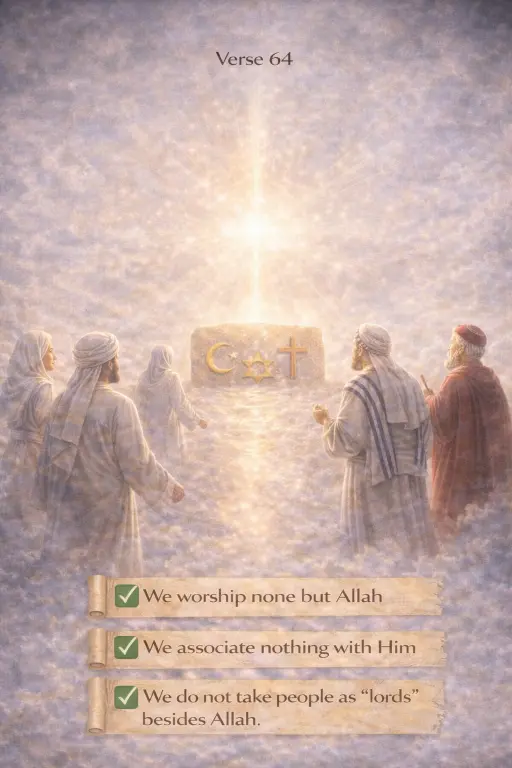
- Allah tells the Prophet to say to the People of the Scripture:
- “Come to a word that is just between us and you…”
- That fair word is:
- ✅ We worship none but Allah
- ✅ We associate nothing with Him
- ✅ We do not take people as “lords” besides Allah (meaning: we don’t obey humans like they are God)
- If they refuse, Muslims say:
- “Bear witness that we have submitted to Allah.”
- Simple meaning: Allah is calling everyone to the most basic truth:
- One God. No partners. No human gets God’s place.
Like saying: “Let’s agree on the biggest rule: we follow the real boss (Allah), not random people who pretend to be the boss.”
- Verses 65–66 — “Why argue about Ibrahim when you weren’t there?”
- Allah says:
- Why argue about Abraham being “Jew” or “Christian” when the Torah and Gospel came after him?
- Simple meaning:
- ✅ Abraham lived before those labels even existed.
- ✅ So arguing like that doesn’t make sense.
- Then Allah says:
- You argue about things you know a little about… why argue about what you don’t know at all?
- Lesson:
- ✅ Don’t speak confidently about something you don’t actually know.
- ✅ Allah knows; humans can be mistaken.
Like kids arguing about what happened in a movie they never watched.
- Verses 67–68 — Who really follows Abraham?
- Allah says:
- Abraham was not a Jew or Christian.
- He was:
- ✅ Hanif = he turned away from false gods and focused on Allah only
- ✅ Muslim = he submitted to Allah
- ✅ and he did not associate partners with Allah
- Then Allah says:
- The people most entitled to Abraham are:
- ✅ those who truly followed him
- ✅ this Prophet
- ✅ and the believers
- And Allah is the Protector of believers.
- Simple meaning:
- The real “Abraham-followers” are not people who claim a label.
- It’s people who follow Abraham’s belief: worship Allah alone.
If someone says “I’m a fan of this athlete,” but they hate everything the athlete teaches, are they really a fan?
A real follower follows the message.
- Verses 69–74 — Some people try to mislead (but Allah’s guidance is the real guidance)
- Verse 69
- get confused about the truth,
- abandon pure worship of Allah,
- doubt the message,
- follow wrong ideas instead.
- When someone fights truth, they harm their own heart and direction first.
- They may confuse others temporarily, but the real loss is theirs because they choose misguidance.
- they don’t see that they’re damaging themselves spiritually,
- and they don’t understand the consequences of rejecting or twisting truth.
This is Qur’an 3:69 in the Qur’an.
What the verse is saying (very simple, but clear):
1) “A group from the People of the Scripture…”
This means: not all of them, but some people from communities who had earlier scripture (like Torah/Gospel followers) were involved.
2) “wish they could lead you astray”
“Lead you astray” means they want believers to:
3) “but they only lead themselves astray”
Allah says their effort backfires:
4) “yet they do not realise it”
They think they are “winning” or “being clever,” but Allah says:
One-line summary
Some people try to pull believers away from guidance, but in reality they are ruining their own guidance — without even noticing it.
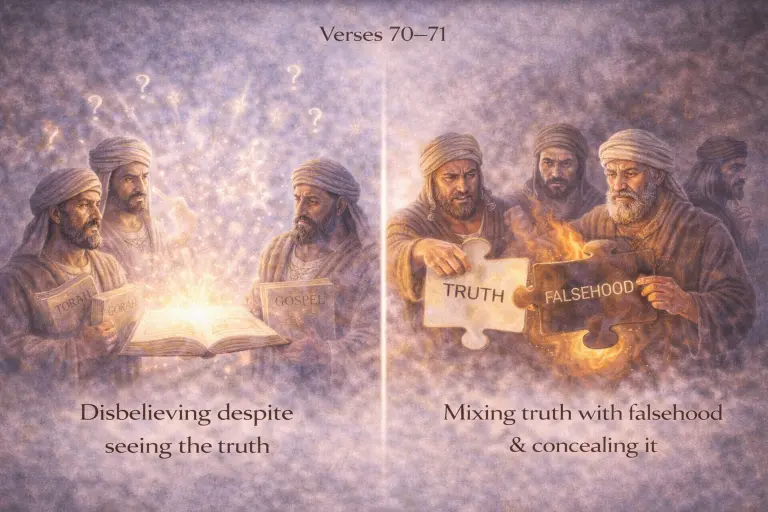
- Verses 70–71
- Allah’s revealed verses and guidance,
- proofs and evidences Allah gives,
- clear truths they can recognize from what they already know.
- they know certain truths,
- they recognize evidence,
- they have religious knowledge that should make them more honest, not less.
- taking something true and then adding something false to it,
- so people get confused and can’t tell what’s real anymore.
- hiding information that you know is true,
- not because you’re unaware,
- but because admitting it would hurt your status, argument, or agenda.
- If you know the truth, you must be honest about it.
- The worst kind of wrongdoing is not “I didn’t know,” but “I knew, and I twisted it.”
Verse 70 — “Why do you disbelieve in the signs of Allah while you yourselves bear witness?”
What “signs of Allah” means
“Signs” (āyāt) can mean:
“While you yourselves bear witness”
This means:
“You can see the evidence and you know what is true — so why reject it?”
Simple example: It’s like a teacher saying to a student who saw the correct answer: “You know it’s correct — why are you pretending it’s wrong?”
Verse 71 — “Why do you mix truth with falsehood and conceal the truth while you know?”
This verse gives two specific wrong actions:
1) “Mix truth with falsehood”
That means:
Example (simple): Saying one correct statement, then slipping in a wrong one right next to it, making it sound like it’s all one package.
2) “Conceal the truth while you know”
This means:
“You’re not making an honest mistake — you know the truth, but you hide it and blur it.”
The core lesson of verses 70–71
These verses warn that knowledge increases responsibility:
One-line summary
Allah is confronting knowledgeable people who recognize the truth, but reject it, mix it with falsehood, and hide it — even though they know better.
- Verse 72
- Pretend to accept the message of the believers (Islam) publicly for a short time.
- Like: “Yes, we believe too.”
- Later the same day, publicly announce: “Actually, we reject it.”
- So people see them “join” and then “leave.”
- “If knowledgeable scripture-people accepted it then rejected it, maybe something is wrong.”
- “Maybe they discovered a problem we don’t know.”
- Don’t be shaken by people who play games with belief.
- A quick “I believe” then “I don’t” can be a planned trick to create doubt, not a genuine change of mind.
This is Qur’an 3:72 in the Qur’an.
What’s happening in this verse (very simple):
Allah is exposing a strategy that some people from the People of the Scripture discussed.
Their strategy (step by step)
“Believe at the beginning of the day…”
Meaning:
“…and reject it at the end of it…”
Meaning:
“So that they might turn back (from their faith).”
Meaning: they wanted new believers to doubt and think:
So the goal was not honest investigation. It was psychological manipulation: create confusion and insecurity.
Why this tactic can affect people (simple example)
Imagine a few “experts” enter a class and say:
“This is the correct answer.”
Then a few hours later they say:
“No, it’s wrong.”
Some students might panic and think:
“Maybe we’re being fooled.”
Even if the “experts” were never sincere.
The core lesson
Allah is warning believers:
One-line summary
Some people planned to fake belief briefly, then publicly reject it, to make believers doubt and turn back.
- Verses 73–74
- “Only trust people from our group.”
- “Don’t accept that outsiders can have real guidance.”
- “Don’t admit others could receive revelation/knowledge too.”
- Real guidance is not owned by any group.
- It’s not controlled by scholars, tribes, or religious labels.
- It comes from Allah alone.
- They worried Allah could give revelation, knowledge, honor, or leadership to people outside their community (like the new believers).
- They worried their monopoly on “being the chosen/right ones” would be challenged.
- On Judgment Day, others could say: “We followed Allah’s guidance—why did you reject it?”
- All favor (bounty)—guidance, revelation, honor, mercy—belongs to Allah.
- Allah gives it by His wisdom, not by people’s control.
- Allah knows who deserves it and what’s in hearts.
- Allah’s gifts are huge and unlimited.
- No group can claim: “Only we get it.”
- Allah can give guidance and mercy to anyone He wants.
These are Qur’an 3:73–74 in the Qur’an. They continue the same theme as verse 72: exposing how some People of the Scripture tried to control who gets guidance, and Allah correcting that.
Verse 73 (broken down simply)
1) “Do not believe anyone except one who follows your own religion.”
This is a quote of what some of them told each other.
Meaning:
So it’s like gatekeeping: keeping truth “exclusive” to their community.
2) Allah’s reply: “Surely the (true) guidance is the guidance of Allah…”
Allah tells the Prophet to answer:
3) Why were they saying this?
“…that someone may be given the like of what you were given, or that they may argue against you before your Lord.”
This points to two fears behind their gatekeeping:
Fear A: “Someone else might be given what we were given.”
Fear B: “They might argue against you before your Lord.”
So Allah is exposing a motive: it wasn’t pure truth-seeking; it was fear of losing status.
4) Allah’s final rule in verse 73
“Indeed all bounty is in the Hand of Allah; He gives it to whom He wills. And Allah is All-Encompassing, All-Knowing.”
Meaning:
Verse 74 (simple)
“He singles out for His mercy whom He wills…”
Allah gives special mercy (like guidance, forgiveness, closeness to Him) to whom He chooses—based on His wisdom and justice.
“And Allah is the Possessor of great bounty.”
One-line summary
Some people tried to keep guidance “exclusive” to their group, but Allah says: guidance and mercy are Allah’s gifts alone—He gives them to whom He wills, and no one can block that.
- Verses 75–76 — Not everyone is the same: honesty matters
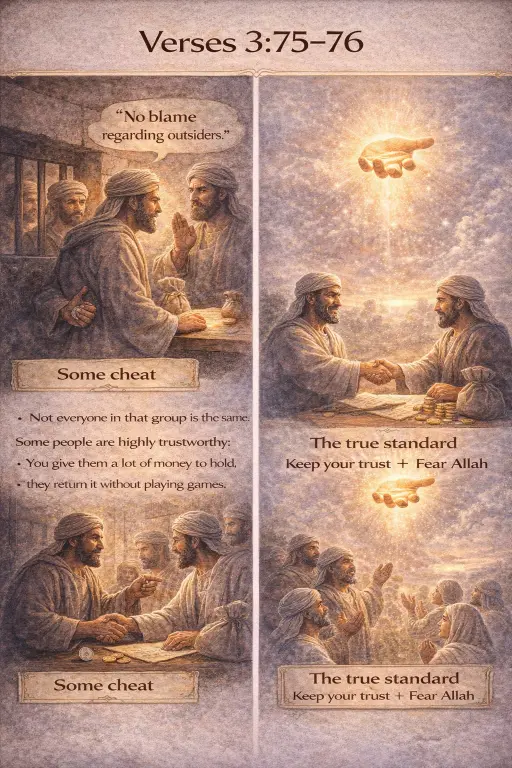
- Not everyone in that group is the same.
- You give them a lot of money to hold,
- they return it without playing games.
- If you give them even a small coin,
- they won’t return it unless you stand over them constantly, demanding it.
- “Cheating our own group is wrong.”
- “Cheating outsiders is fine.”
- They’re acting like Allah permitted injustice.
- But they know Allah did not permit it.
- keeping your promises,
- returning trusts,
- being honest in agreements and money matters.
- being mindful Allah is watching,
- not cheating even when you can get away with it,
- choosing honesty because you respect Allah.
- Some people are honest, some are dishonest—even inside religious communities.
- Cheating outsiders is never “allowed.”
These are Qur’an 3:75–76. Together they teach fairness, honesty with everyone, and that real “religion” is keeping your trust and fearing Allah—not making excuses to cheat outsiders.
Verse 75 — What it means (simple + detailed)
1) “Among the People of the Scripture… some return a great amount”
Allah starts by being fair:
Some people are highly trustworthy:
2) “And among them… some won’t return even one coin”
But Allah says there are also people who are the opposite:
Meaning: they only behave when they’re pressured and watched.
3) Why do they do that?
Allah exposes their excuse:
“There is no blame upon us regarding the illiterates (Arabs).”
Meaning: they claimed it’s “not sinful” to wrong people they considered outside their community.
So their double-standard was:
4) Allah’s verdict: “They speak a lie against Allah—and they know it”
Allah says this excuse is not just wrong—it’s a deliberate lie about Allah:
So it’s intentional dishonesty dressed up as “religion.”
Verse 76 — Allah corrects the standard
1) “Nay…” (No—here’s the truth)
Allah rejects their excuse and gives the real rule.
2) “Whoever fulfills his pledge…”
“Pledge” means:
So the real measure is not labels—it's character and faithfulness.
3) “And fears Allah… Allah loves those who fear Him”
To “fear Allah” here means:
Allah loves the people who have this taqwa (God-consciousness).
The big lesson (in one clear idea)
The true standard with Allah is: keep your trusts + fear Allah → Allah loves those people.
One-line summary
Verse 75 exposes a double-standard—some were honest, some cheated outsiders and falsely claimed Allah allowed it—then verse 76 says the truth: whoever keeps promises and has taqwa, Allah loves them.
- Verses 77–78 — Selling truth for a small price is a huge sin
- Verse 77
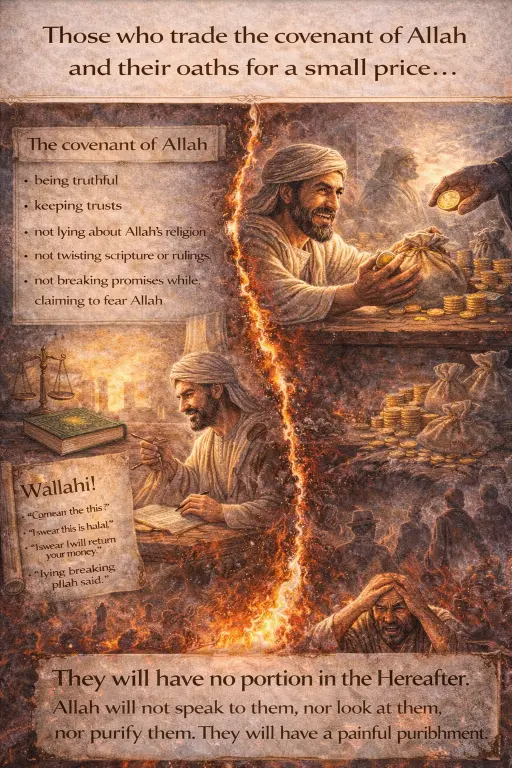
- being truthful
- keeping trusts
- not lying about Allah’s religion
- not twisting scripture or rulings
- not breaking promises while claiming to fear Allah
- “Wallahi, I’m telling the truth.”
- “I swear this is halal.”
- “I swear I will return your money.”
- “I swear this is what Allah said.”
- money
- status
- business advantage
- winning an argument
- keeping power
- pleasing people
- no share of Paradise
- no reward for what they ruined
- no real success in the next life
- no mercy
- no kindness
- no acceptance
- they will not be cleansed or forgiven in that state
- they carry the shame and filth of their lies
- their lies remain against them
- ✅ Don’t use Allah’s name to lie.
- ✅ Don’t sell truth for money or status.
- ✅ Don’t twist religion to benefit yourself.
✅ Verse 77 — Don’t sell Allah’s truth for worldly gain
This verse warns about people who use Allah’s covenant and Allah’s name in oaths to gain something small in this world.
1) “Those who trade the covenant of Allah and their oaths for a small price…”
What is “the covenant of Allah”?
What are “their oaths”?
Oaths are serious promises sworn in Allah’s name (or in a religious way), such as:
What does “trade it for a small price” mean?
It means they sell honesty and religion for worldly benefits like:
Even if it looks “big” to people, Allah calls it “small” because it is nothing compared to the Hereafter.
2) “They will have no portion in the Hereafter.”
Meaning: they lose what matters most:
3) “And Allah will not speak to them…”
This shows extreme rejection and disgrace—because they used Allah’s name as a lie.
(This is about honor and acceptance—NOT because Allah “can’t” speak.)
4) “Nor will He look upon them…”
Meaning:
5) “Nor will He purify them.”
Meaning:
6) “And they will have a painful punishment.”
They chose a small worldly gain over Allah’s truth—so the consequence is severe.
✅ Core lesson (super simple)
This is not a “small sin”—it destroys trust, justice, and faith.
- Verse 78

- “Among them” = among the People of the Scripture (people who had earlier scriptures).
- “A party” = not everyone — only a group among them did this.
- So Allah is not accusing every person; He is targeting a subset who behaved this way.
- Changing the wording when reciting (reading it differently on purpose),
- Twisting the meaning when speaking (bending the message with clever talk),
- Mixing truth with extra words so listeners can’t tell what is actually scripture.
- This is the core trick: they speak so you assume, “That must be from the Book.”
- But Allah says: it isn’t.
- So the sin here is misattribution: making non-scripture sound like scripture.
- They don’t only say “this is religious.”
- They claim Allah Himself said it.
- Allah replies: No — it is not from Allah.
- This is not an innocent mistake like “I misunderstood.”
- It is intentional: they know it’s not Allah’s word but still present it as Allah’s word.
- That’s why it’s such a serious warning.
- Distort with speech,
- Make others think it’s scripture,
- Claim “this is from Allah,”
- While knowing they are lying.
- Quotes a human report and says “this is Qur’an” (when it’s not),
- Adds lines and tells people “Allah said this in the Book,”
- Claims a ruling is Allah’s revelation while knowing it’s not in Allah’s scripture,
- Uses religious language to make human words feel like revelation to mislead people.
- Treats hadith as separate reports (not Qur’an text),
- Clearly says “This is a report” (not “this is Allah’s Book”),
- Is honestly mistaken rather than knowingly lying.
- ✅ Never label something “from Allah / Allah said” unless you have clear proof it is Allah’s revelation.
- ✅ Don’t blend human words into Allah’s words.
- ✅ Don’t use religious authority to sell uncertainty as certainty.
Verse 78 is talking about a specific kind of wrongdoing: making people think “this is Allah’s scripture” when it isn’t, and claiming “this is from Allah” while knowingly lying.
Very simple breakdown
1) “Among them is a party…”
2) “They distort the Scripture with their tongues…”
Key point: “with their tongues” means the distortion is done through speech/recitation/explanation, not necessarily by physically rewriting a book.
3) “So you may think it is from the Scripture, and it is not”
4) “They say: ‘This is from Allah,’ and it is not from Allah”
5) “They speak a lie against Allah and they know it”
Who is Allah talking about?
Allah is talking about people who do all these together:
In short: forging “God said…” to manipulate people.
Does this apply to using Hadith “as Qur’an” when it’s not true?
It depends on what exactly is being done. Verse 78 condemns a specific behavior: presenting something as Allah’s scripture / Allah’s direct words when it isn’t.
✅ It applies if someone does things like:
⚠️ It’s not automatically the same if someone:
Safest Qur’an-first rule
So yes — if someone uses hadith (or anything) in a way that makes people believe it is Allah’s revealed scripture, Verse 78’s warning fits exactly.
- Verses 79–80 — Prophets never ask to be worshipped

- The Book (revelation / scripture)
- Wisdom (right judgment and correct teaching)
- Prophethood (a mission to guide people)
- “Worship me.”
- “Treat me like God.”
- “Make me the center of worship.”
- Teach the Book correctly (share Allah’s guidance honestly).
- Study it seriously (learn it and live by it).
- worship,
- ultimate authority over Allah’s guidance,
- or obedience that replaces Allah.
These are Qur’an 3:79–80. Allah is correcting a major lie: a true prophet will never tell people to worship him (or angels/prophets). A true prophet calls people to worship Allah alone and live by Allah’s Book.
Verse 79 — A true prophet never asks for worship
1) “It is not (possible) for a human that Allah should give him the Book, wisdom, and prophethood…”
Allah is talking about a real messenger—someone Allah honored with:
2) “…then afterwards he would say: ‘Be my worshippers instead of Allah.’”
Allah says this cannot be the outcome of true prophethood. A real prophet will never tell people:
A prophet’s job is to pull people away from worshipping creation and bring them to worship Allah alone.
3) “But (he would say): ‘Be you worshippers of the Lord…’”
Instead, the real message of every true messenger is:
“Be devoted to Allah (the Lord). Worship Allah alone. Obey Allah’s guidance.”
4) “Because of your teaching of the Book, and because of your studying it.”
Allah explains the path to becoming “people of the Lord”:
Verse 80 — Don’t take angels or prophets as “lords”
1) “Nor would he command you to take the angels and the prophets for lords.”
Allah adds another boundary: a true messenger would never tell people to treat angels or prophets as “lords”. Here “lords” means giving them what belongs only to Allah, like:
2) “Would he command you to disbelieve after you have submitted?”
Allah’s logic is simple: If the messenger brought you to Islam (submission to Allah), he would never command you to do something that is disbelief.
One-line summary
A true prophet never says “worship me” or “take angels/prophets as lords”—he calls people to worship Allah alone and live by Allah’s Book.
Big Story (81–92)
- ✅ All prophets were on one team: one message from Allah
- ✅ When truth becomes clear, rejecting it is a serious choice
- ✅ Islam here means submission to Allah (not just a label)
- ✅ Allah’s punishment is real — but Allah’s mercy is also real for those who repent
- ✅ Money cannot “buy” your way out from Allah
- ✅ Real goodness requires giving something you truly love
✅ Verse 81 — Allah made a promise with all prophets

- same core message: worship Allah alone,
- same truth foundation,
- continuation of guidance — not contradiction.
- Believe in him = accept he is truly sent by Allah.
- Help him = support Allah’s guidance in the way you can.
- Prophets are on one side: Allah’s side.
- A later true messenger confirming Allah’s truth must be believed and supported.
- Followers should not reject later guidance out of pride, identity, or status.
What Allah is doing in this verse: Allah describes a covenant (a binding promise) He took from all prophets: if a later messenger comes confirming the truth they already have, they must believe him and support him.
Step-by-step meaning
1) “When Allah took the covenant with the prophets…”
A covenant is not casual — it is a serious promise before Allah. Allah is saying: every prophet is part of one truth-chain, not separate “brands.”
2) “Whatever I give you of the Scripture and wisdom…”
Allah reminds them: your knowledge and authority are gifts from Allah — not self-made.
3) “Then afterwards there comes to you a messenger, confirming what is with you…”
The later messenger will confirm what the prophets already had:
4) “You shall believe in him and you shall help him.”
Two duties:
“Help” does not require physical meetings. It includes leaving teaching that prepares your people to accept later truth, and not building pride/tribal barriers that cause rejection.
5) “Do you acknowledge and take (binding) upon you My covenant?”
Allah makes it explicit: Are you accepting this as a binding promise?
6) “They said: We have acknowledged.”
The prophets accept. This shows unity among prophets under Allah’s mission.
7) “Then bear witness, and I am with you among the witnesses.”
This covenant is witnessed and recorded. Allah Himself witnesses it, so nobody can later claim: “We didn’t know.”
Your question: how can one messenger “talk with” another if they don’t meet?
This verse is not describing prophets having conversations with each other across time. It is Allah speaking to the prophets and taking a covenant from them.
What does “a messenger comes to you” mean then?
Two Qur’an-consistent ways to understand it (no physical meeting required):
A) “Comes to you” = comes to your community after you
The earlier prophet’s responsibility includes preparing his followers not to reject later truth.
Like a principal telling every teacher: “If a future teacher arrives with the same official curriculum, support them.” The teachers don’t need to meet that future teacher to be bound by the rule.
B) Allah addresses “the prophets” as one collective category
Allah can speak to “the prophets” as a unified group across history, making a universal rule: prophets confirm and support Allah’s guidance — they don’t compete.
Main lesson
✅ Verse 82 — Turning away after this is rebellious
- Allah says: Whoever turns away after that promise is defiantly disobedient.
- Simple meaning:
- If someone knows the truth and still rejects it, they are not just “confused”—they are choosing stubborn rebellion.
✅ Verse 83 — Everything in creation submits to Allah
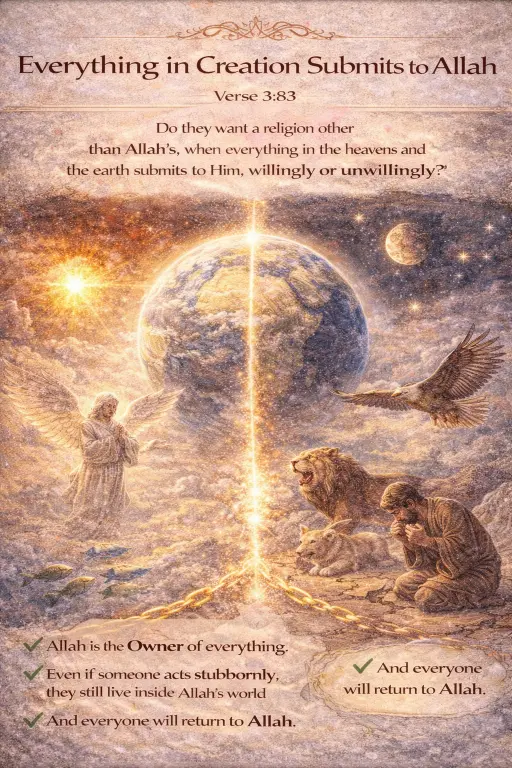
- Allah asks:
- Do they want a religion other than Allah’s, when everything in heaven and earth submits to Him, willingly or unwillingly?
- Simple meaning:
- ✅ Allah is the Owner of everything.
- ✅ Even if someone acts stubborn, they still live inside Allah’s world and under Allah’s power.
- ✅ And everyone will return to Allah.
Like a kid refusing the school rules—but they’re still inside the school, using the school’s books, air, and time.
They can’t escape the school system.
✅ Verse 84 — Muslims believe in all prophets (no favoritism)

- We believe Allah is the source of guidance.
- We believe the Qur’an is revelation sent down to the believers with Muhammad.
- Allah sent guidance before the Qur’an too.
- The message didn’t start with one nation only.
- It ran through the earlier prophet line connected to those names and their descendants (“the tribes” = the communities that came from that family line).
- Moses and Jesus were real messengers from Allah.
- The other prophets also received guidance from the same Lord.
- So Muslims don’t “accept some prophets but deny others.” We accept the whole chain.
- We do not split prophets into “true” vs “false”.
- We do not believe in one and reject another.
- We don’t treat guidance like a sports team where you pick a favorite and disrespect the rest.
- A student can’t say: “I accept Teacher A as real, but Teacher B is fake.”
- Because the issue is not the teacher’s personality—it’s the principal’s authority behind them.
- Our loyalty is not to tribes, labels, or “my prophet vs your prophet.”
- Our loyalty is to Allah.
- We submit to Allah by accepting His entire guidance system.
- ✅ Don’t play “favorites” by believing some and rejecting others.
- ✅ Don’t respect some while insulting others.
- ✅ Don’t use prophets to build ego, sect pride, or rivalry.
- ✅ Your stance is: we accept them all as true messengers from one Lord.
1) “Say… We believe in Allah, and what has been sent down to us…”
This is the starting point:
So Islam is not “a new human idea.” It’s “Allah’s guidance.”
2) “And what was sent down to Abraham, Ishmael, Isaac, Jacob, and the tribes…”
This means:
Islam is telling you: the same God sent guidance across history.
3) “And what was given to Moses, and Jesus, and the prophets from their Lord…”
This adds a key point:
4) “We make no distinction between any of them…”
This is the part about favorites / “one prophet better than another”.
In this verse, “no distinction” means:
Every prophet is Allah’s messenger, and rejecting any messenger is rejecting Allah’s system of guidance.
A really simple example
It’s like a school where the principal sends many teachers over the years with the same official curriculum.
5) “And to Him we have submitted.”
This is the conclusion:
So does this mean “we can’t say one prophet is better”?
What this verse directly teaches is:
Also, the Qur’an elsewhere indicates Allah can give different roles/honors to different messengers—but that’s Allah’s decision, not something humans turn into a pride-game or a reason to reject any prophet.
Safe Qur’an-straight takeaway: Believe in every prophet Allah sent, respect them all, don’t divide them into “my side vs your side,” and submit to Allah alone.
✅ Verse 85 — If someone wants a religion other than submission to Allah, it won’t be accepted
- to submit / surrender to Allah,
- to accept Allah as the only Lord,
- to worship Him alone,
- to follow the guidance Allah sends.
- someone chooses a way of life/religion where they refuse Allah’s submission,
- or they replace Allah’s authority with something else (people, desires, tradition, partners, etc.),
- or they reject the guidance Allah sent after it became clear.
- on the Day of Judgment, that chosen path won’t count as valid worship/faith with Allah,
- because the foundation is wrong: not submitting to Allah.
- they lose the real success: Allah’s approval, mercy, and Paradise,
- they traded the lasting life for something temporary.
What does “Islam” mean here?
In Qur’anic language, Islam literally means:
So in this context, it’s not just a “label.” It’s the core religion of all prophets: submitting to Allah and obeying His revelation. That fits the flow of the previous verse (3:84): we believe in Allah and all the prophets and submit to Him.
“Whoever seeks other than Islam as religion…”
This means:
It’s basically: choosing a path that isn’t “submit to Allah as the only God.”
“It will never be accepted from him”
Meaning:
“I am the One you return to. If you reject My submission and My guidance, you can’t bring Me another ‘religion’ and expect it to be accepted.”
“And he will be among the losers in the Hereafter”
“Losers” here means:
It’s not about losing an argument—it’s about losing the final outcome.
The whole verse in one simple line
If a person refuses submission to Allah (Islam in its Qur’anic meaning) and chooses another way instead, that choice will not be accepted by Allah, and it leads to loss in the Hereafter.
✅ Verse 86 — Why would Allah guide people who knowingly rejected after believing?


- Allah asks:
- How would Allah guide people who disbelieved after believing—after they knew the messenger is true and proofs came?
- Simple meaning:
- If someone sees clear truth, admits it, then rejects it out of pride, they are choosing ظلم (wrong).
- Allah doesn’t guide wrongdoers who knowingly prefer darkness over truth.
Like a student who understands the correct answer, says “Yes, that’s correct,”
then lies and says it’s wrong because they want to look cool.
- Verses 87–88 — Serious warning for stubborn rejection
- Allah says:
- Such people have the curse of Allah, angels, and mankind.
- They remain in punishment, and it won’t be reduced, and they won’t get more time.
- Child-friendly meaning:
- This is a strong warning: if someone becomes stubbornly rebellious and refuses truth until the end, it leads to terrible consequences.
✅ Verse 89 — The door is open: repent and fix yourself

- Allah says:
- Except those who repent and correct themselves—Allah is Forgiving and Merciful.
- Simple meaning:
- No matter how wrong someone was: if they truly turn back to Allah and change, Allah can forgive.
Like a kid who did something wrong, then truly says sorry, stops doing it,
and tries to repair what they broke.
✅ Verse 90 — Fake repentance doesn’t work

- Allah says:
- Those who disbelieve after believing, then keep increasing in disbelief—repentance will not be accepted.
- Simple meaning: This is about people who:
- ✅ keep rejecting again and again
- ✅ keep hardening their heart
- ✅ don’t try to return sincerely
- It’s like someone saying “sorry” with their mouth, but their actions show they never meant it.
✅ Verse 91 — You can’t buy your way out with gold

- Allah says:
- If someone dies in disbelief, even if they offered an earth full of gold, it wouldn’t be accepted as ransom.
- They will have painful punishment and no helpers.
- Simple meaning: On Judgment Day:
- ✅ money cannot buy escape
- ✅ status cannot bribe
- ✅ only faith and sincerity matter
Like trying to pay the teacher with candy to erase cheating—doesn’t work.
✅ Verse 92 — You won’t reach true goodness until you give from what you love

- Allah says:
- You won’t reach righteousness (real goodness) until you spend from what you love.
- And Allah knows everything you spend.
- Simple meaning:
- Real generosity is not giving leftovers only.
- It’s giving something you actually care about:
- ✅ your time
- ✅ your money
- ✅ your favorite things
- ✅ your comfort
If you have 10 sweets: giving the broken one is easy.
But giving a good one you love—that shows real kindness.
- Big lesson: Allah sees what you give and why you gave it.
- ✅ All prophets were united: they support the truth and each other
- ✅ Everything belongs to Allah and returns to Him
- ✅ Muslims believe in all prophets and submit to Allah alone
- ✅ Knowing the truth then rejecting it is a serious choice
- ✅ Allah warns strongly — but Allah forgives those who truly repent and change
- ✅ Money cannot buy safety from Allah
- ✅ True goodness means giving from what you love
Big Story (93–109)
- ✅ Don’t invent rules and blame Allah for them
- ✅ Truth is truth — follow Ibrahim’s pure worship of Allah alone
- ✅ The Ka‘bah (Bakkah) is the first house of worship and Hajj is a duty for those able
- ✅ Some people try to confuse believers and pull them away from the straight path
- ✅ Believers must hold tight to Allah, stay united, and do good in society
- ✅ Division after clear truth is dangerous
- ✅ Allah will judge fairly, and Allah never wrongs anyone
- ✅ Everything belongs to Allah and returns to Him
✅ Verse 93 — Food rules and “prove it from the Torah”

- “Children of Israel” = the descendants of Jacob (also called Israel).
- So it’s talking about the community that came from Jacob’s family line.
- Allah is saying: originally, foods were not broadly forbidden for Jacob’s descendants.
- The one exception mentioned here is something Jacob personally avoided.
- Important detail: it says Jacob made it unlawful “to himself.”
- Meaning: it was a personal restriction, not a universal rule Allah revealed for everyone at that time.
- The verse doesn’t specify which exact food it was or the reason — so we don’t need to invent details.
- The key point is who made the restriction:
- Not Allah as a revealed law (at that stage),
- but Jacob as a personal choice.
- This part sets a timeline: Jacob lived before the revelation of the Torah (connected with Moses later).
- So Allah is saying: don’t claim that certain foods were already forbidden by God in Jacob’s time, before the Torah existed as revealed law.
- In other words:
- Personal practice happened first (Jacob’s own restriction).
- Revealed law came later (Torah rules).
- This is a powerful argument style.
- Some People of the Scripture were claiming:
- “Certain foods were forbidden by God منذ البداية / from the earliest times.”
- Allah replies to Muhammad:
- “Challenge them: bring your own scripture and read it out — if you’re telling the truth.”
- So the verse is saying:
- Stop making up religious rules and attributing them to Allah.
- Use evidence from revelation, not assumptions, rumours, or later traditions.
- Imagine this:
- A dad never said, “No candy ever.”
- But one day, a grandfather says, “I personally won’t eat candy anymore.”
- Later, a written family rulebook comes with some health rules.
- Now someone claims: “Candy was always forbidden by Dad from the beginning!”
- So the dad says: “Show the rulebook if you’re honest.”
- Meaning:
- Don’t confuse someone’s personal habit with God’s command.
- Don’t rewrite history to make your argument sound religious.
- Not everything “religious-sounding” is from Allah.
- Personal restrictions ≠ divine law.
- Truth claims require proof — especially when you say “Allah forbade this.”
1) Who are the “Children of Israel” and who is “Israel”?
2) “All food was lawful… except what Israel made unlawful to himself”
3) “Before the Torah was revealed”
4) Why does Allah say: “Bring the Torah and read it, if you are truthful”?
5) The simple “child” version
6) Main lessons of the verse
✅ Verse 94 — Lying about Allah is a big wrongdoing

- Verse 3:94 is directly tied to what came right before it in 3:93:
- Allah clarified: food was generally lawful to the Children of Israel, except what Israel (Jacob) personally made unlawful to himself before the Torah was revealed.
- Then Allah challenged: “Bring the Torah and read it, if you are truthful.”
- So “after that” means: after the truth was clarified and the evidence was demanded.
- It’s inventing claims like:
- “Allah forbade certain foods from the beginning (even in Jacob’s time)” when Allah did not.
- Turning Jacob’s personal restriction into a divine command, then saying: “Allah commanded this.”
- Claiming: “This is Allah’s law” without proof from revelation, even after being challenged to bring the Torah.
- In short: they are inventing religious rules/history and stamping Allah’s name on it.
- Because after proof is demanded, continuing to lie isn’t a mistake — it’s ظلم (wrongdoing):
- Wrong against Allah — attributing to Him what He didn’t say.
- Wrong against people — misleading them with fake “religion.”
- Wrong against themselves — choosing falsehood after evidence.
- This verse condemns people who fabricate “Allah said…” claims — especially about laws like what’s halal/haram — after the truth has already been clarified and proof has been demanded.
What exactly is it referring to?
So what is the “lie against Allah” they are inventing?
Why does Allah call them “wrongdoers”?
One-line summary
✅ Verse 95 — Follow Ibrahim’s pure religion

- It refers back to 3:93 right before it:
- Allah clarified that food was generally lawful to the Children of Israel,
- except what Israel (Jacob) personally made unlawful to himself before the Torah was revealed,
- then Allah said: “Bring the Torah and read it, if you are truthful.”
- So “after that” means: after the truth was clarified and evidence was demanded.
- It means making up claims and attaching Allah’s name to them, such as:
- Claiming Allah forbade certain foods “from the beginning” when He didn’t,
- Turning a personal choice (Jacob’s own restriction) into a divine law,
- Saying “Allah commanded this” without proof from revelation.
- In short: fabricating religion and labeling it as “from Allah.”
- Because once the truth is clear, continuing to do this becomes deliberate ظلم (wrongdoing):
- Wrong against Allah — attributing to Him what He didn’t say,
- Wrong against people — misleading them with fake religion,
- Wrong against themselves — choosing falsehood after evidence.
- Allah is saying:
- “After the proof has been shown, if someone still invents ‘Allah said…’ claims, they are not just mistaken — they are wrongdoers.”
What does “after that” refer to?
What does “invent a lie against Allah” mean?
Why are they called “wrongdoers”?
Simple meaning
✅ Verse 96-97 — The first House (Bakkah) and Hajj
- “House” here means the House of worship: the Kaaba.
- Allah is saying this House was set as a worship center for people, not for one tribe only.
- “First” here means: the earliest foundational House Allah appointed as a worship focus for humanity.
- Blessed: Allah put barakah in it — goodness, spiritual benefit, and lasting significance.
- Guidance for the worlds: it points people to:
- worshipping Allah alone,
- unity (one direction, one center),
- obedience (following Allah’s command, not making up religion).
- This verse lists proofs, meaning, and duties connected to the House.
- Allah says the House area contains clear signs — things that visibly remind you this place is tied to Allah’s guidance and history.
- This refers to Maqam Ibrahim, linked to Abraham.
- The point is not “tourism” — it’s: this House is connected to Abraham’s mission of pure worship of Allah.
- Allah declares the sanctuary as a place of security.
- Meaning: it is meant to be a protected sacred space — people should feel safe there and treat it with seriousness, not chaos.
- Allah makes pilgrimage to the House a duty owed to Allah for those who are able.
- “Whoever can afford the journey” means:
- you have the means and ability,
- you can reach it without destroying your life/obligations.
- So it’s an obligation with a condition: capability.
- Allah ends with a hard truth:
- If people reject this command, Allah does not lose anything.
- Allah is not “benefiting” from our worship — we are the ones who need guidance and obedience.
- Allah says: The Kaaba in Mecca is the main worship House He appointed for people.
- It has clear signs connected to Abraham.
- It’s meant to be a safe sacred place.
- If you’re able, you must go on pilgrimage.
- And if someone rejects, Allah doesn’t need them — they need Allah.
Verse 96 — “The first House appointed for mankind… at Becca”
What “House” means
“The first… appointed for mankind”
“Blessed, and a guidance for the worlds”
Verse 97 — “In it are clear signs… the station of Abraham… security… pilgrimage”
1) “In it are manifest signs”
2) “The station of Abraham”
3) “Whoever enters it attains security”
4) “Mankind owes to Allah… pilgrimage… whoever can afford”
5) “Whoever disbelieves… Allah is free from need of the worlds”
Super simple version
✅ Verse 98-99 — Why reject signs and block believers?

- “Why do you disbelieve in the signs of Allah, while Allah is Witness over what you do?”
- “Signs” includes:
- Allah’s revealed messages and clear truths,
- the evidences that point to Allah,
- the guidance that they recognize as true.
- So the verse is not only about “not believing” — it’s about rejecting clear guidance after recognizing it.
- This is the warning part:
- You can hide things from people,
- but you cannot hide your actions, motives, or manipulation from Allah.
- So the verse is basically:
- “How can you knowingly reject truth when Allah sees exactly what you’re doing?”
- “Why do you turn away from the path of Allah those who have believed, seeking to make it crooked, while you yourselves are witnesses? And Allah is not unaware of what you do.”
- This means blocking people from guidance, like:
- discouraging believers,
- confusing them,
- intimidating them,
- throwing doubts to make them quit.
- “Crooked” means:
- making the straight path look suspicious or wrong,
- twisting words,
- misrepresenting what Allah says,
- making truth look like falsehood.
- Meaning: you know better.
- They have enough knowledge to recognize what’s true, yet they still try to bend it for other people.
- Same core warning as verse 98, repeated:
- Allah knows the behind-the-scenes effort,
- and Allah will hold people accountable for it.
- Verse 98: “Why reject Allah’s signs when Allah sees what you’re doing?”
- Verse 99: “Why try to pull believers off the right path and twist it, when you know the truth—and Allah knows your actions?”
- These verses condemn two things:
- Rejecting truth knowingly, and
- Trying to drag others away by twisting and corrupting the message.
Verse 98
What “signs of Allah” means
“Allah is Witness over what you do”
Verse 99
“Turn away from the path of Allah”
“Seeking to make it crooked”
“While you yourselves are witnesses”
“Allah is not unaware”
Super simple version
Main lesson
✅ Verse 100 — Warning: don’t follow people who will pull you back
- Allah is saying:
- Be careful who you follow.
- If you let some people who were given earlier scripture lead you — especially those who don’t want you on Allah’s path — they can pull you away from your faith and push you back into disbelief.
- It’s not saying: “never listen to anyone from the People of the Scripture.”
- It’s warning about obeying a group among them who are actively trying to mislead or twist religion.
- It’s like Allah saying:
-
“You just found the right road.
Don’t follow someone who secretly wants to drag you back into the wrong road.”
Simple meaning
What it’s not saying
Super simple “child” version
✅ Verse 101 — How could you disbelieve when you have Qur’an and the Messenger?
- Allah is saying:
- You have direct access to guidance right in front of you.
- The Qur’an is being recited clearly, so truth isn’t hidden or far away.
- So the message is:
- “With guidance this clear, why would you choose disbelief again?”
- This connects to verse 100 (the warning): even if people try to pull you away, you still have the strongest protection — Allah’s own words.
- Meaning:
- In that moment, believers had the Messenger present to:
- teach the revelation,
- correct misunderstandings,
- stop people from being misled.
- So Allah is emphasizing: your situation includes extra clarity and protection, so falling back into disbelief would be a serious choice, not an accident.
- This is the practical instruction:
- “Hold firmly” means:
- stick tightly to Allah’s guidance,
- don’t let go under pressure,
- don’t swap Allah’s words for people’s opinions.
- Result:
- Holding to Allah leads to clear direction (the straight path).
- It’s like Allah saying: the way to stay safe from confusion is to cling to Him and His revelation.
- Allah is saying:
-
“Why would you turn away when the Qur’an is being recited and guidance is right there?
Hold tightly to Allah, and you’ll stay on the straight road.”
1) “How can you disbelieve while Allah’s verses are being recited to you…?”
2) “...and His Messenger is among you”
3) “Whoever holds firmly to Allah…”
4) “...has been guided to a straight path”
Super simple version
✅ Verse 102 — Have real taqwa and don’t die except in submission

- Allah is speaking to people who already accepted faith — so this verse is about how to maintain it, not just how to start.
- Taqwa (in simple terms) = protecting yourself by staying aware of Allah and avoiding what displeases Him.
- Think of it like a spiritual shield:
- You remember Allah is watching.
- You don’t play with sin like it’s nothing.
- You try to obey, and when you slip, you return quickly.
- take Allah seriously,
- don’t treat guidance like a hobby,
- don’t reduce religion to vibes, culture, or tradition.
- Before choices: ask, “Does this please Allah or displease Him?”
- When you slip: repent quickly, fix what you can, don’t justify it.
- In private and public: same honesty — because taqwa is about Allah, not people.
- Keep the Qur’an central: measure beliefs and actions against Allah’s words.
- This is not saying you control the moment of death. It means:
- Live in a way that if death comes suddenly, you are already in submission.
- Don’t delay obedience thinking “I’ll change later.”
- Don’t live in a double-life state where you only “be Muslim” sometimes.
- Muslim = one who submits to Allah:
- Allah’s commands come first,
- you don’t knowingly insist on rebellion,
- you keep returning to Allah even when you fail.
- Daily: keep some Qur’an in your day (even small, consistent).
- Decisions: choose halal over haram, even when it costs you.
- Character: be truthful, fair, and clean-hearted — especially when no one sees.
- Repent fast: don’t make sin your lifestyle.
- Stay with believers: don’t let people drag you away.
- Make your goal: die on submission — meaning live on submission.
- Allah is saying:
-
“Take Me seriously. Stay careful and close to Me.
And live as My servant every day, so if death comes, you are already submitted.”
1) “O you who believe”
2) “Have taqwa of Allah as He should truly be feared”
“As He should truly be feared” means
How to live taqwa daily (very practical)
3) “And do not die except while you are Muslims”
What does “Muslim” mean here?
Simple “how to live in submission” checklist
Child-simple version
✅ Verse 103 — Hold tight together; don’t split
- A tug-of-war style rope can be appropriate if it shows unity (everyone holding one rope toward safety/light), not two teams fighting each other.
- “Rope of Allah” means: Allah’s guidance — the thing you grab onto so you don’t fall.
- In simple terms:
- Cling tightly to what Allah revealed.
- Do it together, not each person pulling in their own direction.
- A rope saves people from falling — but only if they actually hold it.
- So the verse is saying:
- Unity comes from sharing one anchor: Allah’s guidance.
- Allah is not saying “never disagree.” People can differ.
- The warning is against division that breaks the community into hostile groups.
- Division happens when people:
- follow ego/tribe/leader instead of Allah,
- turn differences into hatred,
- fight for “my side” rather than truth.
- Allah reminds them of their past:
- they used to be separated, rival, or hostile,
- then Allah guided them and changed their relationship.
- This teaches:
- unity is a gift, not “we’re just nice people.”
- hearts don’t truly unite without guidance and sincerity.
- Key point: Allah says He united hearts, not just “agreements.”
- Real unity isn’t only political or external — it’s:
- loyalty to truth,
- mercy,
- forgiveness,
- a shared purpose.
- This is a strong warning:
- before guidance, they were heading toward destruction,
- Allah saved them through Islam.
- So division is dangerous because it can drag people back toward:
- ignorance,
- ظلم (injustice),
- hatred,
- and spiritual ruin.
- Meaning:
- Allah explains these lessons clearly,
- so you stay on the guided path: united upon Allah, not split into rival camps.
- Allah is saying:
-
“Grab Allah’s guidance together like a rescue rope.
Don’t split into fighting groups.
Remember: you used to be enemies, but Allah united your hearts and saved you from destruction.
So stay guided and stay united.”
Tug-of-war picture idea
1) “Hold fast, all together, to the rope of Allah”
2) “And do not become divided”
3) “Remember Allah’s favour upon you: when you were enemies…”
4) “He joined your hearts… so you became brothers”
5) “You were on the brink of a pit of Fire, and He saved you”
6) “Thus Allah makes clear His signs… so you may be guided”
Super simple version
✅ Verse 104 — Be a community that calls to good
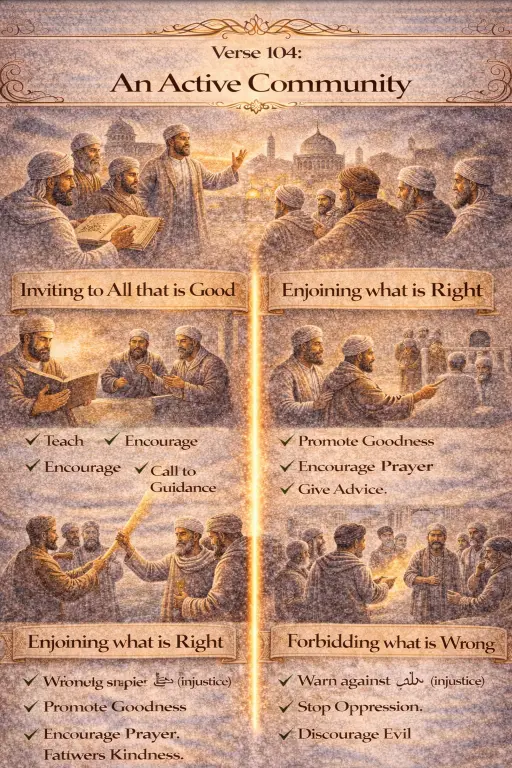
- Allah says:
- Let there be a group that:
- ✅ invites to good
- ✅ tells people to do right
- ✅ stops wrong
- These are the successful.
- Simple meaning:
- A healthy community is not silent when ظلم happens.
- They help each other do what is right.
Like kids who say: “That’s not fair—don’t bully,”
and they protect the weak.
✅ Verse 105 — Don’t be like people who split after clear proof

- Allah is warning believers:
- Don’t turn religion into fighting factions.
- Don’t let pride, group-loyalty, leaders, or debates become more important than Allah’s guidance.
- اختلاف (differences) can happen, but the verse is condemning the kind that becomes division (parties that oppose and hate each other).
- This is the key part: the problem is not “they were confused.”
- It’s:
- the truth became clear,
- evidence was present,
- yet they still chose division — often by twisting, arguing for ego, or defending “our side” over truth.
- Because this kind of division is not a small issue:
- it corrupts religion,
- misleads people,
- breaks the unity Allah commands (right after 3:103–104).
- No — the verse does not name any group.
- By the wording, it’s a general principle that applies to any people who:
- receive clear proofs,
- then still split into factions,
- and weaponize differences into division and hostility.
- So you can’t honestly say this verse is “about” one modern group by name.
- Any movement or sect (whatever label) that causes Muslims to break unity, fight each other, or treat group identity as the truth itself is falling into the kind of danger this verse warns about.
- Put Allah’s guidance first, not labels.
- Don’t defend “my group” when it’s wrong — follow truth even if it’s against your side.
- Avoid arguments that create hatred and arrogance.
- Work for unity on what’s clear, and don’t turn disagreements into “enemy camps.”
What the verse is saying
1) “Do not be like those who became divided and differed…”
2) “…after clear proofs came to them”
3) “For them there is a great punishment”
Is this specifically about Tablighi / Sunni / Shia?
What you can say is
✅ Verse 106 — On the Day when faces will be whitened and faces will be blackened
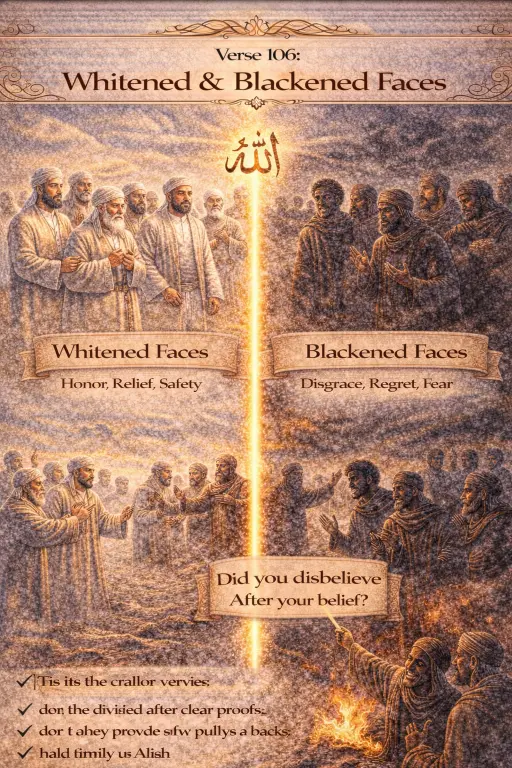
- This is a Qur’anic way of describing clear outcomes on the Day of Judgment:
- Whitened faces = people whose end is good: honor, relief, safety, acceptance.
- Blackened faces = people whose end is bad: disgrace, regret, fear, rejection.
- It’s not talking about skin color in this life. It’s about spiritual result and public outcome on that Day.
- Allah then focuses on one category specifically: people who end in disgrace.
- This is the key accusation:
- They had belief (they knew, accepted, were guided),
- then they turned back — not by accident, but by choosing disbelief after guidance.
- This fits the earlier verses:
- don’t be divided after clear proofs,
- don’t obey people who pull you back,
- hold firmly to Allah.
- Meaning:
- the punishment is connected to their choice: persistent rejection after knowing better.
- It’s not describing details; it’s stating the principle:
- When someone knowingly abandons belief after guidance, they face consequences.
1) “On the Day when faces will be whitened and faces will be blackened”
2) “As for those whose faces are blackened…”
3) “Did you disbelieve after your belief?”
4) “Then taste the punishment for what you used to disbelieve”
✅ Verse 107 — In Allah’s mercy forever
- This means the people who end that Day with honor and acceptance.
-
“Whitened” here is not about skin color. It’s a Qur’anic image for:
joy,
relief,
dignity,
being cleared from shame and fear. - This is the main point: their success is because of Allah’s mercy.
-
It means:
Allah forgives,
Allah accepts,
Allah protects them from punishment,
Allah grants them safety and reward. - So it’s not “they earned it purely by themselves.” It’s Allah’s mercy that surrounds them.
-
Meaning:
that mercy will not end,
they won’t be removed from it,
it’s lasting safety and reward. -
Allah is saying:
“The people who end that Day with bright honored faces will be covered in Allah’s mercy, and they will stay in that mercy forever.”
1) “As for those whose faces are whitened…”
2) “They will be within the mercy of Allah”
3) “In it they will abide forever”
Super simple version
✅ Verse 108 — These are the signs of Allah…

- “Signs” here means Allah’s verses — the revealed messages that guide and warn.
- So Allah is saying: these teachings are not human opinions; they are Allah’s own guidance.
- Meaning: they are recited accurately and truthfully.
- What Allah tells you is real — not guesswork, not false stories, not unfair accusations.
- So when Allah warns about punishment or promises mercy, it’s not random — it’s based on truth.
- Allah is never unfair to anyone — ever.
- No one is punished without reason.
- No one is wronged in judgment.
- Reward and punishment are based on what people chose after guidance came.
- “These verses are Allah’s true guidance being recited to you. And Allah is never unjust to anyone in the worlds.”
1) “These are the signs of Allah…”
2) “Which We recite to you in truth”
3) “And Allah does not intend injustice to the worlds”
Super simple version
✅ Verse 109 — Everything belongs to Allah and returns to Him
- Allah says:
- To Allah belongs everything in the heavens and earth, and to Allah all matters return.
- Simple meaning:
- ✅ Allah owns it all.
- ✅ Allah is the final Judge.
- ✅ Nothing escapes Allah.
Like the principal owning the school and being the final decision-maker—but perfectly just. Child-friendly summary (93–109):
Big Story (110–120)
- ✅ A “best nation” is not about pride — it’s about doing good for people
- ✅ Your job is to support what is right and stop what is wrong
- ✅ Not all “People of the Scripture” are the same — some are truly righteous
- ✅ Wealth and children cannot protect someone from Allah if they reject truth
- ✅ Be careful who you trust deeply — some people smile outside but want you to fall
- ✅ Patience + taqwa protects you from a lot of harm
✅ Verse 110 — “Best nation” means best in good actions
- Allah says:
- “You are the best nation brought out for mankind…”
- Why? Because you:
- ✅ believe in Allah
- ✅ command what is right
- ✅ forbid what is wrong
- Allah also says:
- If the People of the Scripture believed, it would have been better for them.
- Some of them do believe — but many disobey.
- Simple meaning: You are “best” when you are useful for people:
- ✅ you help others do good
- ✅ you stop ظلم
- ✅ you stand for truth
- And Allah is also being fair:
- He says some People of the Scripture are believers — not everyone is the same.
Like a class being called “the best class” because:
they help others,
they don’t bully,
they remind each other to do the right thing.
✅ Verse 111 — They can only annoy you a little
- Allah says:
- “They will not harm you except a little annoyance…”
- Meaning:
- ✅ they might tease, argue, spread small trouble,
- ✅ but they won’t destroy the truth.
Like someone trying to distract you in class,
but they can’t stop you from learning unless you let them.
✅ Verse 112 — Consequences for rebellion and ظلم
- Allah says humiliation and hardship reach those who persist in wrongdoing,
- except if they are under a covenant (agreement/protection).
- Allah also explains why:
- ✅ they rejected Allah’s signs
- ✅ they attacked prophets unjustly
- ✅ they disobeyed and kept crossing limits
- Simple meaning:
- When people keep choosing ظلم and rebellion again and again,
- their life becomes shaky — they lose honor and stability.
This is describing the result of serious, repeated wrongdoing—not a random punishment.
- Verses 113–115 — Not all People of the Scripture are the same
- Allah says:
- “They are not all alike.”
- Among them is an upright group:
- ✅ they recite Allah’s verses at night
- ✅ they pray sincerely
- ✅ they believe in Allah and the Last Day
- ✅ they do right and stop wrong
- ✅ they rush to do good
- And Allah says:
- ✅ Any good they do will not be denied.
- Simple meaning:
- Allah is being just: some of them are truly good people.
- Allah sees their effort and rewards it.
Like saying: “Not everyone in that group is bad.”
Some kids are kind, honest, and helpful — and they will be rewarded.
✅ Verse 116 — Wealth and children can’t save someone from Allah
- Allah says:
- For those who disbelieve, their money and children won’t protect them from Allah.
- Simple meaning: You can’t use:
- ✅ money
- ✅ family
- ✅ status
- to escape Allah’s judgment.
Like breaking a serious rule and saying:
“But I’m rich!” or “But my family is important!”
That doesn’t erase the mistake.
✅ Verse 117 — Their spending is like a freezing wind that ruins a harvest
- Allah gives an example:
- What they spend in this world is like icy wind that hits a farm and destroys the crops.
- Allah did not wrong them — they wronged themselves.
- Simple meaning:
- Some people spend money for pride, showing off, or fighting truth.
- It looks big — but it becomes wasted.
- Because the inside (belief and sincerity) is broken, their “good-looking actions” don’t grow into real reward.
Like working hard on a school project,
but you spill water on it at the end — and it’s ruined.
Not because the teacher was unfair,
but because you didn’t protect your own work.
✅ Verse 118 — Be careful who you take as “inner circle” friends
- Allah tells believers:
- Don’t take outsiders as close inner friends (people you tell everything to) if they are the type who:
- ✅ want to corrupt you
- ✅ love seeing you suffer
- ✅ hide stronger hatred in their hearts
- Simple meaning (important and balanced):
- This is not saying “be rude to everyone.”
- It’s saying:
- ✅ be wise with trust
- ✅ don’t give your secrets and your heart to someone who clearly wants you to fall
Like not sharing your personal diary with someone who always laughs when you cry.
✅ Verse 119 — Some people act friendly, but privately they get angry at you
- Allah says:
- You may love them, but they don’t truly love you.
- They say “we believe” when they meet you, but when alone they rage.
- Allah tells you:
- ✅ Don’t be fooled — Allah knows what’s in hearts.
Like someone who smiles in front of you,
then talks badly about you behind your back.
✅ Verse 120 — If you succeed, they’re sad; if you fail, they’re happy
- Allah says:
- If good happens to you, it upsets them.
- If harm happens to you, they celebrate.
- But if you have:
- ✅ patience
- ✅ taqwa
- their plotting won’t harm you at all.
- Simple meaning:
- Some people get jealous. They don’t want you to win.
- Your protection is:
- ✅ staying calm
- ✅ staying close to Allah
- ✅ doing the right thing
Like someone who hates when you get a good mark.
But if you keep studying, staying steady, and trusting Allah,
their jealousy can’t stop your success.
- ✅ “Best nation” means: best in doing good, stopping wrong, and believing in Allah
- ✅ Not all People of the Scripture are the same — some are righteous and sincere
- ✅ Money and family can’t protect someone from Allah if they reject truth
- ✅ Some spending becomes wasted like a ruined harvest when done with ظلم and pride
- ✅ Be wise with your closest friends — some people pretend but want you to suffer
- ✅ Patience + taqwa keeps you safe from jealous plots
Big Story (121–136)
- ✅ Be brave and organised in hard times
- ✅ Trust Allah when you feel scared
- ✅ Victory comes from Allah, not just numbers or strength
- ✅ Patience + taqwa bring Allah’s help
- ✅ The Prophet delivers the message, but Allah decides judgment
- ✅ Don’t take unfair money (interest/usury) that crushes people
- ✅ Rush to forgiveness and Jannah
- ✅ Good believers control anger, forgive, and keep giving
- ✅ If you make a mistake, don’t stay in it—repent and improve
- Verses 121–122 — The battle was organised, and some people felt scared
- Verse 121
- Allah reminds the Prophet’s time:
- The Prophet left early in the morning to place believers in positions for battle.
- And Allah is:
- ✅ All-Hearing
- ✅ All-Knowing
- Simple meaning:
- Allah knows everything that was said, planned, and felt in people’s hearts.
Like a teacher who sees the whole classroom—who is nervous, who is serious, who is whispering.
- Verse 122
- Two groups almost lost courage.
- But Allah protected them.
- And believers should trust Allah.
- Simple meaning:
- Even good people can feel scared.
- But Allah helps those who still choose faith and trust Him.
Like two kids about to quit a race because they feel weak—then they remember their coach believes in them, so they keep going.
✅ Verse 123 — Reminder: Allah helped you at Badr when you were weak
- Allah says:
- He already gave you victory at Badr, when you were weak.
- So fear Allah and be grateful.
- Simple meaning:
- Allah is reminding them: “Remember—when you had less power, Allah still helped you.”
- So the right response is:
- ✅ gratitude
- ✅ obedience
- ✅ humility
Like winning a match even though your team had fewer players—so you say “Alhamdulillah,” not “I’m unbeatable.”
- Verses 124–126 — Angels and Allah’s help (to calm hearts)
- Verse 124
- The Prophet said:
- “Is it not enough that Allah supports you with 3,000 angels?”
- Verse 125
- Allah says:
- If you have:
- ✅ patience
- ✅ taqwa
- and the enemy comes suddenly,
- Allah can support you even more (5,000 angels).
- Verse 126
- Allah explains:
- This was good news to calm your hearts.
- And the key rule:
- ✅ Victory only comes from Allah.
- Simple meaning:
- Allah can help in ways we can’t see.
- But the point isn’t “numbers of angels” like a scoreboard.
- The point is:
- ✅ Allah reassures believers
- ✅ Allah is the real source of victory
Like when you’re scared in the dark, and your parent says: “I’m here with you.”
That doesn’t just change the room—it changes your heart.
✅ Verse 127 — Allah can break the enemy’s power
- Allah says He can:
- ✅ remove part of the disbelievers’ strength
- ✅ or defeat them so they leave disappointed
- Simple meaning:
- Allah can stop ظلم and false pride, even if it looks strong at first.
- Verses 128–129 — The Prophet isn’t the judge; Allah decides
- Allah tells the Prophet:
- “It’s not your decision” whether Allah forgives them or punishes them.
- Then Allah says:
- Everything belongs to Allah.
- Allah forgives whom He wills and punishes whom He wills.
- And Allah is:
- ✅ Forgiving
- ✅ Merciful
- Simple meaning:
- The Prophet teaches and warns.
- But Allah is the final Judge.
- And Allah’s mercy is always possible—but Allah is also just.
Like a teacher who explains the rules, but the principal decides the final result.
✅ Verse 130 — Don’t consume usury (riba): unfair money that grows and crushes people
- Allah says:
- Don’t consume usury, doubled and multiplied.
- And fear Allah so you succeed.
- Simple meaning (child-friendly):
- This is about unfair money deals where someone lends money and demands extra extra extra back,
- so the poor person gets trapped.
- Allah says: don’t do that—because it’s ظلم.
Like lending your friend 10 sweets and saying:
“You must give me 20 tomorrow or else!”
That’s not kindness—that’s bullying.
- Verses 131–133 — Obey Allah, seek mercy, rush to forgiveness and Jannah
- Allah says:
- ✅ fear the Fire prepared for disbelievers
- ✅ obey Allah and the Messenger to receive mercy
- ✅ rush toward forgiveness and Jannah, as wide as the heavens and earth, for people of taqwa
- Simple meaning:
- Don’t walk slowly toward goodness. Run toward it.
- Seek Allah’s forgiveness quickly, and aim for Jannah.
Like if you broke something at home, you don’t hide all day—
you go quickly and say sorry and fix it.
✅ Verse 134 — The people Allah loves: giving, controlling anger, forgiving
- Allah describes the people of taqwa:
- ✅ They spend in good times and hard times
- ✅ They control anger
- ✅ They forgive people
- And Allah loves the doers of good.
- Simple meaning: Real strength is:
- ✅ giving when you can
- ✅ still giving when it’s hard
- ✅ not exploding in anger
- ✅ forgiving instead of holding hatred
Like someone who is mad but chooses to breathe, calm down, and be kind.
- Verses 135–136 — When they make a mistake, they repent and don’t keep repeating it
- Allah says:
- When they do something wrong:
- ✅ they remember Allah
- ✅ they ask forgiveness
- ✅ they don’t continue the sin proudly
- Their reward:
- ✅ forgiveness
- ✅ Jannah forever
- ✅ great reward
- Simple meaning:
- Good people are not “perfect robots.”
- They sometimes slip.
- But the difference is:
- ✅ They don’t stay in the wrong.
- ✅ They return to Allah and change.
Like a child who lies, then feels bad, tells the truth, says sorry, and stops doing it again.
- ✅ Allah knows what you do and what you feel
- ✅ Believers can get scared, but Allah helps them trust Him
- ✅ Victory comes from Allah, not just strength
- ✅ Patience + taqwa bring Allah’s support
- ✅ The Prophet teaches, Allah judges
- ✅ Don’t do unfair money deals that trap people
- ✅ Run toward forgiveness and Jannah
- ✅ Allah loves people who give, control anger, and forgive
- ✅ If you sin, repent and fix yourself—Allah forgives the sincere
Big Story (137–153)
- ✅ Look at history — people who rejected truth didn’t “win forever”
- ✅ The Qur’an is clear guidance for everyone
- ✅ Don’t give up when you get hurt — life has up and down days
- ✅ Jannah needs real effort and patience, not just wishes
- ✅ Muhammad is a messenger — you worship Allah, not a person
- ✅ No one dies early or late by accident — Allah already knows the time
- ✅ Good believers stay firm, make duʿā, and keep going
- ✅ Don’t copy people who reject truth — they can pull you backward
- ✅ Allah helps believers
- ✅ In battles, disobedience and arguing can cause loss, even after early success
- ✅ Tests happen to clean hearts and teach important lessons
- ✅ Allah can still forgive believers who return sincerely
✅ Verse 137 — “Look at what happened before you”
- Allah says:
- Many ways of life passed before you. Travel and see what happened to those who denied.
- Simple meaning:
- Go look at history:
- ✅ old nations,
- ✅ ruins,
- ✅ stories of arrogant people.
- When people rejected truth and did ظلم, their “power” didn’t last.
Like seeing old broken toys of a bully who used to brag—now it’s all gone. It shows pride doesn’t last.
✅ Verse 138 — The Qur’an is clear guidance
- Allah says:
- This Qur’an is a clear statement, guidance, and a reminder for those who fear Allah.
- Simple meaning:
- The Qur’an is not confusing on purpose.
- It is a clear map telling people what is right and wrong.
Like a bright sign on the road that says: “Safe path this way.”
✅ Verse 139 — Don’t lose heart
- Allah says:
- Don’t lose heart and don’t grieve. You will be superior if you are true believers.
- Simple meaning:
- Even if believers feel sad or defeated sometimes,
- Allah says: Don’t give up. Stay faithful and strong.
Like falling in a race—your coach says: “Get up. You can still finish strong.”
✅ Verse 140 — Some days you win, some days you get hurt
- Allah says:
- If you got hurt, the other side also got hurt.
- Allah lets days change between people so He shows who truly believes,
- and He takes martyrs (people who die while standing for truth).
- Allah does not love wrongdoers.
- Simple meaning:
- Life isn’t always “easy win.” There are:
- ✅ strong days
- ✅ hard days
- Hard days show:
- ✅ who is real
- ✅ who is only there when it’s easy
Like a team: when it’s raining and hard, you see who still tries and who quits.
✅ Verse 141 — Tests clean believers and end the power of disbelievers
- Allah says:
- Allah purifies believers and destroys the disbelievers.
- Simple meaning:
- Hard tests can clean believers from:
- ✅ pride
- ✅ laziness
- ✅ fake faith
- And they also weaken the people who insist on ظلم and arrogance.
Like washing dirty clothes — the washing is rough, but it makes you clean.
✅ Verse 142 — Jannah needs real effort
- Allah says:
- Do you think you will enter Paradise without Allah showing who strives and who is patient?
- Simple meaning:
- You can’t say: “I want Jannah,” then never try.
- Jannah needs:
- ✅ effort
- ✅ patience
- ✅ staying loyal to Allah in hard times
Like saying “I want to be top of the class,” but never studying.
✅ Verse 143 — You wished for martyrdom, then you saw real danger
- Allah says:
- You used to wish for death (martyrdom) before you met it. Then you saw it with your own eyes.
- Simple meaning:
- Some people talked bravely: “I’m ready for the hardest test!”
- Then when the real danger came, they realised it’s serious and scary.
Like saying “I’m not scared of the dentist!” Then when you sit in the chair, you get nervous.
✅ Verse 144 — Muhammad is a messenger; don’t stop if he dies
- Allah says:
- Muhammad is only a messenger. Messengers passed before him.
- If he dies or is killed, will you turn back?
- Whoever turns back won’t harm Allah. Allah rewards the grateful.
- Simple meaning (very important):
- We worship Allah, not the Prophet.
- Even if a messenger is gone, Islam doesn’t end.
- Truth doesn’t disappear because one person dies.
If a teacher leaves the school, the school rules still stay.
The rules came from the principal (Allah), not the teacher.
✅ Verse 145 — Nobody dies except by Allah’s permission
- Allah says:
- No soul can die except by Allah’s permission, at a fixed time.
- Whoever wants reward of this world gets some of it,
- whoever wants reward of the Hereafter gets it.
- Allah rewards the grateful.
- Simple meaning:
- Every life has a time Allah already knows.
- And people choose what they aim for:
- ✅ only dunya reward?
- ✅ or Hereafter reward?
- Allah rewards people who are grateful and sincere.
Like choosing prizes: Some want a small candy now, some want a big prize later.
✅ Verse 146 — Many prophets had strong believers with them
- Allah says:
- Many prophets fought with many godly people.
- They didn’t lose heart, didn’t weaken, didn’t give up.
- Allah loves the patient.
- Simple meaning:
- Believers in history faced hardship too. But they stayed firm.
- Allah loves patience.
Like seeing heroes in the past who didn’t quit when life got hard.
✅ Verse 147 — Their duʿā: forgive us, keep us firm, help us
- They said:
- “Our Lord, forgive us our sins, make our feet firm, and give us victory…”
- Simple meaning:
- Their hearts were humble. They didn’t brag.
- They asked Allah for:
- ✅ forgiveness
- ✅ strength
- ✅ help
Like saying: “Allah, I messed up. Help me do better. Keep me strong.”
✅ Verse 148 — Allah gave them rewards
- Allah gave them:
- ✅ reward in this world
- ✅ and the better reward in the Hereafter
- Allah loves the doers of good.
- Simple meaning:
- Doing good is never wasted.
- Allah rewards in both ways, and the Hereafter reward is the greatest.
✅ Verse 149 — Don’t obey disbelievers who pull you back
- Allah warns believers:
- If you obey those who disbelieve, they will turn you back and you’ll lose.
- Simple meaning:
- Some people want you to leave truth.
- If you follow them, you may end up going backward.
Like finally improving your behavior, then a bad friend says: “Come back to trouble.”
✅ Verse 150 — Allah is your Protector
- Allah says:
- Allah is your Protector and best Helper.
- Simple meaning:
- Even when you feel alone, Allah is the strongest support.
✅ Verse 151 — Fear enters hearts when people associate partners with Allah
- Allah says He will cast terror into hearts of those who associate partners with Allah,
- because they have no proof for it.
- Simple meaning (child-safe):
- When people build their life on false gods and ظلم, their hearts become weak and scared inside.
- Truth gives strength. Falsehood creates fear.
✅ Verse 152 — Allah’s promise was true, but disobedience caused defeat
- Allah says:
- Allah fulfilled His promise when you were winning by His permission.
- But then:
- ✅ you lost courage
- ✅ you argued
- ✅ you disobeyed orders
- after Allah showed you what you love (victory/spoils).
- Among you are some who desire this world, and among you are some who desire the Hereafter.
- So Allah let you be turned away (defeat) as a test,
- and Allah still forgave you. Allah is gracious to believers.
- Simple meaning:
- Believers were winning.
- Then some people got distracted by dunya and argued and disobeyed, so they lost.
- But Allah says: This was a test.
- And Allah forgave those who returned sincerely.
Like a team winning, but then they stop listening to the coach and start fighting—so they lose the match.
✅ Verse 153 — In panic, people ran, and the Prophet called them
- Allah reminds them:
- They were climbing away, not looking back, while the Messenger called them from behind.
- So Allah gave them distress after distress,
- so they wouldn’t keep crying over what they lost, and so they learn.
- Allah knows everything you do.
- Simple meaning (child-safe):
- When panic happened, some people ran.
- Allah let them feel the pain of the lesson, so their hearts learn:
- ✅ obey
- ✅ stay together
- ✅ don’t panic and abandon others
Like running away from your group on a trip—then you get scared and realise: “I should have stayed with the leader.”
- ✅ History shows arrogant rejection doesn’t last
- ✅ The Qur’an is clear guidance
- ✅ Don’t give up when you get hurt — ups and downs test hearts
- ✅ Jannah needs real effort and patience
- ✅ Muhammad is a messenger — worship Allah, not people
- ✅ Life and death happen only by Allah’s permission
- ✅ Strong believers make duʿā, stay firm, and don’t quit
- ✅ Don’t follow people who try to pull you away from truth
- ✅ Disobedience and arguing can cause loss, even after success
- ✅ Allah can forgive believers who repent and return
Qur’an-Only Explanation (3:154–170)
Big story (154–170)
Allah is teaching:
- After fear, Allah can send calm and peace.
- Some people panic and think wrongly about Allah — but the truth is: Allah is in control.
- Shayṭān can make people slip when they already have weaknesses/sins.
- Don’t say “if only…” in a blaming way — life and death are in Allah’s hands.
- The Prophet ﷺ was gentle, forgiving, and he consulted people — leadership needs mercy.
- Trust Allah: if Allah helps you, nobody can defeat you.
- Prophets do not betray — honesty is a must.
- A test shows who is true and who is fake.
- Some people talk big but run away when it’s time to act.
- Those who die while standing for Allah’s cause are not “lost” — Allah honours them.
- 3:154 — After distress, Allah sent calm… and exposed wrong thinking
After fear, Allah sent security to some, while others worried and spoke wrongly.
- Some believers felt calm (even drowsy) — a sign Allah gave them peace.
- Others stayed anxious and said: “Do we have any say in this?”
- Allah answers: “The matter belongs entirely to Allah.”
- Allah corrects the blame-game: even if you stayed home, what Allah decreed would still happen.
- Why? So Allah can test what is in hearts and purify believers.
Simple meaning: When something scary happens, tests show what’s inside people: trust or panic.
Child example: Like a storm at school: some kids stay calm because they trust the teacher; others panic and complain — but the teacher still knows what to do. The storm shows who stays steady.
- 3:155 — Some people ran back, but Allah forgave them
Some slipped and turned back, but Allah pardoned them.
- Some believers turned back in the battle because Shayṭān pushed their weakness.
- Allah mentions it was linked to mistakes they had earned — Shayṭān uses weak points.
- But Allah says He has already pardoned them — Allah is Forgiving and Forbearing.
Child example: A kid keeps breaking rules, then under pressure fails again — but if they truly feel sorry and return to good, the teacher can forgive.
- 3:156 — Don’t say: “If they stayed, they wouldn’t die”
Don’t speak like people who blame and say “if only…”
- Allah warns believers not to copy the blaming talk of disbelievers.
- Life and death are in Allah’s hands — blaming people with “if only” causes regret and pain.
- Allah is All-Seeing of what people do.
Child example: After an accident, someone says: “If you didn’t go outside, this wouldn’t happen.” But you don’t truly know. Allah knows. Your job is to be kind and trust Allah.
- 3:157–158 — Allah’s mercy is better than dunya, and everyone returns to Allah
Allah’s forgiveness and mercy are better than what people collect, and all return to Him.
- Dunya things (money, status, stuff) end — Allah’s mercy is what truly matters.
- Whether a person dies naturally or is killed, everyone will be gathered back to Allah.
Child example: Choosing between a small toy now vs a forever prize later — the forever one is better.
- 3:159 — The Prophet ﷺ was gentle, forgiving, and consulted people
Mercy, forgiveness, consultation — then trust Allah.
- Allah reminds that the Prophet ﷺ was gentle by Allah’s mercy.
- Harshness would make people leave — so Allah teaches mercy in leadership.
- Allah commands: pardon them, ask forgiveness for them, and consult them.
- After deciding, trust Allah — Allah loves those who rely on Him.
Child example: A coach who screams makes the team quit. A kind coach corrects mistakes and keeps the team together.
- 3:160 — If Allah helps you, nobody can beat you
Allah’s help is the real protection.
- If Allah supports you, nobody can overcome you.
- If Allah leaves you, nobody can truly help you.
- So believers should put their trust in Allah.
Child example: Having the strongest protector with you — no bully can win.
- 3:161 — Prophets don’t steal or betray
No prophet betrays; betrayal will be exposed and repaid fairly.
- Allah makes it clear: prophets do not act dishonestly.
- Whoever betrays will face it on the Day of Resurrection.
- Allah repays every soul fully and unfairness does not happen.
Child example: Stealing from the class box: you might hide it from people, but you can’t hide it from Allah.
- 3:162–163 — Not everyone is equal: Allah sees ranks
Seeking Allah’s pleasure is not like earning His anger.
- Allah shows a clear difference between sincerity and wrongdoing.
- People have different ranks with Allah — Allah sees what everyone does.
Simple meaning: Two people can look similar outside, but Allah knows the truth inside.
- 3:164 — A huge favour: Allah sent a messenger
A messenger recites, purifies, and teaches.
- Allah reminds believers of a great favour: a messenger from among them.
- He recites Allah’s verses, helps purify people, and teaches the Book and wisdom.
- Without guidance, people were clearly lost — so guidance is a gift.
Child example: Being lost in a forest, then someone comes with a map and leads you out.
- 3:165 — When disaster hit, you asked “Why?” Allah says: “From yourselves”
Loss can come from your own mistakes.
- Some were shocked by hardship, even though earlier they had caused the enemy more hardship.
- Allah teaches responsibility: some consequences come from your own choices (like disobedience and arguments).
- Allah is Able to do all things — but humans are still accountable for their actions.
Child example: If a team loses because they didn’t follow the coach, they shouldn’t blame the coach.
- 3:166–168 — The test showed believers and hypocrites
Hard times reveal who is real and who is pretending.
- Allah explains that events happened by His permission to reveal true believers.
- It also exposed hypocrites who made excuses and avoided helping.
- They spoke with their mouths what was not in their hearts — Allah knows what they conceal.
- They blamed others: “If they listened to us, they wouldn’t have died.”
- Allah answers: “Then stop death from yourselves if you’re truthful.”
Child example: A kid never helps in group work, then says: “You failed because you didn’t listen to me.” But they weren’t even working.
- 3:169–170 — Those who die for Allah’s cause are honoured by Allah
Do not think they are “gone” — Allah honours them and provides for them.
- Allah teaches that those who are killed while standing for Allah’s cause are not “lost.”
- They are with their Lord, receiving provision, rejoicing in Allah’s bounty.
- They are also glad for believers still on earth — that there will be no fear or grief for them.
Child example: Someone who did the bravest right thing — Allah rewards them with safety and happiness.
Child-friendly summary (154–170)
- Allah can change fear into calm.
- Some people panic and blame, but Allah is always in control.
- Shayṭān uses weaknesses — but Allah forgives those who truly return.
- Don’t say “if only…” to blame — life and death are with Allah.
- The Prophet ﷺ was gentle, forgiving, and he consulted people.
- If Allah helps you, nobody can defeat you.
- Honesty matters — prophets do not betray.
- Tests reveal true believers and hypocrites.
- Allah honours those who stand for His cause.
Qur’an-Only Explanation (3:171–189)
Allah teaches believers to stay brave after hardship, trust Allah instead of fear, and remember that this world is temporary. Allah also warns against stinginess, lying about Allah, hiding truth, and loving praise without honesty. Tests separate sincere people from fake ones, and the final success is the Hereafter.
- 3:171 — Believers’ reward is never lost
“Allah does not let the reward of the believers be lost.”
- Allah is telling us: every sincere effort for faith and truth is counted.
- Even if people don’t appreciate your good, Allah sees it perfectly.
- 3:172 — Good + taqwa after injury = great reward
- Some believers were hurt, but they still responded to Allah and the Messenger and didn’t quit.
- Allah praises the ones who kept doing good and kept taqwa (being careful to obey Allah).
- 3:173 — “Allah is sufficient for us” (trust beats fear)
- People tried to scare the believers: “The enemy is gathering—be afraid!”
- But the believers’ faith became stronger, and they said: “Allah is enough for us.”
- This is called tawakkul: trusting Allah while still doing what’s right.
- 3:174 — Allah returned them with favour; no harm touched them
- Because they trusted Allah and followed what is right, Allah protected them and gave them bounty.
- They were seeking Allah’s pleasure—not showing off or chasing pride.
- 3:175 — Fear tactics are from Shayṭān
- Allah teaches: Shayṭān tries to scare believers using “his allies.”
- So don’t fear people in a way that makes you disobey Allah.
- Fear Allah (respect Allah) more than you fear creation.
- 3:176–178 — Don’t be saddened by people who rush into disbelief
- Allah tells the Prophet: don’t let it crush you when people run toward disbelief.
- They don’t harm Allah—Allah is not “in need” of them.
- If Allah gives them more time, it’s not because they’re “safe.” It can be a test and a chance—some people use it to get worse.
- 3:179 — Allah separates the good from the bad through tests
- Allah does not leave believers mixed forever with hypocrisy and hidden evil.
- Tests and events expose what people really are inside.
- Allah doesn’t give everyone unseen knowledge; Allah chooses messengers for revelation.
- The safe path: believe + taqwa → great reward.
- 3:180 — Stinginess is not “smart”; it becomes a burden
- Allah warns people who are stingy with what Allah gave them.
- They think hoarding is good, but Allah says it is bad for them.
- Everything returns to Allah anyway—Allah “inherits” everything when people are gone.
- 3:181–182 — Arrogant words and ظلم are recorded; Allah is never unjust
- Allah mentions people who spoke arrogantly about Allah and acted with ظلم.
- Allah teaches: people will face the results of what they sent forward.
- And Allah is never unfair to anyone.
- 3:183–184 — Excuses to reject messengers; denial happened before
- Some people demanded special conditions before believing, as an excuse.
- Allah replies: messengers already came with clear proofs—yet people still rejected them.
- The Prophet is not the first to be denied; it happened to messengers before.
- 3:185 — Real success is the Hereafter; dunya is a “delusion”
- Every soul will taste death.
- People will be fully repaid on Judgment Day.
- True success is being saved and admitted to Jannah.
- This world can trick people with shiny things that don’t last.
- 3:186 — You will be tested, and you may hear hurtful words
- Allah warns believers: tests will come in wealth and in yourselves (life).
- You may hear painful speech from others.
- The winning response is: patience + taqwa.
- 3:187 — Don’t hide the truth for a small price
- Allah took a covenant: make the scripture clear, don’t conceal it.
- But some people threw it behind their backs and “sold” it for small gain (status, money, power).
- Allah says that trade is terrible.
- 3:188 — Loving praise without honesty is dangerous
- Allah warns about people who are happy with what they did wrong,
- and they love being praised for things they didn’t even do.
- This is a sickness of pride and fake image.
- 3:189 — Allah owns all dominion and has power over everything
- Allah closes this section by reminding: He owns the heavens and earth.
- Allah is Powerful over all things—so don’t be fooled by temporary power of people.
Stay firm after hardship, and don’t let fear control you—say “Allah is enough for us.” Tests separate sincere hearts from fake ones. Don’t be stingy, don’t lie about Allah, and don’t hide truth for money or praise. This life is temporary; the real success is the Hereafter. Allah owns everything and judges with perfect justice.
Qur’an-Only Explanation (3:190–200)
- 3:190 — The sky and earth are “signs” for smart hearts
“Certainly, in the creation of the heavens and the earth, and the alternation of the night and the day, are signs for people of understanding.”
- Allah is saying: when you look carefully at the world, it points to a Creator.
- The sky, the earth, and the day/night cycle are not random “noise.” They are signs for people who think deeply.
- The message is: this world did not make itself — it has design, order, and purpose.
Child example: If you see a beautiful LEGO castle, you don’t say: “It built itself.” You know someone designed it.
- 3:191 — Good believers remember Allah often and reflect on creation
“Those who remember Allah while standing, sitting, and lying on their sides, and reflect on the creation…”
- Remembering Allah is not only in one moment of the day. It can be in daily life: standing, sitting, and resting.
- Reflecting means: they think deeply about what they see and learn a lesson from it.
- They say: “You did not create this in vain.” Meaning: Allah made everything with purpose.
- They praise Allah: “Glory be to You.” (You are perfect.)
- They make a sincere duʿā: “Protect us from the punishment of the Fire.”
Child example: A kid looks at the stars and thinks: “Allah made all this… I should be thankful and live right.”
- 3:192 — A bad ending is a terrible loss (and wrongdoers won’t have helpers)
“Our Lord, surely whoever You cause to enter the Fire, You have surely disgraced him…”
- This is a duʿā asking Allah for protection from a terrible ending.
- They are saying: “Allah, don’t let us end in shame and loss.”
- They also admit: wrongdoing is dangerous, and wrongdoers won’t have rescuers against Allah’s justice.
Child-safe meaning: It’s a serious warning: this is an ending nobody wants, so believers ask Allah to save them.
- 3:193 — They heard the call to faith, believed, and asked Allah to clean them
“We heard a caller calling to faith… so we believed…”
- They heard the message: “Believe in your Lord,” and they accepted it.
- Then they ask Allah for three things:
- 1) Forgive our sins (erase what we did wrong).
- 2) Remove our evil deeds (clean the bad effects and stains).
- 3) Let us die with the righteous (end our life in a good state, with good people).
- This shows humility: real believers don’t act proud — they ask Allah for forgiveness and help.
Child example: Like a student hearing the teacher say “This is the right way,” and replying: “Okay, I’ll follow it… and forgive my mistakes.”
- 3:194 — They ask Allah to give His promised reward and protect them from disgrace
“Grant us what You promised us through Your messengers… You do not break the promise.”
- They believe Allah’s promises are real and true.
- They ask: “Allah, include us in Your promise and don’t let us be disgraced on the Day of Resurrection.”
- This is not doubt in Allah — it is humble begging: “Allah, keep us among the successful.”
Child example: Like a parent promising a reward for good behavior, and the child saying: “Please don’t forget me—I’m trying.”
- 3:195 — Allah answers: no good deed is wasted (male or female)
“I will not let go to waste the work of any worker among you, male or female…”
- Allah replies clearly: no sincere good work is ever lost.
- Allah makes it explicit: male or female — both are equally counted and rewarded.
- Allah mentions people who struggled for truth and were harmed for Allah’s cause.
- Allah promises to:
- remove their evil deeds (forgive and clean them),
- and admit them into Gardens as a reward from Allah.
- And Allah’s reward is the best reward.
Child example: Like a teacher saying: “I don’t care if you’re a boy or a girl—if you work hard and do right, you will be rewarded.”
- 3:196–197 — Don’t be fooled when wrong people look successful
“Let not the movement (in ease) of those who disbelieve throughout the land deceive you.”
- Sometimes wrong people look like they are “winning”: money, travel, comfort, popularity.
- Allah says: don’t let that trick you — it is brief enjoyment.
- The lesson: this world is temporary, and final outcomes belong to Allah’s judgment.
Child example: Like a kid cheating in a game and looking like they got a high score… but later they get caught and lose everything.
- 3:198 — People with taqwa get Allah’s best reward forever
“But those who have taqwa of their Lord will have Gardens… abiding therein forever…”
- Taqwa means being careful not to disobey Allah, and trying to live sincerely.
- Allah promises lasting reward: Gardens with rivers, forever.
- Allah’s reward is better than anything temporary in this life.
Child example: Like choosing between candy that ends quickly, versus a forever home of happiness and peace.
- 3:199 — Some People of the Scripture truly believe and stay humble
“Among the People of the Scripture are those who believe… humbling themselves before Allah…”
- Allah is fair: He says not everyone is the same.
- Some People of the Scripture sincerely believe in Allah and in what Allah revealed.
- They are humble and do not “sell” Allah’s verses for money or status.
- Allah says they will have their reward, and Allah is swift in taking account.
Child example: Like saying: “Not everyone in that group is bad—some are honest and good, and Allah knows them.”
- 3:200 — Final checklist for success: patience, firmness, taqwa
“Be patient… stand firm… have taqwa of Allah so that you may be successful.”
- Allah ends with powerful instructions:
- Be patient (don’t collapse when life is hard).
- Outdo others in patience (be extra strong and consistent).
- Stand firm (don’t quit truth when pressured).
- Have taqwa (stay careful with Allah’s limits).
- The result: success with Allah.
Child example: Like training for a big race—you don’t quit when it hurts. You keep going until you finish.
The universe is a sign that Allah created everything with purpose. Good believers remember Allah often and think deeply, so they make duʿā for forgiveness and a good ending. Allah promises: no good deed is wasted, male or female. Don’t be tricked by temporary success of wrong people—Allah’s reward is the best and forever. The final key to success is patience, staying firm, and taqwa.